

If You Think Mobile Phones Are Expensive Now, You Won't Believe What They Cost In The '80s
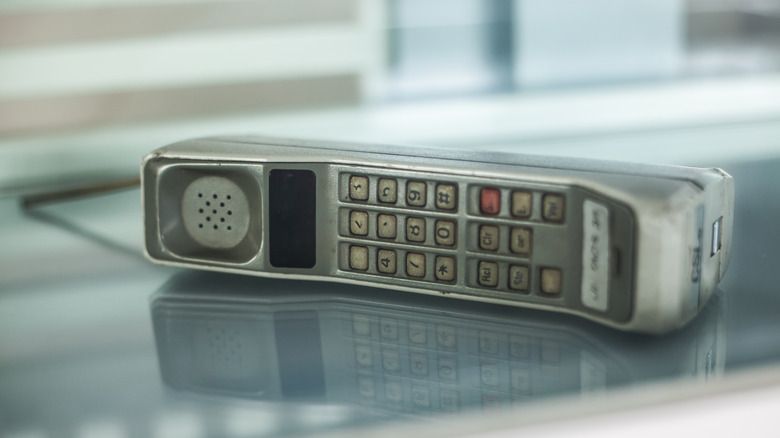
It's fascinating how accessible and affordable today's tech really is. Take television sets as an example. Some of the more iconic TVs from the '80s, like the 27-inch Sony Trinitron, could cost as much as $850 at the time — adjusted for inflation, that's around $2,500. Sure, paying the equivalent of $2,500 on a TV today seems excessive, but it's not out of the question. The same can't be said for cellphones, which were still in their infancy stage during the Reagan Era. The Motorola DynaTAC 8000X, also known as The Brick, is the grandfather of all mobile phones, and when it went on sale in 1984, it was priced at $3,995. That would be like spending $12,804 on a phone today!
Watch any '80s film, and you'll quickly notice that only the flashiest characters used those large cellphones. But it wasn't just the phone itself that was ridiculously priced. If you wanted to actually use the phone, that required a flat monthly fee of $50 ($160 today), while calls would run you up to $0.40 ($1.28 today) per minute during busy hours. The entire package is enough to make this $5,400 Android phone look affordable in comparison.
What could the Motorola DynaTAC do?
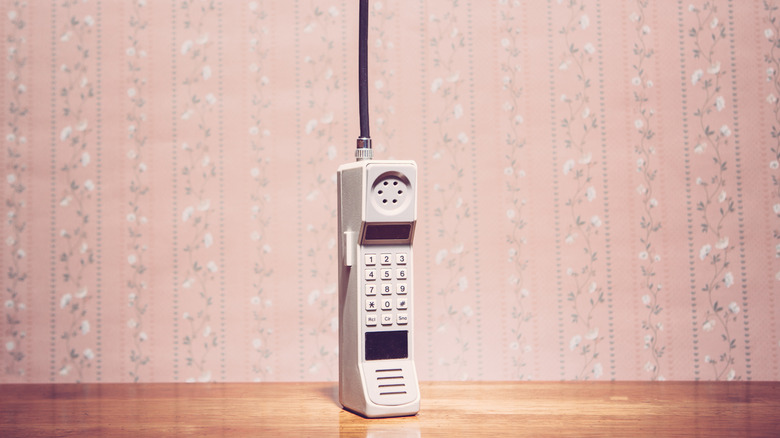
The Motorola DynaTAC — which stood for Dynamic Adaptive Total Area Coverage — weighed nearly two pounds (790 grams, to be specific) and measured more than a foot tall including the detachable antenna. Furthermore, this groundbreaking mobile phone took around 10 hours to charge, and it could only provide you with about 30 minutes of call time. The importance and rarity of these phones is shown in auction prices close to $18,000, which could add them to the list of valuable, rare vintage tech that might be hiding in your attic. Comparing this phone to a modern device is like comparing a horseless carriage to a Ferrari, but it is also a testament to how far we've come in terms of technology.
So how did mobile phones go from something only rich Wall Street bankers used to a device in the hands of 5.78 billion people globally? As a tool in its infancy, the production costs were justifiably high. The initial adoption was also low due to the higher costs of admission, so production volumes remained fairly limited. In other words, manufacturers had no way to scale in order to bring down costs. As the technology behind the phones and the mobile networks improved, prices of the devices and associated service costs dropped, which made it accessible to more users.
How cellphones got cheaper with time
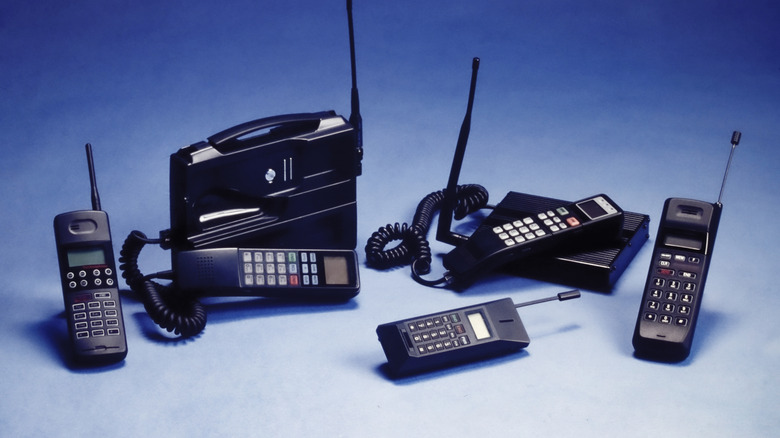
Five years after the brick-shaped DynaTAC was born, Motorola released MicroTAC 9800X. In addition to being smaller, it was also marginally cheaper at $2,995 ($9,600 today). The trend continued. A 1994 IBM Simon cellphone cost a little over $895 or about $2,900 adjusted for inflation, bringing prices a bit closer to the modern flagships. By the mid-2000s, cellphones were no longer a luxury item. A Motorola RAZR V3 was relatively affordable at $499 ($1,600 in today's dollars), and it even had a camera.
In fact, prices became so affordable, that the trailblazing iPhone had a launch price of $499 in 2007, which is roughly $1,600 today. While it's true that top-of-the-line devices can be pricey, it's not an insane amount considering you're getting an advanced piece of tech. So, whenever you feel jaded at tech prices, just remember how much a bulky '80s cellphone used to cost, and think of the value and features you get from a modern smartphone.