

Switzerland Is Building One Of The Most Powerful Batteries In The World 88 Feet Underground
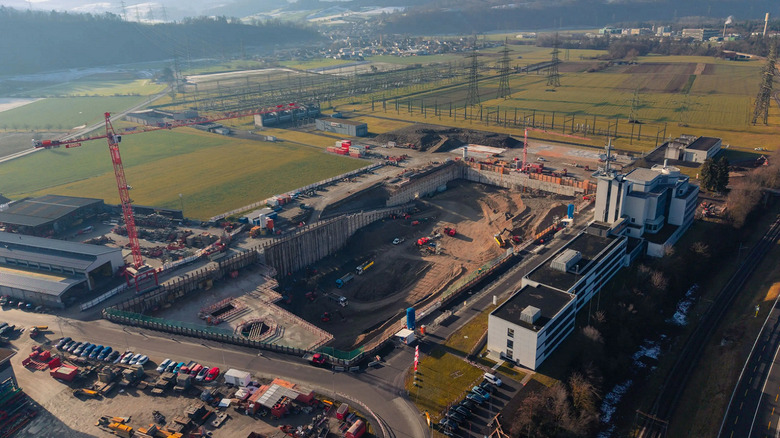
A Swiss company called FlexBase is building what's being hailed as one of the world's most powerful batteries near the picturesque medieval town of Laufenburg, Switzerland. The battery, based on a technology called redox flow that joins other emerging battery technologies that may change the world, will live in an 88-foot-deep pit, in a sprawling excavation that's the "length of two soccer pitches," according to reporting at New Atlas (that's over 200 yards for our American readers).
The goal of the project is to store excess energy when sources are abundant and then release it to stabilize the grid when there's a dearth. It's meant to help address issues with the intermittent nature of renewable energy sources like wind and solar, which are increasingly becoming an important part of the European energy grid. Beyond the headline-grabbing scale of the project, it's also interesting in that it's foregrounding a relatively old chemistry concept and placing it at the center of a major energy infrastructure project.
The Swiss project

According to FlexBase, a Swiss energy group, the project will pair energy storage with data infrastructure, creating a huge, interconnected complex that includes the battery installation, a data center, and associated technical space. It's being constructed at the evocatively named and historic "Star of Laufenburg," an electricity transmission hub and substation complex that was the site of the first high-voltage synching of the electrical grids of Germany, France, and Switzerland.
The battery has a reported capacity of 2.1 gigawatt-hours (GWh). That means it can store enough power to run 200 average U.S. homes for a year. Importantly, it's also capable of quickly delivering that energy, meaning it can swiftly react to fluctuations in the grid and balance supply and demand deficits. If it performs as promised, it could become a model for how large-scale storage supports renewable-heavy power networks, while also serving digital infrastructure (a topic of increasing concern as we enter the era of AI data centers and their voracious appetites for power).
How redox flow batteries work
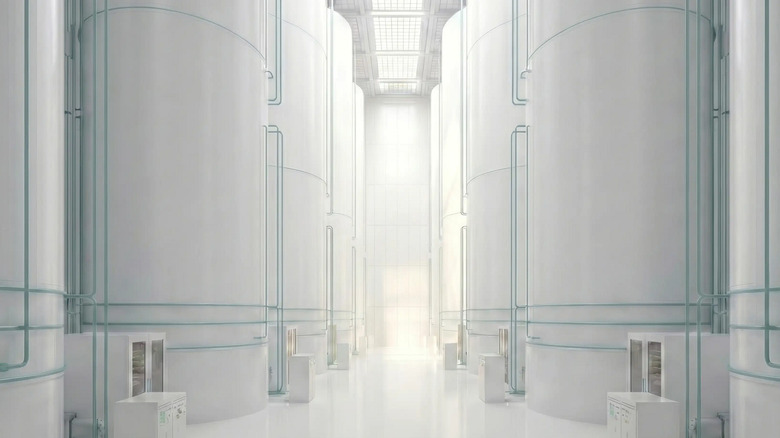
Redox flow batteries work somewhat differently from the lithium-ion packs (including the new lithium-metal tech being pioneered in China) which have become so ubiquitous in consumer electronics and electric vehicles. Rather than stashing energy in solid electrodes like Li-ions, they keep energy in liquid electrolyte tanks. They then move that liquid through a cell stack, triggering chemical reactions.
In a vanadium redox flow battery, for example, the electrolytes circulate on opposite sides of a membrane that allows ion (charged particles) exchange while keeping the liquids separate. When the battery charges, electricity changes the oxidation state (the effective charge) of the fluids and stores energy chemically; when it discharges, the process reverses and electricity is sent back out.
It's a technology originally pioneered way back in 1879, and it gives flow batteries several advantages for grid use (even if it may not outlast civilization like this nuclear battery). They can be scaled by increasing tank size, they tolerate frequent cycling well, and they're considered safer than many conventional battery chemistries because the electrolyte is non-flammable. The tradeoff is that, as the Swiss project proves, they're very large and complex, which is why they make more sense for stationary storage than for stuff like your smartphone or cars.