

5 Health Metrics Your Smartwatch Is Probably Measuring Inaccurately
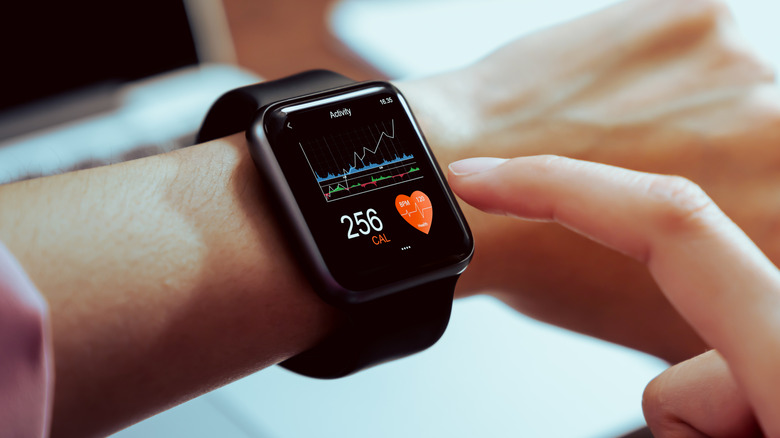
Part of the overall appeal of wearing a smartwatch, besides quickly accessing essential apps from your Android or iPhone, are the various health-tracking capabilities. Smartwatches, at least on paper, can provide readouts on a variety of health metrics, including your caloric burn, heart rate, sleep tracking, and VO₂ Max, which can be invaluable both during workouts and as individual metrics. We say "on paper" because, unfortunately, while smartwatches can gather plenty of data from regular use, whether it's 100% accurate is another matter.
Smartwatches aren't magic; they can't simply sense everything going on inside your body. The health data gathered is based on several observable conditions like your pulse or arm movements, and more often than not, using this to extrapolate certain types of information results in more of an educated guess than an absolute fact. This can be helpful for building good health habits, but it's definitely no substitute for hard metabolic data, and treating it as such could be bad for your general health in the long run.
Step counting

One of the most basic health metrics that smartwatches can track is the number of steps you've taken in a given day. Step tracking isn't rocket science; basic pedometers have been around for hundreds for years, after all. Even so, there's an obvious fallacy in measuring the number of steps you take with something that's attached to your arm, rather than your leg.
You could try wearing an Apple Watch on your ankle, but that would present its own problems. The pedometer in a smartwatch has a tendency to under-count the actual number of steps you take by 5-10%. That's not huge, but if you're going on a long run, it could mean hundreds of steps aren't getting measured. More to the point, even these ideal conditions rely on you accurately pumping your arms in time with the number of steps you're taking.
When using a smartwatch to track steps while lifting or pushing things for example, it's not going to give an accurate readout because your arms are likely not moving at the same rate or pace as your legs. Step counts are great for joggers and runners, but it's a much less helpful health metric for just casually going about your day.
Heart rate
As far as biometrics go, heart rate is generally an easier one to measure. Technically, you don't need a smartwatch for that; just check your pulse while exercising by holding a finger at the top of your neck. Still, getting a quick heart rate readout is convenient if you're engaged in high-intensity exercise, and for the most part, smartwatches are pretty good at catching it. Of course, "pretty good" isn't the same as "perfect."
Smartwatches generally use optical heart rate sensors, shining light into your wrist and measuring the flow of blood through your veins. This is a fairly reliable means of taking heart rate measurements, with about a 5% error rate. However, that error rate only applies during low-intensity exercise. The more vigorously you move, the more difficult it becomes for that optical sensor to get a steady read on your blood flow, hampering the estimation. Additionally, factors like sweat and skin tone can interfere with the sensor, which means certain individuals may receive naturally less-accurate readings. This isn't a massive problem, though it can be problematic for an exercise routine if you're relying on accurate heart rate zones.
Calorie burn
Some smartwatches purport to be able to track the amount of calories you burn while exercising or performing strenuous tasks. If you're on a diet, it can certainly help to know how much energy you're burning so you know how much food to eat. However, a smartwatch can't actually track caloric burn, it merely estimates that number based on a few factors like heart rate and movement.
It would take an extremely advanced algorithm for a smartwatch to calculate this metric accurately, and current smartwatches simply aren't capable. As a result, these wearables are typically incorrect on calorie burn estimates by at least 20%, higher or lower. If you take your smartwatch's calorie burn statistics as gospel, you may end up eating more than you intend to in order to compensate, or less than you need if you think you're overindulging. Either way, these are not healthy habits.
Sleep tracking

Another popular application for smartwatches is tracking the quality of your nightly sleep. By wearing a smartwatch to bed, the device can measure how much you toss and turn in order to determine when you enter different sleep states, and for how long, providing a general score of your sleep quality come morning. But these wearables can't measure the brain activity that's necessary for a 100% accurate readout, so they have to take some shortcuts, which is why tracking sleep with a smartwatch may not actually help.
Smartwatches typically abstract the quality of your sleep using a combination of movement detection and heart rate measurement. This method can detect the moments you enter and leave sleep, but as for detecting the various stages of sleep, it has no idea. When it comes to catching the changing of sleep stages, smartwatches only have a success rate of around 50-65%, a veritable toss-up. Rather than tracking the quality of your sleep, smartwatches are best only relied upon for determining how long you sleep.
VO₂ max

A great way to estimate exercise intensity is measuring the maximum volume of oxygen in your body during a workout, also known as VO₂ max. Figuring out your personal VO₂ max rating will tell you how much oxygen your body is capable of utilizing during strenuous physical activity. Oxygen is every human's most vital resource, and some smartwatches claim to be able to measure the VO₂ max rating to help determine your metaphorical fitness ceiling. However, a smartwatch can't actually measure the amount of oxygen moving in and out of your lungs.
You would need a full medical lab setup for this. This statistic is merely an educated guess on the watch's part, estimated from movement and heart rate. It will assume that if you can move faster with the same heart rate as walking, you've got a high VO₂ max. This often leads to overestimated values for people who are less active and underestimated values in those who are more active. Seeing that number go up over the course of lengthy training can be a good motivator toward improving your lung capacity, but it shouldn't be treated the same as a laboratory-grade reading.