

Tron: Legacy Is Slightly More Scientifically Plausible Than You Probably Realize
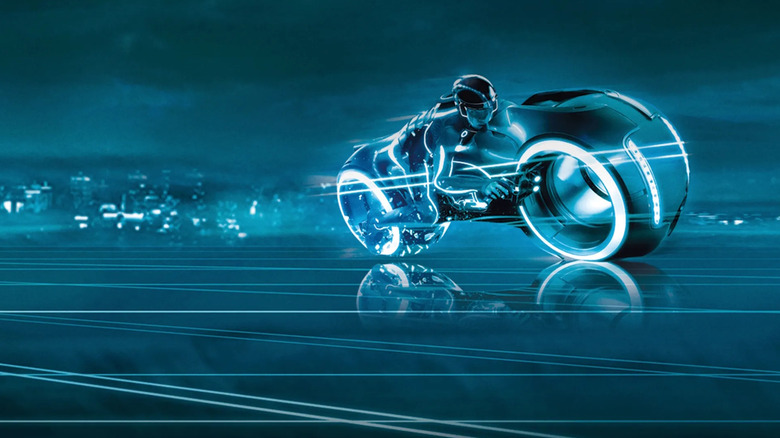
When Disney released "Tron: Legacy" in 2010, not only did it supply one of the best movie soundtracks to test new audio equipment, but it also had a piece of tech that's kind of based on reality: the laser that scans Sam Flynn (Garrett Hedlund) into the digital world. Okay, so we're not actually talking about uploading an entire human being into an extended Daft Punk music video, but the film actually pulls from quite a bit of real science. Talking to USA Today around the launch of the movie, director Joseph Kosinski gave quite a number of sources that the legacy sequel used to come up with its ideas.
In the now archived article, Kosinski states that, "Once the discussion moved past the 'how could you do it'... the scientists had great ideas." Various talks about quantum teleportation and supercomputers, and Kosinski even mentions that they had to ensure the movie was somewhat accurate, lest the audience cotton on. This is backed up in the outlet Scientific American, where Kosinski is interviewed again, "picking the brains" of various scientists to get a solid foundation for the fantastical elements.
Among the scientists they did rely on were Sean Carroll, a physicist from the California Institute of Technology, and John Dick, a retired physicist who worked at Jet Propulsion Laboratory. Elements they brought to the table included quantum computing and hypothesizing about how computer programs would react if they were to go "beyond what programmers initially wanted them to do." Even Kosinski holds a degree from Stanford in mechanical engineering.
The science fiction of Tron: Legacy is becoming real
In 2026, people started seeing computer programs begin to write themselves. Large language models, which power the artificial intelligence software running rampant across the internet, are actively being used to write code. Sometimes this can dip into vibe coding, where the user doesn't especially understand what's being written by the program. However, Anthropic, which operates Claude, claims that it writes most of the code for itself.
When it comes to quantum computing and teleportation, this has been the work for years. Of course, it doesn't function exactly like it does in the movie. Caltech managed to achieve some form of this in 1998, even referencing "Star Trek" in a press release. At the time, this was achieved by "transporting a quantum state of light from one side of an optical bench to the other without it traversing any physical medium in between."
This has made massive leaps since then. In more recent years, science bods have managed to transport information between particles, and in 2024, achieved this through the Internet. This experiment moved a photon through the infrastructure, restricting as much interference as possible. At the end, the photon was received as it was sent.