

Why Are People Ditching Google Search?

Google is the undisputed king of online searches, with Google Search having an 85% market share in the U.S. as of May 2026, according to Statcounter. Yet there's a growing wave of discontent around Google Search, with alternatives like DuckDuckGo showing significant usage increases in the last few weeks, shortly after Google's I/O 2026 event, where the company unveiled its latest innovations in artificial intelligence. The spike in DuckDuckGo interest isn't accidental, as Google announced a major AI-centered redesign for Google Search at the event, marketing it as the biggest change to Google Search in 25 years. The design overhaul aims to place AI-assisted searches, including extended conversations, at the center of Google Search, supplanting the traditional online search model.
DuckDuckGo search traffic recorded an all-time high on June 1, 2026, according to comments the company made to BGR. The Google Search alternative saw increased consumer interest following the Google Search announcements at I/O 2026, with the iPhone app installs almost doubling in early June compared to the previous week. This renewed interest in Google Search alternatives propelled the DuckDuckGo browser to the third position in the App Store's utilities chart in early June 2026, or the second-most downloaded browser after Google Chrome. As of this writing, the app ranks number 11 in the same chart.
Google started adding a wave of new AI features to Google Search a few years ago. In 2023, the company launched a Google Search Generative Experience (SGE) that placed generative AI search results into Search. A year later, Google introduced AI Overviews, an evolution of SGE. AI Overviews appear at the top of regular search results, providing AI-generated results to user queries by default.
What's new in the Google Search redesign?
There is no way to remove the AI Overviews in Google Search now. The feature saw backlash soon after launch when it provided erroneous recommendations like putting "glue on pizza." Google followed up the AI Overviews with an AI Mode in Google Search, a separate tab that allowed users to engage in chats with a Gemini model about search topics, similar to chats in the ChatGPT and Gemini apps. Unlike AI Overviews, AI Mode is optional, as the user has to select the AI Mode menu option to initiate chats with the AI.
The I/O 2026 update to Google Search brings a massive makeover to the Google Search experience beyond AI Overviews and AI Mode. The traditional search bar used for keyword searches has been replaced with a dynamic search bar where users can input natural language prompts for searches similar to prompts used in standalone Gemini and ChatGPT apps. The Google Search tab supports multimodal search, allowing users to add images, files, and videos to text prompts. Google Search also offers reasoning support and allows users to continue AI Mode conversations in AI Overviews. On top of that, Google is bringing AI agents to Google Search that let users set up specific reminders for events.
The Google Search bar isn't the only thing that's changing. Google is also using AI to generate parts of the interface. Google Search can use AI to create visual experiences that can help explain a complex topic via Google's Antigravity tool. Google Search will also use AI agents for online shopping, introducing a Universal Cart that works across merchants and services. The cart will offer smart features, like detecting an issue with a product before you purchase it, and placing orders.
Too much AI in Google Search?
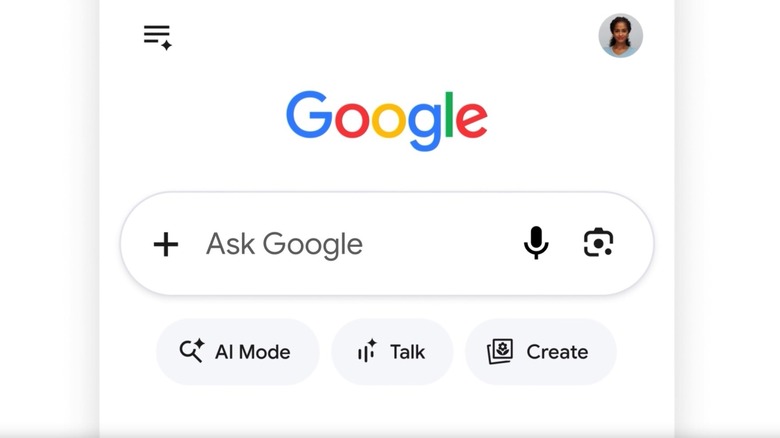
The Google Search experience announced at I/O 2026 may make traditional online searches harder to perform. Features like AI Mode can be useful for discussing concepts and plans with Gemini. AI-assisted shopping and agents may also have a place in Google Search, when users opt into them. But Google is making the AI-centered interface the default experience. There's no toggle to turn off the new AI-based user interface and perform a traditional search that returns a standard results page. This may explain the shift toward DuckDuckGo, which offers optional AI features. Also, DuckDuckGo has created a "NoAI" search page that turns off all AI features, including answers, images, and suggestions.
The new Google Search also showed early errors. Soon after the I/O 2026 announcements, users discovered that searching for a word like "disregard" would trigger a conversation error with the AI rather than showing the expected dictionary result for the word. The AI would take the word as a command to ignore the previous chat and start over. These mistakes reminded people of the "glue on pizza" mishaps from the early days of AI Overviews. Google fixed those issues, and it may fix similar issues with the new Google Search experience. However, this experience further illustrates that AI is Google's primary interest in Google Search.
It's not just regular users who are leaving Google. The European Parliament announced in June 2026 a switch to Qwant, a Google Search rival from France. While the move happened after Google's I/O event in mid-May, it's not necessarily related to the Google Search makeover that's prompted users to switch to DuckDuckGo. Instead, it's part of Europe's larger push to promote local tech solutions and reduce its reliance on non-EU tools.