

Why Do Macs Not Have Touch Screens?
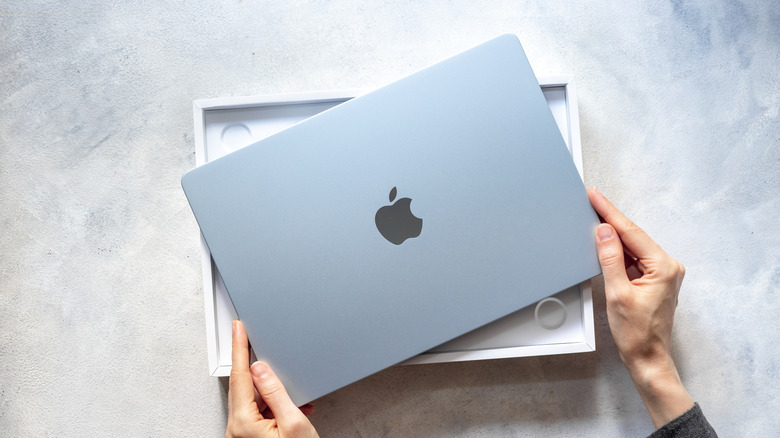
MacBooks have become the computer of choice for those wanting productivity laptops for content creation and daily home and office work. There are few laptops lighter than a MacBook Air, and even fewer computers more powerful than the MacBook Pro for productivity tasks. However, despite Apple dominating the market, MacBooks are still missing an important feature in 2026: touch screens.
It doesn't make much sense to skip out on a feature that most of your competitors put in their devices, so why is Apple so insistent on MacBooks not having touch capabilities? It's not like Apple lacks the technology — the M5 iPad Pro is already powerful enough to function as your main computer.
Apple hasn't made any statements on this in recent years, but we do have a hint at what could've been the reasoning from an earnings call with Tim Cook all the way back in 2012. Cook likened the idea of a unified OS for tablets and touch computers to converging "a toaster with a fridge," further adding that while possible, it would be unpleasant for the user.
What has changed since Apple took a public stance against touch screens?

Further context to Cook's statement can be found in a statement made by Steve Jobs in 2010 in regard to touch-screen laptops, where the former Apple CEO said, "We've done tons of user testing on this, and it turns out it doesn't work. Touch surfaces don't want to be vertical." Jobs then elaborated on this, stating how holding your arm out to reach a laptop screen can easily get tiring, and that it's "ergonomically terrible."
Apple may have been wrong about touch screens not working on laptops — seeing as how many premium laptops come with touch displays now — but the reasoning behind it wasn't entirely incorrect. If you were to use a touch screen as your primary method of navigation on a laptop lying on a desk in front of you, it would result in an incredibly sore arm. However, premium laptops are much slimmer and lighter today, which means you can easily use them on your lap. Furthermore, you're not using the touch screen as your main means of interaction with your computer; you're using the touch features — tapping on the screen, pinching to zoom — on top of the existing touchpad.
Many computers today can also fold or detach their keyboards to work as tablets, removing the distance that makes vertical touch displays annoying entirely. With 2-in-1 convertibles and premium ultra-portable laptops having touch capabilities for a long time now, Apple might want to rethink the idea that touch screens don't work on laptops.
Will there ever be a Mac with a touch screen?
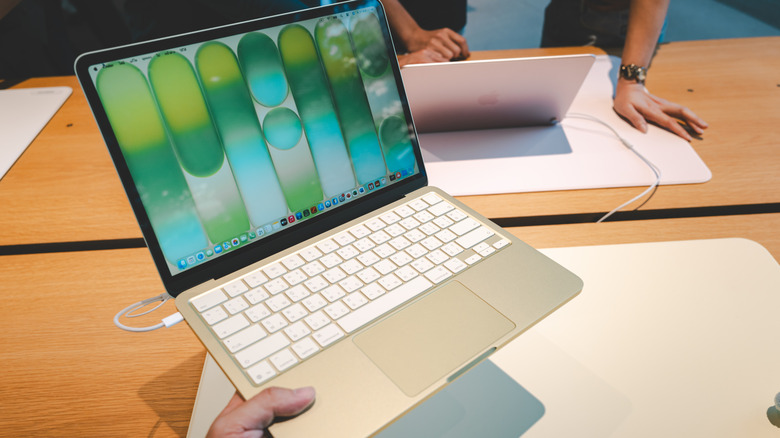
Apple has a decade-plus history of releasing MacBooks without touch screens even when it became normal for other manufacturers to do so, but it appears this is about to change. According to Mark Gurman from Bloomberg and tech analyst Ming-Chi Kuo — both of whom have incredibly good track records with Apple leaks — there should be a touch-screen MacBook Pro coming in early 2027.
Not many details are known yet. But based on the leaked information, the touch-screen MacBook Pro should feature an OLED display, something that Apple hasn't used in MacBooks before. It has also been said that the software engineering team behind the MacBooks is tweaking macOS to better accommodate and make use of a touch screen. For example, Gurman reports that there will be a new touch menu that will appear when you tap an item with certain touch-based commands.
We still don't know if the changes are coming to either the base MacBook or the MacBook Air — or the MacBook Neo for that matter — but the chances seem incredibly low, at least for the immediate future. There's also speculation that this touch-capable OLED MacBook will be a level above the MacBook Pro, and as such, may be named and priced differently. Of course, we will need to wait for a confirmation from Apple to be sure.