

Why People Are Ditching Kindles For Non-Amazon E-Readers
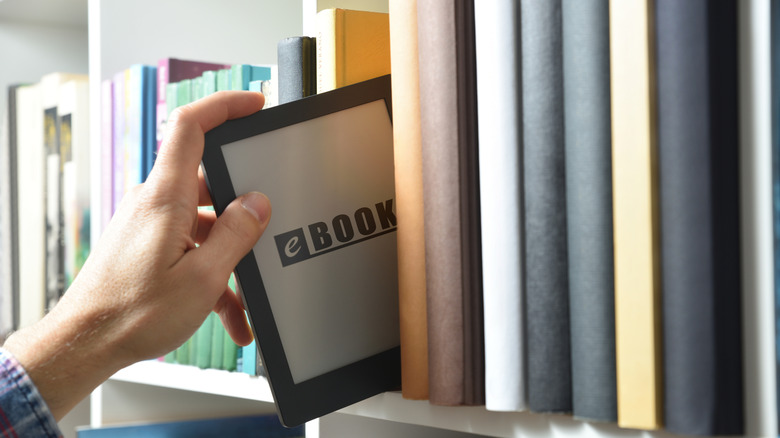
During Amazon's early days, it had a rather good reputation, not only thanks to its giant catalog of e-books (which allowed it to corner the industry, these days controlling 80% of online e-book sales), but also for its discounts as well as its consumer-first attitude. For a time, Amazon coasted on this solid reputation and was seen as a frontrunner in the e-reader market almost immediately after its first Kindle launched in 2007, thanks to its vast digital bookstore and unique hardware that was incredibly tactile with physical page-turn buttons. It was a device designed with purpose, and it wasn't until after the 2019 Oasis that Amazon gave up the ghost on such tactility. No longer do Kindle devices feel designed for consumers' e-reading needs.
The good times simply didn't last; over the last few years Amazon has been dead set on shoring up its store and hardware to cut down on piracy, removing beloved features like Download & Transfer via USB, and even recently cutting off store access to older Kindles despite the fact they still worked perfectly fine, a very eco-unfriendly move for a company that brags about the recycled plastics used in its Kindles. You simply can't back up books from your old Kindle without jumping through a bunch of hoops.
The truth is, you don't own a single e-book bought from Amazon; you've only purchased a license for access, and as is the case with how Amazon fumbled its Comixology buyout, the company has no qualms replacing your entire library with worse copies without a refund in sight. It has even been caught removing purchases from users' devices. In other words, Amazon has shown plenty of examples of why its Kindle brand can't be trusted; thus, people are ditching Kindle for non-Amazon e-readers.
Amazon forgot that the consumer is king

Amazon's loss is everyone else's gain, from e-book and e-reader consumers moving to greener pastures to the hardware companies filling the void Amazon left in the market. Companies like Boox, Rakuten (Kobo), reMarkable, Supernote, and BigMe have gained plenty of ground; there are tons of e-readers to replace your old Kindle with. Many even offer the old features consumers miss, like physical page-turn buttons, expandable storage, and the ability to easily sideload content of any format, some even running Android for app versatility. Amazon doesn't even currently sell a single e-reader with page-turn buttons, but Boox and Kobo absolutely do. Better yet, both brands support ePubs natively out of the box, opening up a wide world of e-book stores. Sure, most retail ePubs contain digital rights management (DRM), a form of copyright protection, but the good news is that it's very easy to remove, if you live in a region where that's legal. With ePubs, you have more opportunities to control your library, especially with management and conversion apps like Calibre.
Basically, if you want to take control of your e-book library, ePubs and the e-readers that support them are a good direction to go. This also allows you to diversify where you purchase your e-books by using several storefronts, so you can avoid the sunk-cost fallacy that may currently be keeping you in Amazon's grasp.
So yes, Amazon has angered its most devoted e-reading customers, not only by removing power user features like the ability to easily download copies of your e-books, but by pulling support for perfectly functional devices while removing store access. Enthusiasts have moved on to more welcoming platforms; there's simply no need for a Kindle anymore, especially if you miss the heyday of Amazon's consumer-focused features, many of which are alive and well on competing platforms.