

Lexar's Next-Gen SSD Could Be A Massive Improvement For Your Next Laptop
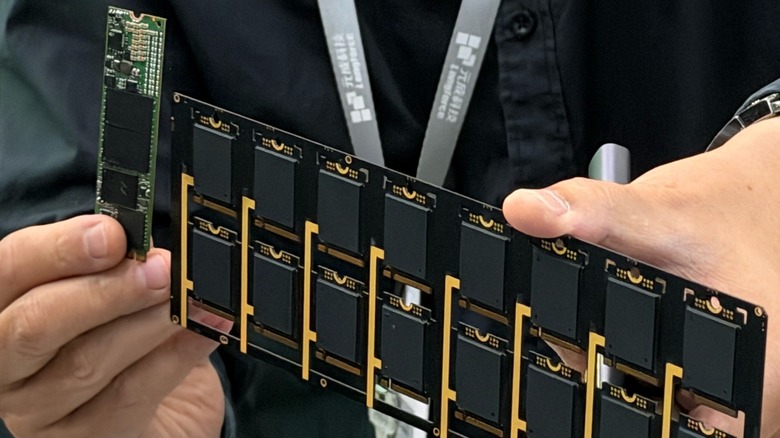
For the past several years, the storage industry has largely relied on a few established standards, notably the 2.5-inch drive and the M.2 2280 form factor. While these formats have housed our data in desktops, laptops, and more devices throughout the years, their physical dimensions have remained largely unchanged, even as other components have shrunk. Lexar is now looking to break that mold, aiming to usher customers into a new era of compact storage with its mSSD (micro Solid State Drive) standard.
The company, which recently released the Play X SSD — its first mSSD product — delivers read speeds up to 7,400 MB/s and write speeds up to 6,500 MB/s by operating as a PCIe Gen 4 drive, in about half the size of a regular SSD. Even though this product still doesn't have a release date for the U.S., it just made its way to Europe as Lexar tests a compact M.2 2230 form factor, the tiniest in the market.
While the company offers its new Play X storage with an M.2 2280 slot adapter, it tells us that it wants to push this new form factor to the industry as its next milestone. "We want to achieve a standard, and we have been talking to our partners about expanding this technology. As we celebrate our 30th anniversary, this is our commitment to innovation," a Lexar spokesperson told us.
Lexar's Play X is the beginning of a new SSD era
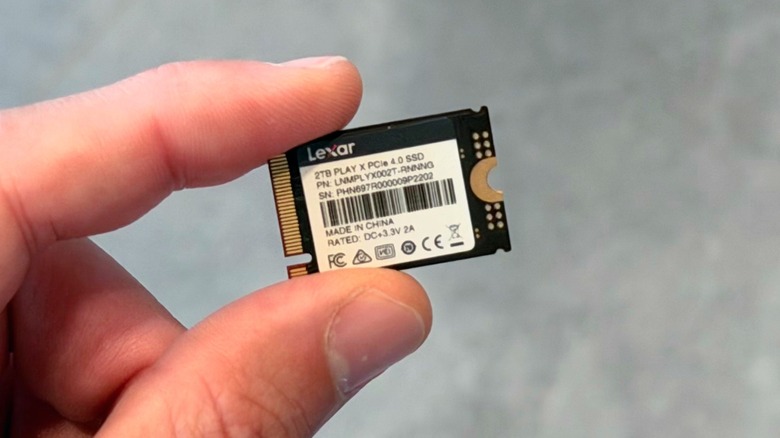
According to Lexar, its new Play X mSSD is the perfect device for gamers and content creators. Still, the company wants to push the new standard to more devices than just PCs. It thinks this PCIe 4.0 2230 SSD could be a perfect match for AI applications, like next-gen smart glasses, robots, and tiny wearables. More than that, the company thinks that this new tech can bring a massive improvement to laptops. Since manufacturers are always trying to make the internal components smaller, this upgrade to the SSD could give them more space to add more memory, a bigger battery, and so on.
Lexar says that its first mSSD product is also a lot more durable and has built-in data protection compared to other major SSDs. Its unified architecture and integrated design bring better dust, moisture, and physical shock resistance, which ensures users' data is safe. According to the company, the mSSD unifies the controller, NAND, and PMIC in a single module, bringing more stability, system integration, and the ability to scale this product for enterprise use, as it could be deployed in businesses to help build servers, AI platforms, and other complex scenarios, thanks to its custom controller and firmware design.
Lexar celebrates its 30th anniversary by introducing a new storage platform
To celebrate its 30th anniversary, Lexar invited us and some other American media to share a bit more of its history. Founded in 1996 in San Jose, California, it was part of Micron's businesses from 2006 to 2017, and it's now owned by Longsys, a flash memory company based in Zhongshan, China. Over a few days, the company took us to explore its manufacturing process in Suzhou and Shenzhen, its quality control lab, how it tests its products using hundreds of different devices to ensure compatibility, and how it sets itself apart from the competition by controlling the entire storage card manufacturing process.
Among its latest products are Lexar's microSD Express card for the Nintendo Switch 2, which delivers a reliable experience when booting up games; portable SSDs, which can be used with smartphones or for on-the-go backups; and DDR5 RAM.
For the new Play X product, the company tells us that it's going to use the form factor to keep developing AI storage solutions for laptops and high-performance AI computing, as it plans to continue to expand the category in the upcoming months and years. As of now, Lexar says it has shipped this new standard to a few laptop partners, so we could see the fruits of these collaborations soon.