

Overnight Charging Vs. Morning Charging: What's Better For Your Battery Health?
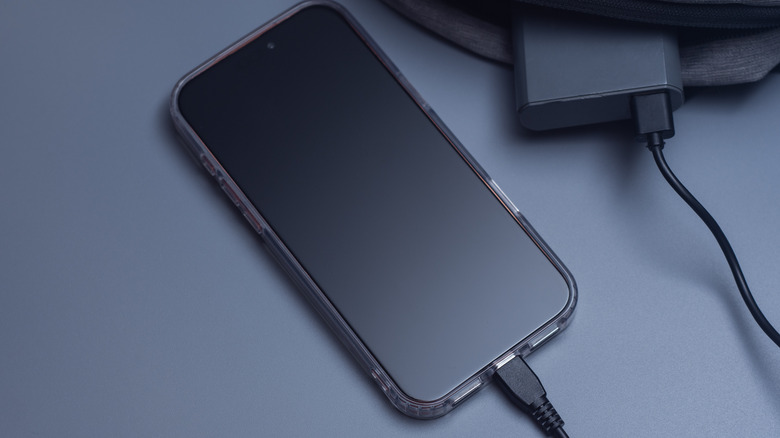
Since you can't fight chemistry, the battery in your smartphone has a finite lifespan, but you could be making some mistakes that are shortening your phone battery's capacity faster. For instance, letting your phone go to 0% is a huge no-no that you will regret once the battery degrades. Does overnight charging impact battery health in a similar way, and should you combat this by opting for fast morning charging?
In short: no and no. Though letting your battery go to 100% isn't recommended, the idea that it will cause rapid degradation is one of the most common battery myths still propagated online. This may have been a problem in the olden days, but modern phones have features that pause charging around the 80% mark, minimizing the time your phone spends at full charge. Put differently, overnight charging is perfectly safe.
Fast charging, on the other hand, is super nifty, but it does wear out the battery a bit faster. This isn't to say you should ditch it completely. Rather, try a combined approach where sometimes you charge it overnight and other times you top off the device with a fast charger. It's also not the end of the world if you charge up your phone quickly before leaving for work.
Why charging your phone overnight isn't a big deal
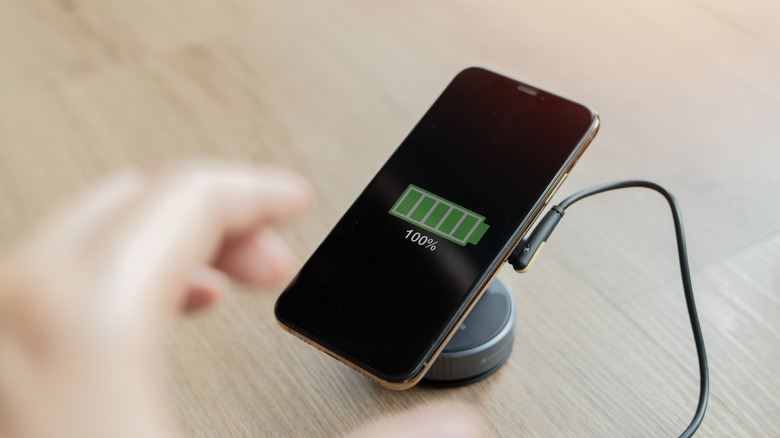
When it comes to the science behind lithium-ion batteries, temperature is what hurts your battery the most. A Li-ion battery charges when ions zip between an anode and a cathode. The higher the wattage, the faster the movement. This is how fast chargers work. They boost the wattage, speeding up the rate at which these ions migrate. The side effect of this is that it also bumps up the internal temperature, as it can break down electrolytes and decrease the overall capacity over time.
So, if you use a regular charger and don't cover your phone with a bunch of blankets at night, you're in the clear. Smartphones generally have smart battery management, which can stop charging once the battery reaches its full power. Leaving the battery at 100% is harmful in theory, but both iOS and Android devices can delay the full charge according to your routines, basically eliminating this particular issue.
Now that we know overnight charging won't tank your battery health, what about an occasional fast charge? Theoretically, using a fast charger frequently can heat the battery and lead to a gradual loss in capacity. However, the effects of fast charging are negligible, representing less than a 1% decrease compared to the slower method. To get the most life from your phone's battery, keep it above a 20% charge and below 80%, and don't allow it to fully discharge, especially if you switch on the phone's optimized charging features.