

IEMs Vs. Earbuds: What's The Difference, And Which Has Better Audio Quality?
We may receive a commission on purchases made from links.
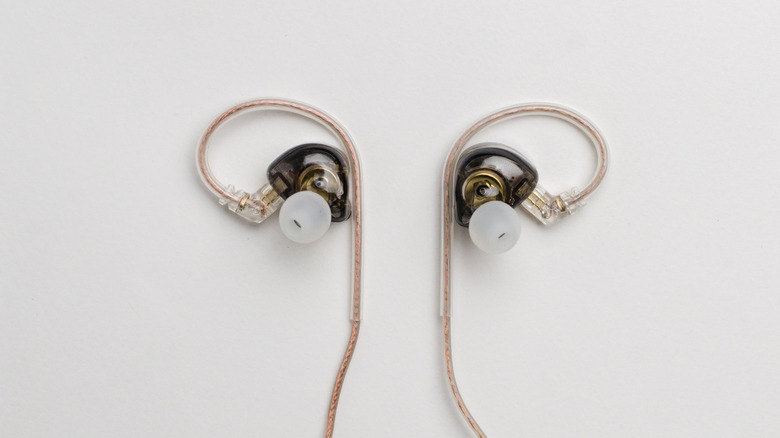
Earbuds are a popular choice when it's time to listen to music or an audiobook, or stream a video without disturbing those around you. The term can be used to generally describe all earphones that go into your ear, but that's not always the case. There are also in-ear monitors, or IEMs. They are also inserted into the ear, or rather more specifically, into the inner portion of the ear. By contrast, earbuds tend to sit in the outer part of the ear.
Both an earbud and an IEM essentially do the same thing: they blast audio into your ears so that you can enjoy music or listen to a podcast. The differences come in how they are inserted and the type of audio quality they produce. IEMs offer improved sound quality overall when compared to earbuds due to a design that better blocks out exterior sound through the use of the eartips, which close off the space within the ear canal.
Price is also a difference between the two, with more expensive IEMs claiming to produce a better sound. Earbuds are placed in the outer ear and don't always include silicone or rubber caps to block out external sound. So if you want to experience a fuller, deeper sound while listening to music, watching TV, or even gaming, IEMs like the Sony Inzone E9 Gaming model are often the better choice.
Which one do users prefer for audio quality?

The consensus from online forums and people who have actually owned both IEMs and earbuds says to go for an IEM if sound quality is your primary objective. As they fit inside the interior ear canal, IEMs can better dampen sound from outside sources such as conversations, other music, or general everyday noise. Their rubber or silicone endcaps plug your ear so the music or whatever audio you're listening to blasts directly into your ear more directly than with an earbud.
For example, reviews for the Moondrop CHU II say the IEMs provide great audio clarity and solid overall sound quality. They're lightweight and don't feel hefty in the ear, and users appreciate the interchangeable cable. Some did complain about tone qualities in certain pitch ranges (around four kilohertz), but those same users were able to dampen that issue by reducing volume when those sounds played.
Among Reddit users who have used both IEMs and standard earbuds, the clear consensus is that IEMs produce better sound quality. They pump out deeper bass and produce a crisper sound due to their placement. Earbuds can move around more freely once placed in your ear, which can produce inconsistency in sound quality over time. So, when you're looking for in-ear devices with the best audio quality, whether you're a professional mixer or just want to listen to music on the go, consider investing in an IEM.
What to look for when purchasing IEMs

If you are considering buying a pair of IEMs, you have a lot of options to choose from across a wide price range. The Moondrop CHU II IEMs mentioned above, for example, are priced at around $23 on Amazon. They come equipped with an aluminum-magnesium alloy diaphragm that boosts treble and a frequency response support for sounds between 15 hertz (Hz) and 38 kilohertz (kKz) — that's a wide range, meaning you won't miss any details in whatever you're listening to.
At the other end of the spectrum, the Essonio ES-C19 in-Ear Monitors are a more luxuriously priced IEM, coming in at around $963. They are noise-cancelling and have a frequency response between 5 Hz and 50 kHz, boosting bass, mid, and treble ranges. Beyond these extremes, there are Bluetooth options available, as well, but the sound quality generally isn't as good since they aren't directly connected to the source device. Bluetooth can also get interrupted and may cause skips and jumps or poor sound quality.
One thing to keep in mind is how you are going to be using the IEMs. If you are a casual listener around the house or at work, you may not need expensive IEMs with an eight-strand 192-core silver-plated balanced cable like the Essonios has. If you produce music in a studio or play in a band, though, it may make sense to at least consider a more expensive option that provides a better hearing experience. Both IEMs and standard earbuds can be wireless or wired, with wired being the better choice if a premium listening experience is your goal. That's likely one reason why old-school wired earbuds are back in style.