

5 Sci-Fi Movies You Have To Watch If You Like Pluribus

Last year, "Breaking Bad" creator Vince Gilligan dropped a bold, new show on Apple TV that was leagues away from the crystal meth cooking business and something a little more out there. "Pluribus" became the must-watch show of 2025 that followed Carol Sturka (Rhea Seehorn) as one of the last remaining humans left unaffected by a worldwide takeover of an extraterrestrial virus. Understandably, what sounds like a hellish overthrow of the human race instead shows those converted to the "Joining" living a pretty chill life. Even so, that doesn't stop Carol from doing her best to fight against the alien organisms that have stolen the identity of almost every human being on the planet.
Nominated for a Golden Globe after its first season, "Pluribus" unashamedly pulls from some classic science fiction stories, as well as a few horrors. Thanks to Letterboxd, Gilligan even revealed a list of the films that inspired "Pluribus," all of which make an appearance in some capacity in the show's first season. While it's certainly a great list to get through, there are five films in particular that help "Pluribus" get to the incredibly compelling standard that remains throughout the first season. Rather than taking you to our leader, we'd advise making your way through this batch before the confirmed second season returns to our screens.
Invasion of the Body Snatchers
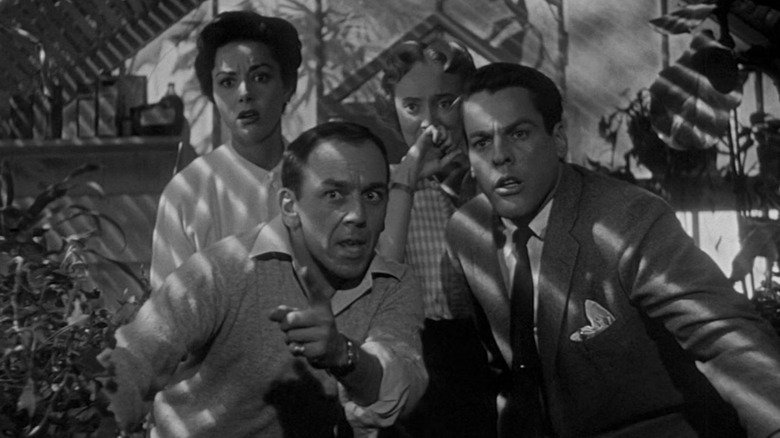
The obvious film to queue up after watching the first season of "Pluribus" is a film where (spoilers) we take another pasting from parasitic aliens. "Invasion of the Body Snatchers" was released in 1956, when director Don Siegel did a disturbingly good job of bringing Jack Finney's 1954 novel, "The Body Snatchers," to life. A nail-biting and otherworldly allegory for conformity and overbearing greater powers, Kevin McCarthy plays Dr. Miles Bennell, who begins to catch on that something sinister is spreading through the streets of Los Angeles, and it comes in the form of giant pods with doppelgangers growing inside them.
While "Pluribus" doesn't hesitate in revealing just what has happened to humans that Carol has missed out on, "Invasion of the Body Snatchers" reveals it slowly, which still remains incredibly unsettling almost 70 years later. The gradual discovery of the pods and their doppelgangers springing to action is still the stuff of nightmares, as is McCarthy screaming at the screen that we'll be next if we're not careful. Admittedly, the movie also contributes to one of the rarest occasions where the remake is better than the original. Nevertheless, it's a great adaptation of the book and a blueprint not just for Philip Kaufman's crack at the story but also for many other alien-infiltration movies that followed. It's always worth going back to where the root of the terror and where "Pluribus" gets its core story from.
The Truman Show

In 1998, Jim Carrey's career took a shift away from slapstick comedy with "The Truman Show," a movie about the loss of identity and being controlled by an unknown force. Peter Weir's classic — occasionally uncomfortable — dramedy follows Truman Burbank, who, since birth, has been at the center of the most-watched television series on Earth, and eventually comes to realize just how much his life is not his own. A similar theme plays out in "Pluribus" with Carol under the watchful collective eye of practically every other human on the planet.
Thanks to an incredible script from Andrew Niccol, Weir does a remarkable job of creating a world within a world, while Carrey does his very best to climb out of it. Perhaps less terrifying than other movies on this list, Truman is a hero bred from tragic circumstances that you're aching to see him break free from. The entire cast and crew are halting Truman's exit, led by Christof (Ed Harris) as the show's creator and false god in a beret and Meryl (Laura Linney) as an actress who portrays Truman's invasive wife. "The Truman Show" sees a hero attempt to break free from conformity, which is exactly what Carol is attempting to do in "Pluribus."
The Omega Man
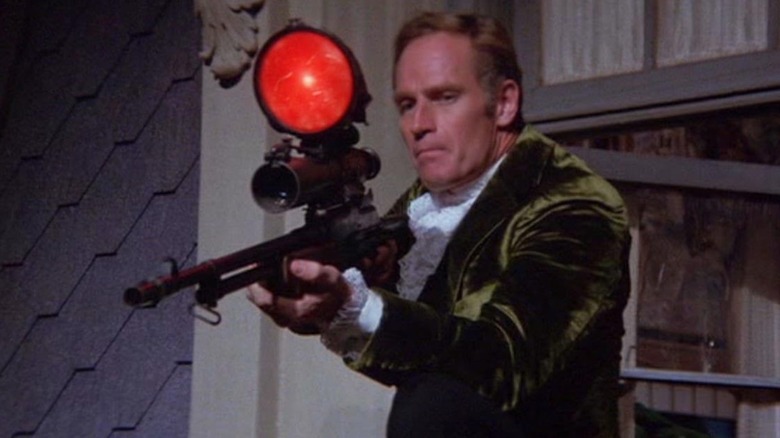
Currently, the world waits in a rather confusing fashion for the "I Am Legend" sequel, given that it's going to be building off an alternative ending that didn't make it into theaters. However, there's another adaptation of Richard Matheson's novel of the same name, led by Charlton Heston. Released in 1971, "The Omega Man" provided a much better take on the book than the Will Smith's 2007 version. Instead of turning into zombies, those infected with this mysterious virus still have some humanity left, but they spend their time trying to force Heston's last man on Earth into their new cult-like way of life.
Isolated in the streets of San Francisco, Heston spends his days trying to hunt down the cloak-wearing zealots, while also doing his best to keep hold of his sanity. Much like "Pluribus," those who have succumbed to the virus have continued on into a new age, while Robert Neville tries to save humanity from going the way of the dinosaurs. While it might not have the CGI polish of "I Am Legend," there's still enough here to entertain, and that includes seeing Heston dressed in a 1960s leisure suit (think Austin Powers) while wielding a sniper rifle, which looks both bonkers and brilliant at the same time. Top that, Mr. Smith.
The Shining

There are certainly strong parallels between Carol Sturka's experiences and those of Jack Torrance at the Overlook Hotel in "The Shining." Two authors (albeit one more successful than the other) left to their own devices are constantly lured by a greater entity desperate to convert them. Admittedly, having only the first season to go off of so far, it feels safe to say that Jack has a tougher time of it in the 1980 Stanley Kubrick adaptation of Stephen King's spine-tingling read. Bartenders, women in cursed rooms, and photos that show a guest list of ghouls all play their part in trying to make the writer's stay a permanent one. In the case of this classic horror, though, there's one specific detail that Gilligan pays particular homage to.
In his breakdown of movie muses that helped him in creating "Pluribus," Gilligan recalled one iconic scene from Kubrick's movie that any self-respecting horror fan would've spotted a mile away. In Episode 1, Carol is approached by a pair of neighbor kids who remind her of where she hidden a spare key to her house. About this scene, Gilligan said: "And yes—we borrowed the image of those creepy neighbor kids from Kubrick's even creepier twin girls." This, of course, refers to the Grady twins that appear during Danny's lap around the hotel in "The Shining." It's a blink-and-you'll-miss-it moment in "Pluribus" that proves, under any circumstances, children talking in sync is enough to give audiences the heebie-jeebies.
The Thing

John Carpenter's "The Thing" is a 1982 sci-fi horror about stolen identities by terrifying aliens, a remake that left its mark on film history as a chilling tale about the occupants of Outpost 31. Like "Invasion of the Body Snatchers" but unlike "Pluribus," Carpenter's body horror masterpiece is about an enemy hiding in plain sight, rather than revealing itself in the initial encounter. As a result, tensions run high as R.J. MacReady (Kurt Russell) takes charge of an alien invasion that has corrupted his colleagues. The result is a gut-wrenching, pulse-pounding watch that still strikes a nerve, even in its quietest moments.
One of the scariest moments is the team test, where MacReady hooks us in with nothing but some heated copper wire and blood tests to find out who's who. Unlike the collective group on "Pluribus," the alien organism in "The Thing" replicates its target down to the cellular level, so much so that it doesn't even know it's an alien. "Pluribus" might well depict the horrifying concept of losing humanity, but Carpenter's classic did it first and, at times, in a far grislier and more disturbing fashion. Also, while we know that, for now, Carol is still herself, the ending of "The Thing" remains one of the greatest sci-fi horror movie endings ever, leaving us to question whether or not we're safe from an alien invasion.