

Dolby Cinema Vs. Dolby Digital: Which Has The Best Audio Quality?
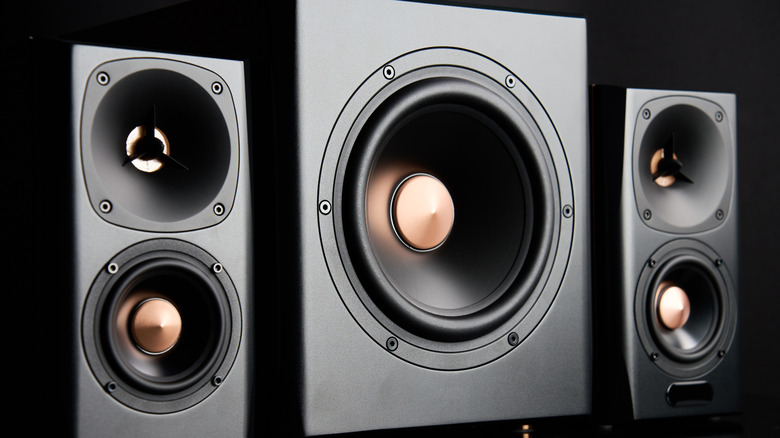
The Dolby audio company has been a staple of professional cinemas, home theaters, and music studios for over six decades. When it comes to cinematic sound, Dolby is one of the leading audio firms for mixing and mastering the highs and lows of many of our favorite films and shows. Dolby Cinema and Dolby Digital are just two of the company's many innovations, but if you're looking to experience the best audio quality possible, the former is most definitely the superior option. It'll also require you to get in your car and drive to a Dolby-compatible theater.
Dolby Cinema (DC) is the pro-grade cinematic version of Dolby audio you'll hear when watching a movie at a DC-certified theater. More of a full-on branded experience, DC utilizes Dolby Atmos, an object-based surround sound configuration that maps audio both horizontally and vertically. In a DC theater, Atmos speakers are placed along the walls and ceiling, creating an immersive soundstage that engulfs you three-dimensionally. But DC theaters also use custom theater acoustics to drive the Atmos audio, in addition to Dolby Vision HDR laser projection for enhanced visuals.
Dolby Digital is a digital compression format (also referred to as AC-3) that the Dolby company has been using since the 1990s. Used for everything from Blu-rays and DVDs to streaming platforms, cable programming, and video games, the Dolby Digital format is commonly used to encode audio for either 2.0 stereo playback or 5.1 surround sound.
Dolby Digital is just a format, whereas Dolby Cinema is a complete cinematic experience
Over time, engineers were able to expand the traditional Dolby Digital codec to add support for additional surround channels and even lossy versions of Dolby Atmos. Formats like Dolby Digital Plus (E-AC-3) are able to carry lossy Atmos metadata alongside their compressed surround sound data. For lossless Atmos playback at home, Dolby TrueHD is the codec you want to use, and you'll typically find this format supported on UHD Blu-ray discs.
But not even the biggest, nicest-looking and sounding DC theaters use Dolby TrueHD; instead, all audio and visual data is written to a Digital Cinema Package (DCP), which is then onboarded and processed by professional cinema servers. Dolby TrueHD is simply the best we can do at home with our Atmos soundbars and multi-speaker setups.
You can also expect to pay a bit more to watch films in a Dolby Cinema. The price difference isn't astronomical compared to a standard ticket, so it may be worth the few extra dollars if it's a film you've been dying to see for months or years. Plus, who can deny the next-level comfort of the reclining lounge seats and couches that many Dolby Cinema theaters are equipped with?