

The Four Gene Roddenberry Rules That Guided Star Trek's Starship Designs
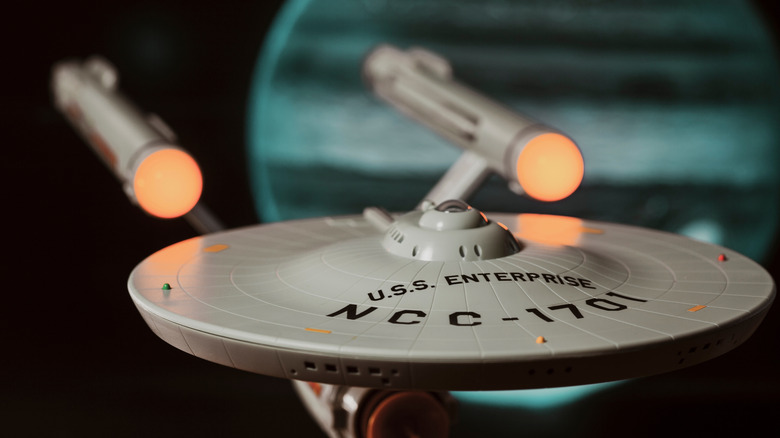
Starfleet may be imaginary, but its ships are carefully conceived based to a large degree on concepts developed by "Star Trek" creator Gene Roddenberry. Using those concepts, set and prop designer Matt Jeffries created the original Enterprise and its internal elements as well as other parts of the Trek universe. While some of his designs were more complex than Roddenberry wanted, many are still used. In fact, these designs form the basis for the technical manual that had been used as a source for designing in-universe vehicles, weapons, and other items that have appeared in not just some of the early "Star Trek" movies but also in a number of television episodes.
Over the years, designs have changed and improved, but all are built around specific elements that make a Starfleet ship unique. As most of these rules revolve around the size, shape, and location of nacelles, it's helpful to know exactly what they are. According to Memory Alpha, an online storehouse of all things Trek: "A nacelle was an outboard housing structure that contained warp coils and other components that together made up a starship's warp engine." It's important to note that in the "Star Trek" universe, nacelles are also present on subwarp (slower than light speed) ships, where they house components of impulse-powered engines.
How the warp nacelles in Starfleet vessels work

It is, so far as we know, impossible for human beings to consistently travel through space at faster-than-light speeds. But in the world of "Star Trek", the assumption is that FTL technology is relatively common. In addition, as in most other science fiction worlds, the Trek universe requires a technological solution for the time dilation that would make time pass at different speeds for people standing still or traveling faster than light. Without these solutions, there would be no galactic travel, nor would it be possible to communicate effectively from space to Earth.
Starfleet vessels were specifically designed to get past these physical limitations. The ships' engines, which are housed in the nacelles, use various in-universe systems to create a "warp bubble," or subspace displacement field. Ships can move at FTL speeds while the people inside the ships avoid the effects of special relativity.
To make all this happen, every warp-capable ship has an engine system with multiple parts. The warp core, where a controlled matter/anti-matter explosion is channeled through a matrix of dilithium crystals to create warp plasma, is inside the engineering bay of the ship itself. Here, the energy created by the core moves through conduits to the nacelles. Warp coils in the nacelles use that energy to create the warp bubble that allows faster-than-light travel.
Probably the most visible and iconic part of the ship design — the nacelles — came from the idea that the engines were too powerful to be kept inside the ship. In fact, the warp core itself is designed to be ejected in the event of an impending explosion. In theory, this lends an element of safety to an otherwise risky form of propulsion.
Rule #1: Warp nacelles must be in pairs
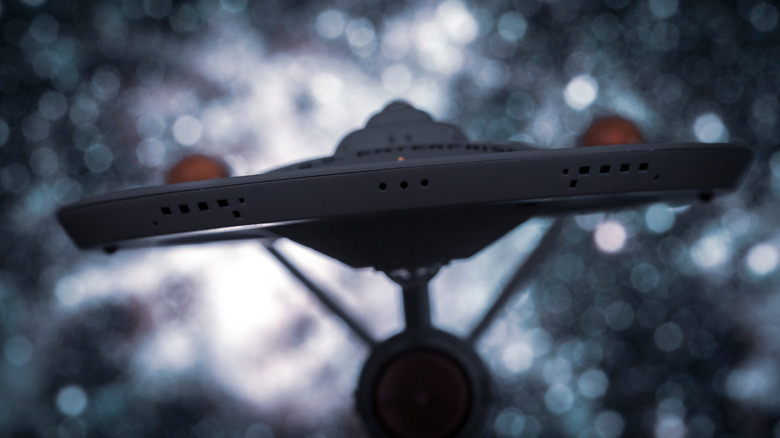
Roddenberry's first rule of design states that nacelles should always come in pairs. The idea behind it may be mostly aesthetic, but according to the technical manual (via Ex Astris Scientia): "A pair of nacelles is employed to create two balanced, interacting fields for vehicle maneuvers. In 2269, experimental work with single nacelles and more than two nacelles yielded quick information that two was the optimum number for power generation and vehicle control."
While it would seem impossible to create starships with single nacelles, there are examples of single nacelle starships both in Starfleet and in other fleets. Examples of single nacelle Starfleet ships include the Saladin-class starships, which were created in 2260s, and the Freedom Class starships, built in 2344.
Outside of Starfleet, both the Vulcans and the Ni'Var built starships with single, ring-shaped nacelles. The Suurok class ships, for example, were built in the 22nd century, while the T'Pau type ships were built much later in the 32nd century.
Rule #2: Warp nacelles must have at least 50% line-of-sight on each other across the hull
According to rule two, warp nacelles must have at least 50% line-of-sight on each other across the hull. If warp fields from nacelles must interact, it stands to reason that the nacelles should be placed in such a way that energy can be shared between them. It also looks a lot more interesting from the front.
Like Roddenberry's other rules, this rule is broken in canon, most significantly by the Defiant, a ship designed as part of the "Deep Space Nine" series. Unlike many other ships, the Defiant's nacelles are "underslung," making them less vulnerable to attack but also breaking the rules of design.
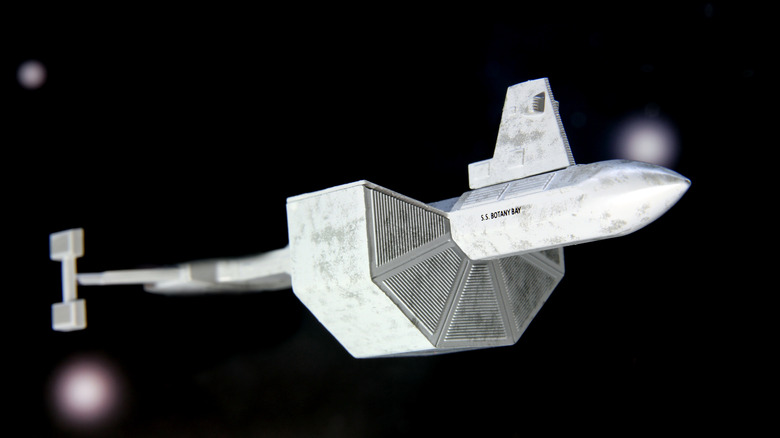
But the Defiant wasn't the first ship to break rule #2; in fact, it was already broken in the original series with the episode called "The Way to Eden." In this ship, Dr. Sevrin and his group of space hippies travel to their proposed new home in a spaceship with nacelles that are completely blocked by the body of their ship. Meanwhile, the Botany Bay, Khan's ship in the episode "Space Seed," has no nacelles at all.
Rule #3: Both warp nacelles must be fully visible from the front
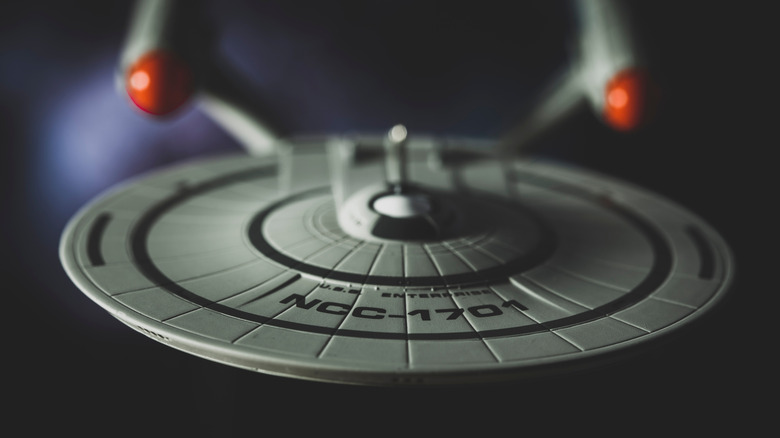
Rule three states that both warp nacelles must be fully visible from the front. Again, this is an aesthetic choice that comes with an in-universe explanation. Each nacelle has, at its tip, a piece of equipment called a Bussard ramscoop or Bussard collector, named after the Bussard ramjet, an interstellar propulsion system proposed by American physicist Robert W. Bussard in 1960. The Bussard ramjet has been suggested in the present day as a possible tool for making interstellar travel possible. In the "Star Trek" universe, these ramscoops gather up particles, including hydrogen, and repurpose them for energy, much in the way Bussard originally theorized.
The reality, however, is that quite a few Starfleet designs break this rule. Prime examples include the Intrepid class starships, such as the Starship Voyager. These ships, which are smaller and faster than Enterprise-style Galaxy class ships, break rule No. 3 when in warp configuration. The same is true of the Ambassador class ships. In all these cases, either Bussard collectors, the nacelles, or both are only partly visible from the front.
Rule #4: The bridge must be located at the top center of the primary hull
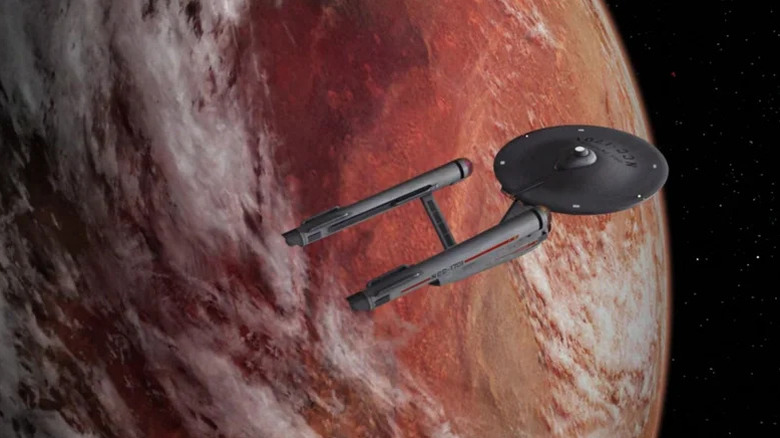
Roddenberry's rule No. 4 states that the bridge must be located at the top center of the primary hull. This is, of course, a poor choice for a ship that is likely to go into battle. By placing all the ship's vital controls and personnel front and center, Starfleet makes their ships absurdly vulnerable.
But this isn't a serious issue because, after all, Starfleet vessels aren't intended to do battle. Rather, they are ships of exploration, research, and discovery. Actively and intentionally placing the bridge at the top center of each ship should, in theory, suggest to other species: "we come in peace."
Of course, anyone who has watched more than two "Star Trek" episodes or even one movie knows perfectly well that Starfleet vessels go into battle pretty much on the daily. One possible solution to this issue is introduced in "Star Trek: The Next Generation." The show reveals that it's possible to separate the ship into two parts — one to safely transport civilians and the other with a "battle bridge" to fend off enemies. In practice, we have to take it as given that enemy aliens just don't have the brains or technology to simply hit the bridge with their first shot — an assumption that makes little sense given the uniquely complex and sophisticated nature of Trek aliens.