

Roger Ebert Said Audiences Need To See This Sci-Fi Movie To Fully Appreciate All Others
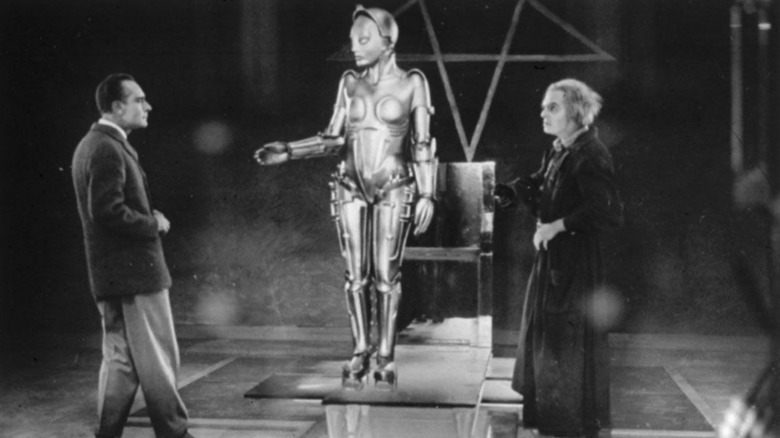
Science fiction is a popular genre. Why make a story with normal guns and cars when you can write one with laser guns and flying cars? While it's easy to appreciate the best sci-fi movies of modern times, sometimes you need to look back at the films that came before. That's exactly what Roger Ebert suggested you do, and he has the perfect film to serve as that portal: "Metropolis," a 1927 German expressionist movie directed by Fritz Lang.
The film takes place in a large, seemingly utopian city called, well, Metropolis (no relation to the DC comics city of the same name) and chronicles the adventure of Freder Fredersen. What begins as Freder trying to follow a beautiful woman unravels into a tale about love, vengeance, the human cost of luxury, and social change. The visuals are rather stunning for the '20s, leaning heavily into the art deco style. As the saying goes, artists are rarely appreciated in their own time, and the same is true for Lang.
While many people, Ebert included, have praised "Metropolis" as a seminal sci-fi film, reviews were far less glowing at release. When Variety reviewed "Metropolis," the magazine praised the film's artistic vision but called the narrative "manufactured." Likewise, The New York Times called "Metropolis" a "technical marvel" but otherwise "soulless." As time went on, critics reevaluated "Metropolis" and now view it as not only a classic but also necessary viewing material for any sci-fi aficionado.
What makes the movie so influential
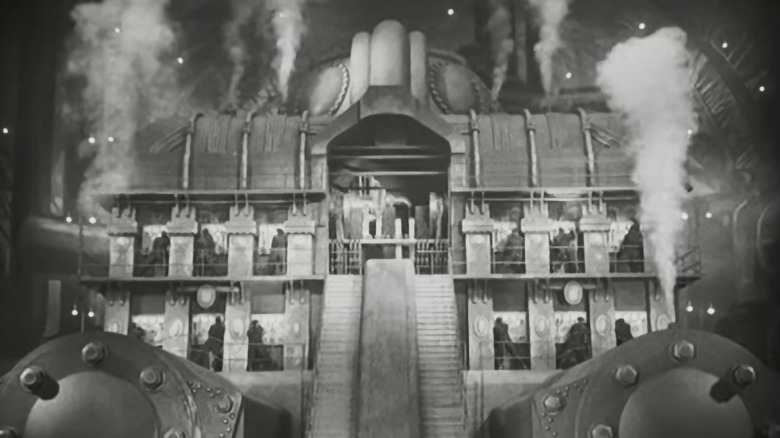
Roger Ebert is arguably the end-all, be-all of movie reviewers. He was so dedicated to the craft that he reviewed "Blade Runner" twice so he could give "The Final Cut" a perfect score. Roger Ebert summarized his 1998 review of "Metropolis" by saying "the result is one of those seminal films without which the others cannot be fully appreciated," but what else did he think about the movie?
Like the critics who saw "Metropolis" in 1927, Ebert fell in love with the visuals and production — and said it made Stanley Kubrick's "mania for control" look tame in comparison. Unlike the reviewers of the '20s, Ebert actually called the movie's story original and found that (and loved how it) seeped into every pore of the visuals. Ebert pointed out some of what he believed to be the most important and striking scenes, including the underground power plant and the dance of "Maria" (actually a robot duplicate, but saying too much would spoil the message and spectacle).
No matter what side of the aisle of opinions someone stands, they always praise the striking and unique visuals of "Metropolis," and many people have paid homage to "Metropolis" and its artistry. Arguably one of the most legendary examples is C-3PO, specifically the original vision of the droid. While Ralph McQuarrie conceptualized much of the technology for the "Star Wars" films, he always drew his inspiration from somewhere. For the X-Wing, he refined the original idea pitched by Colin Cantwell (who created the design while he was at a British Pub). Whereas C-3PO was basically McQuarrie's masculine take on the Marie robot from "Metropolis."
Don't confuse the OG for the anime, but watch it all the same

Madhouse and Toho released an anime titled "Metropolis" in 2001, which is seemingly a reimagining of Fritz Lang's 1927 film in anime form. In truth, 2001's "Metropolis" film is an adaptation of the manga "Metropolis" by Osamu Tezuka (best known for "Astro Boy"), which is itself inspired by Lang's original. Like the 1927 movie, Tezuka's "Metropolis" takes place in a seemingly utopian city and features themes of social and class inequality, but unlike the inspiration, the anime and manga's underclass are all robots.
In what can only be described as an example of history repeating itself, reviews of the anime "Metropolis" echo those of the live-action original at the time of its release: The story is nothing special, but the visuals are a treat for the senses. Even Roger Ebert's review retreads the same ground as his review of Lang's "Metropolis": Ebert summarized the film as "not a remake of the 1926 classic, but a wild elaboration." In his eyes, this movie is the perfect entry point for newcomers to anime and necessary viewing for existing fans of the medium.