

How Do DVDs Actually Work?
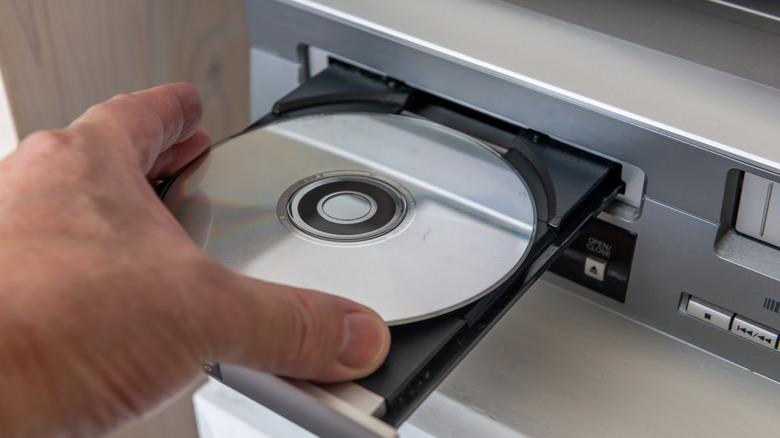
Between the ubiquity of VHS cassettes and the convenience of digital streaming, not to mention the many nostalgic forgotten formats like LaserDisc, DVDs reigned supreme in the home entertainment scene. With affordability and resilience, DVDs could store digital information on their internal reflective layers and, depending on the precise model of DVD, even rewrite their information for convenient storage purposes. Whether you were watching movies or sharing data between friends, DVDs facilitated it all throughout the early 2000s, and with proper care, DVD and Blu-ray collections can still last a long time today.
DVDs are similar to digital compact discs (CDs), with approximately the same size, thickness, and materials. Rather than a drastic difference in materials or manufacturing, DVDs differentiated themselves from CDs and other similar formats through their use of multiple data storage layers, made up of polycarbonate plastic injected just below the disc's surface. These layers could be read and parsed by a red laser from a DVD player or PC disc drive, allowing you to access and play the files stored within. DVDs set the stage for Blu-ray discs, with ever-growing data storage capabilities.
Data is stored on multiple writable layers
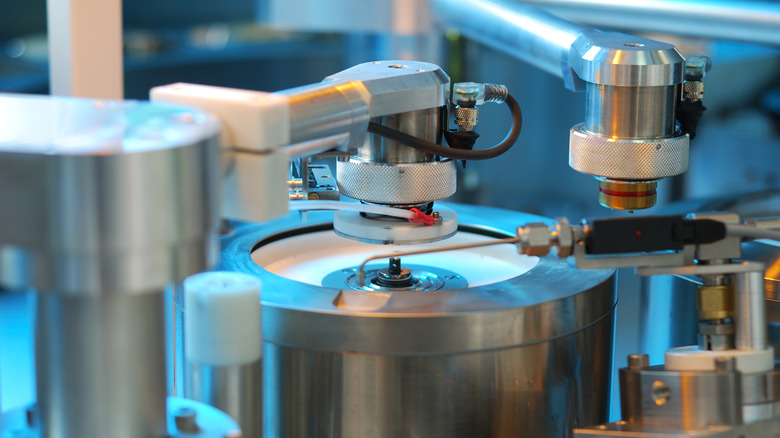
Both sides of the DVD are made of polycarbonate (PC), but the underside is transparent, while the top side typically has a label on it. Underneath the base layer of the DVD's surface is a second reflective layer composed of metals like aluminum and gold. This is why, when you hold up the bottom of a DVD to a light, it shines in a distinctive rainbow of colors.
Within the underside of a DVD is a spiral track of data, spinning outward from the center. Along the length of this spiral track are a multitude of microscopic bumps, also known as pits. When you place a DVD in a DVD player, the player shines a red laser light onto the bottom side of the disc, penetrating the PC layer and reaching the pits on the reflective layer. Next to the laser emitter is a sensor that determines when and to what intensity the light is being reflected back. As the disc spins, the sensor parses the presence or lack of pits as binary code, with the entire sequence stored within the data track gradually adding up to form whatever files are stored on the DVD.
A read-only DVD has its pits imprinted during its manufacturing process, and they can't be changed afterward. However, there are also rewritable DVDs, which use a special phase-changing material. When a laser is shone on this material, it changes states between amorphous and crystalline, creating a similar effect to the pitted discs that a DVD player can parse. Since the material's state can always be changed, you can always alter the content present on the DVD.
Other storage mediums like Blu-Ray store data differently
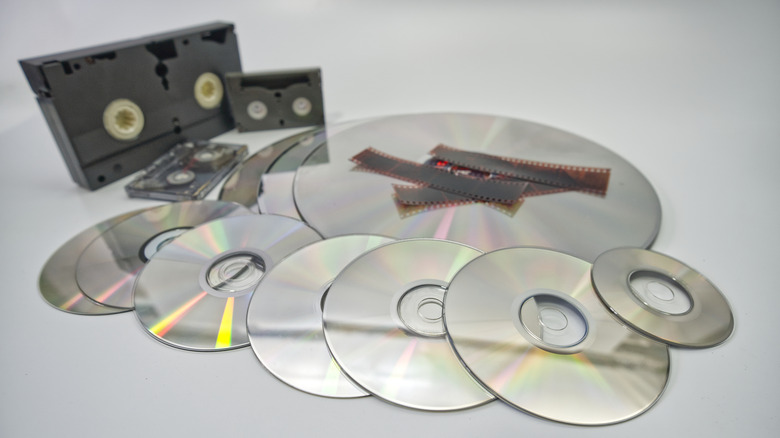
CDs and read-only DVDs are made in a similar fashion and with similar materials, and they store and read data in the same way, broadly speaking. Both of them make use of microscopic pits in a reflective layer, and both are read by a laser emitter and sensor. The difference between them is that the pits on a DVD are exponentially smaller, so more of them can be clustered together along its surface.
This results in a storage medium with far more storage space. Additionally, the laser in a DVD player has a narrower focus, so it can read those smaller, more tightly-packed pits. The laser in a CD player is too wide to properly parse the pits in a DVD, so nothing would happen if you tried to play a DVD in one. Blu-ray discs also use many of the same manufacturing tenets and materials as DVDs, but they take their technology even further.
Despite only using a single layer versus a DVD's two-layer approach, Blu-rays have even more tightly-packed data tracks with even smaller and more numerous pits. A Blu-ray player uses a blue-violet laser light with an even narrower focus, with the extra benefit of an additional lens sitting closer to the reading mechanism. This all adds up to even greater storage capacity, which also means higher fidelity for video files. These kinds of physical discs are still a great way to store data, which may be part of why Gen Z is getting more interested in physical media.