

What Is The 38% Rule For The Best Audio Experience?
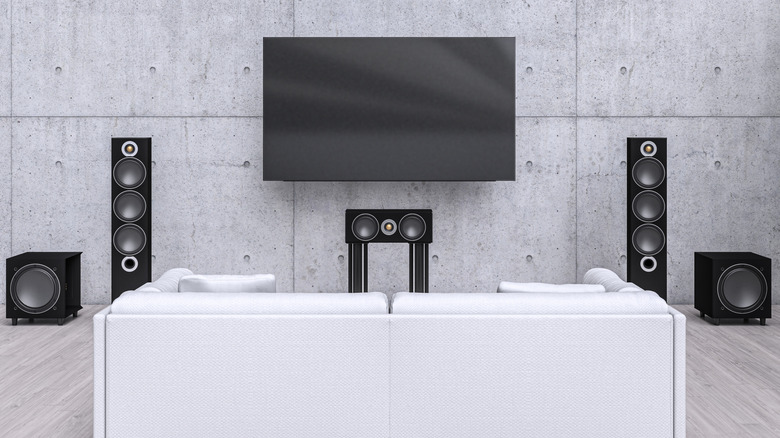
Do you care about the nuances of your audio experience when watching TV or a movie, listening to music, or gaming? If so, you likely already appreciate the way speaker placement can make a significant difference in sound quality. However, you might not account for the degree to which where you sit in the room can also impact just how impressive your setup sounds. According to some, following the "38% rule" is key to optimizing your listening pleasure. The rule states that someone should generally strive to sit 38% of the room's length away from the front wall (where the main speakers and TV would typically be) to minimize the negative effects of low-frequency valleys. However, in practice, this is less of a rule and more of a good starting point to begin getting a sense of where you should sit to get the most out of your audio system.
First, it's worth noting that on communities like Reddit's r/audioengineering subreddit, several users who claim to have decades of experience recording music say they've never even heard of the rule. Those who have heard of it specify that it's not a rule, but simply a guideline. More importantly, they argue it's only meant to apply in circumstances when speakers are mounted directly onto front walls. The effectiveness of the "rule" may therefore vary depending on your setup. That's just one reason not to treat this suggestion as law.
Why you shouldn't worry about getting the 38% rule perfectly right

The 38% rule offers a decent way to begin testing various listening positions as you search for the sweet spot. That doesn't mean it's always practical. In some cases, following the 38% rule would force someone to sit far too close to their TV screen for comfort. In a smaller room, an alternative to the traditional 38% rule would be to reverse it, striving to sit 38% of the room's length from the rear wall instead of the front wall.
It's also worth noting that the creator of the rule has made it clear that he never intended it to be treated as such. According to the YouTube channel Acoustics Insider, the 38% rule is generally credited to Wes Lachot, a studio designer and acoustic treatment professional. Lachot himself has apparently made comments on message boards where users have discussed this topic, clarifying that he didn't mean for the suggestion to become a rule others should strictly adhere to. He merely stated that, in a typical mid-sized room with speakers mounted on the front wall, getting out of the 50% listening position (or the middle of the room) is the goal. Applying the 38% guideline helps to achieve that in many cases.
Be aware that Lachot's audience also tends to be engineers and musicians. For the average person, it may be unnecessary to determine the absolute perfect listening spot.
How the 38% rule can be helpful
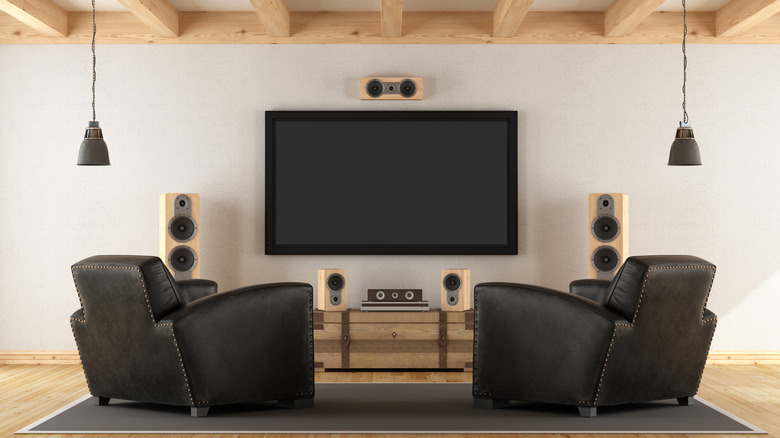
The fact that you don't need to follow the 38% guideline (which, again, was never meant to be a rule) as gospel doesn't mean it can't be useful. True, sitting exactly 38% of the room's distance from the front wall probably isn't a requirement for an enjoyable audio experience. Nevertheless, the 38% rule is a good place to start to help you determine if you're sitting too close to (or too far away from) the front wall to fully appreciate your audio system's capabilities. Start at 38%, then move around to find the sweet spot for you.
It's also smart to remember that the 38% rule is just one of many tips you can apply to get more out of your equipment. For instance, you can also look into how the surface on which you place your speakers affects the sound quality. Or, not to be confused with the 38% rule, which applies to a listener's position in the room, there's the 83% rule, which can theoretically help you identify the ideal speaker position.
Trying to apply all these tips as if they were laws you must abide by can prevent you from actually enjoying your audio system. You don't want to spend so much time trying to feng shui your room just right that you forget to prioritize your own comfort and satisfaction. These types of guidelines can be valuable when applied as general suggestions, but you don't need to worry about following them to the letter.