

Americans Might Still Get To See The 2026 Solar Eclipse - Here's How

A total solar eclipse will curve across the northern hemisphere on August 12, primarily affecting Iceland, Greenland, northern Russia, Spain, the Atlantic Ocean, and parts of Portugal. For anyone in those areas, it will be a wondrous sight, while everyone else is going to miss it — well, most of it. A partial solar eclipse will be visible for most of Canada and Europe, parts of Africa, and the United States. In the U.S., the eclipse path runs from Alaska down to the Carolinas, yet will be visible in nearby areas, such as New York City and Washington, D.C.
An eclipse happens when the moon passes between the Earth and the Sun, casting its shadow on the former. A total solar eclipse is when the moon perfectly aligns between the Earth and the Sun, blocking the star's face, giving the appearance of a full blackout. A partial eclipse is when the alignment is imperfect, and the shadow appears as a crescent. As long as you're located in the shadow's viewing path, or visibility path, at the right moment, you'll see the eclipse.
The path in the U.S. stretches from northwest to northeast, with most viewing times between early morning to midday. It's important to note that during a total solar eclipse's maximum, or "totality phase," is the only time you can view the event without wearing safety glasses. You'll need a pair before then, and you'll want to test them out beforehand to make sure they're actually safe and that you're not using fake solar glasses.
When will the partial solar eclipse be available in my area?
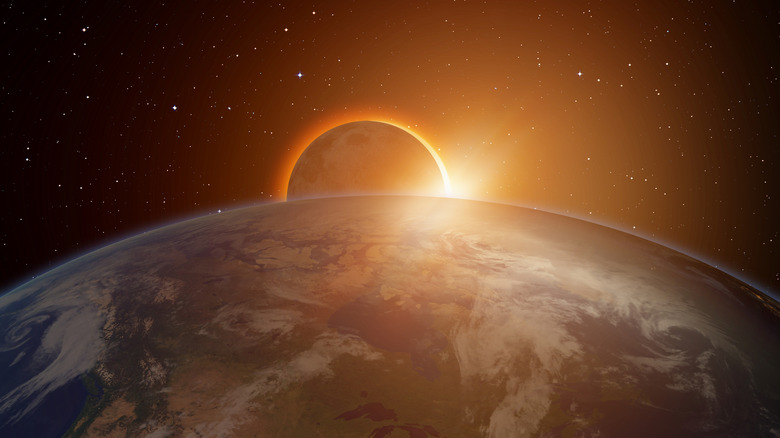
If you're in the eclipse's path or radius, you can observe the partial event. Remember, wear glasses. You can also safely record the solar eclipse with your phone using the right apps and tools. Many solar eclipse maps are wrong because they don't use the correct solar radius values, leading to inaccurate viewing estimates.
However, Basselian Elements maps are an exception. The center of the August 12 path (shown as a black line there) stretches through the North America, slightly above Vancouver, Canada, and moves into Washington state. It progresses east and southward through parts of Montana, North Dakota, South Dakota, Minnesota, Wisconsin, Illinois, Indiana, Ohio, West Virginia, and North Carolina. NASA's official schedule reveals the start and end times for major cities. Starting at 7:36 a.m. on August 12, the partial eclipse will be visible in Anchorage, Alaska, with the maximum coverage at 8:21 a.m., and concluding at 9:09 a.m. On the same day in New York, the partial eclipse begins at 1:07 p.m., with the maximum at 1:54 p.m., and the end at 2:38 p.m.
In Washington, D.C., it begins and ends a few minutes later, starting at 1:17 p.m., max at 1:53 p.m., and ending at 2:27 p.m. To find the best times for your area, search for the closest city on Time and Date. As long as you're in the center path or close to it, the partial eclipse will be visible around the given time. In Chicago, for example, the partial eclipse starts at 12:16 p.m. and ends at 12:40 p.m.. The further west you are, the earlier in the day the eclipse will begin.