

The '60s Space Race Influenced The Tech We Still Use Today - Here's How
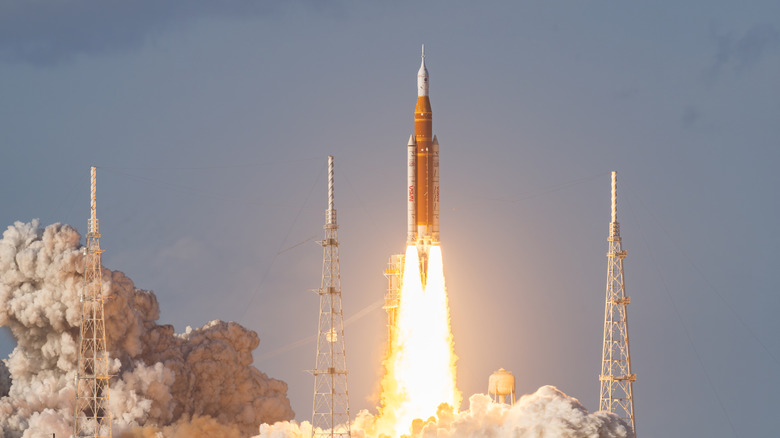
In the 1960s, the United States and the Soviet Union were among the most powerful countries in the world. After World War II, they competed with one another to see who could not only reach space, but also investigate and explore it fastest. The race came down to who would be the first: the first to launch a satellite, the first to put someone in space, the first to put a human on the moon.
The technology that powered the space race still exists today in and around our homes, businesses, and pockets. In the '60s, home computers and cellphones (in the way we know them today) weren't yet invented, which meant NASA relied on brain power and calculators until IBM supplied powerful enough computers. NASA even used solar power on satellites before they sat perched on top of houses and companies. You can even thank the space agency for memory foam and wireless headsets.
The space race has been brought to life through several films, including "Hidden Figures." The film follows a group of African American women mathematicians who played a pivotal role in NASA's efforts to put a man in space, and it featured the IBM computer introduction. To get a better idea and to fully understand the concept of the space race and technology of the 1960s, there is also "For All Mankind" — the alternative-history Apple TV+ series that is a modern sci-fi classic.
The silicon solar cell and home computers
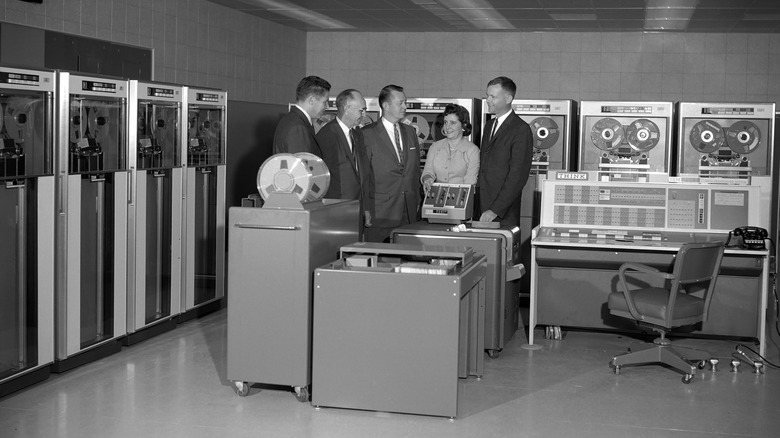
Two important pieces of technology from the space race that are used today are the solar cell and computers. Solar cells, as the name suggests, are used to draw power from the sun and use it as a form of power. IBM's massive guidance computer built for NASA led to the creation of the first silicon chips as we know them, which are used in computers, smartphones, consoles, and even cars today.
Solar panels are a common way to harness the sun's energy and convert it into electricity that can power your home, devices, and appliances. The semiconductor technology that powers them has been around since American inventor Charles Edgar Fritts engineered the first solar cell by applying gold leaf to selenium, although, in 1883, it wasn't powerful or practical to use in situations. It wasn't until 1940 at Bell Labs that Russell Ohl perfected the design that led to the first true silicon solar cell. Today, we can get solar panels for our homes and businesses.
Home computers, laptops, and smartphones are now readily available, but in the 1960s, they would have been science fiction. Powerful tech like the IBM guidance computer and MIT's involvement in designing the Apollo Guidance Computer helped launch the moon mission. The machinery from back then is now condensed down to fit into smaller, more personal computers. It had a processor and was able to make calculations faster than a human. Space exploration is challenging, but what was once science fiction of the '60s got some things right about space exploration.
Memory foam and wireless headsets
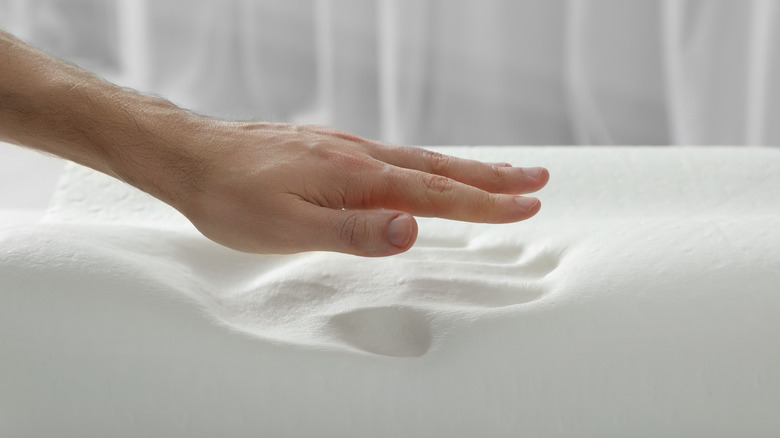
Two more technology marvels are a bit closer to home and are ones you may use on a daily basis. Memory foam used in pillows and mattresses was actually invented at NASA to help improve safety for its crew and astronauts. The late 1960s saw NASA engineers create a soft, absorbing material called memory foam to line the seats of planes. Also called temper foam, the material was designed in such a way that it conformed to the body when used. When the person would stand back up, the foam would revert back to its original shape. The foam was never fully used as seating for commercial planes, but did wind up in space shuttles, pillows, and mattresses.
The second piece of tech is the wireless headset, more commonly the one you see being worn on one ear with its stick mic pointed towards the mouth. To speak with astronauts and mission control, NASA needed headsets. Collaborating with Pacific Plantronics, the two companies created a new headset for astronauts based on its MS-50 design. This lightweight device was built in just 11 days and was installed inside helmets. They were the genesis for the wireless headsets you see today and ones used for gaming. In 1962, the U.S. put John Glenn in space as the first American to orbit Earth. It was a costly endeavor and one of the 10 most expensive space missions of all time.