

NASA Knows The Sun Isn't Yellow, But Still Calls It A 'Yellow' Dwarf - Here's Why
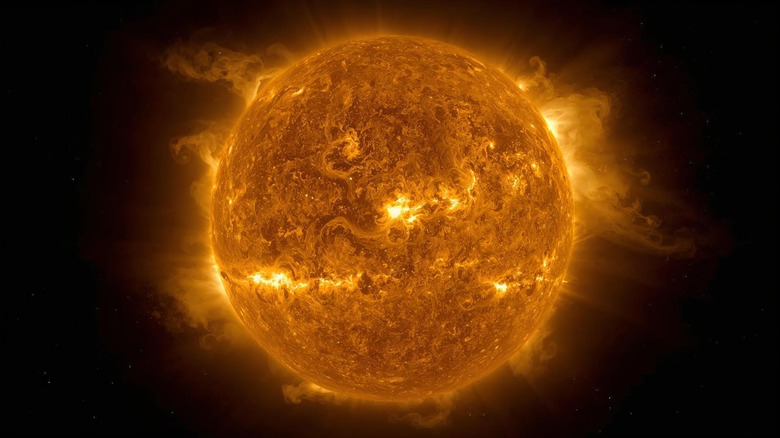
While you probably grew up drawing yellow suns, the star our solar system revolves around isn't actually the goldenrod Crayola hue we know and love. Though it's classified as a yellow dwarf, that refers to its spectral class and place in the Hertzsprung-Russell diagram rather than its color, though they are related. The chart plots stars according to temperature and luminosity in terms of temperature and brightness, patterns that help scientists understand and trace the life cycle of a star.
The Hertzsprung-Russell diagram uses the spectral sequence scale of O, B, A, F, G, K, M where O is the hottest and M is the coolest; hotter stars appear blue to the human eye, while cooler ones appear red or orange. Stars are also given a number between 0–9 based on their temperature compared to those within their type, with lower numbers indicating hotter stars. As for the "dwarf" part of its categorization, that refers to its size; since it's smaller than a giant, supergiant, or hypergiant, the sun is considered a dwarf star.
Our sun is a G2 star, meaning it's pretty hot compared to other yellow stars. Its visible spectrum peaks in the green portion of the spectrum, but since it also emits wavelengths across the spectrum, they blend together. That makes its actual color white, even if it doesn't look it from Earth.
Why the sun appears yellow
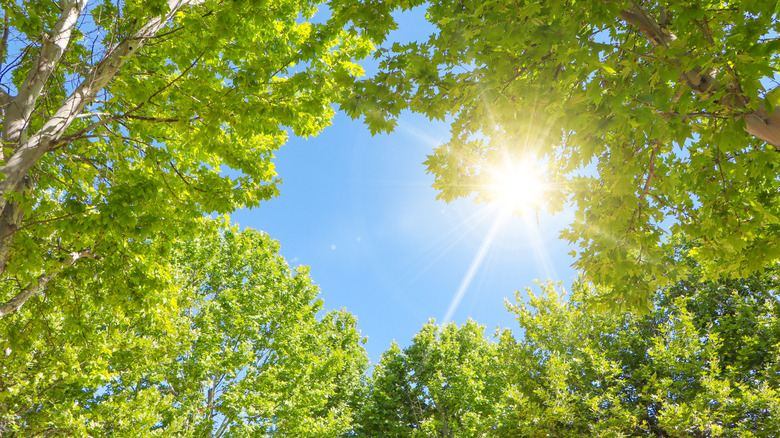
The sun appears yellow to the human eye for the same reasons why the sky is blue and sunsets are various shades of red, orange, and purple: Rayleigh scattering. This process impacts how electromagnetic waves are dispersed when they hit smaller particles, in this case, those found in the Earth's atmosphere. Shorter wavelength blue light scatter more effectively than longer wavelength ones, leaving the red and yellow sun we see.
Rayleigh scattering explains why the sun seems to change color throughout the day. When the atmosphere is thinner, like on a clear day, the sun appears yellow or white. , However, sunlight has to pass through a thicker layer of atmosphere during sunrise and sunset, causing more of the shorter wavelengths to scatter and leaving behind the vibrant colors we associate with dawn and dusk..
That's also why the sun and sky appear red, orange, or yellow when there's a lot of smoke or smog from things like burning fossil fuels and catastrophic wildfires. However, while Rayleigh scattering is still present, larger smoke particles also produce Mie scattering, which contributes to these dramatic colors. In addition to creating a dangerous amount of air pollution that affects most of the country, the particles emitted can give the sun and the sky an ominous look — and it's all because of the same Rayleigh scattering that creates beautiful sunrises and sunsets.