

Google's New Solar Farm Could Power Over 315,000 Homes — Here's How
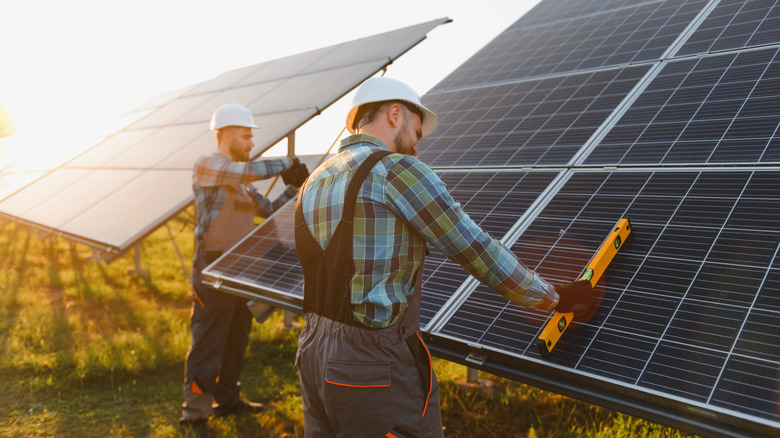
Big tech companies and data centers have growing demands for electrical power. Deloitte estimates that, by 2035, AI data centers will need 30 times more power (for a total of about 123 gigawatts, or GW) than they need now. With such demands for electricity on the horizon, it's not surprising to see big tech companies going all-in on nuclear energy and other means of generating electricity with an emphasis on clean energy generation. Tech giant Google recently took a major step forward in this area, announcing its partnership with Cypress Creek Energy to create the largest solar farm in the United States.
The Steel River Energy Center's solar farm will be in northeast Arkansas in Mississippi County. Upon completion of the project in 2029, it will generate 2.5 GWdc (or gigawatts of direct current) and 2.9 GWh (or gigawatt hours) of battery storage, which is enough annual power for 315,000 Arkansas homes. By matching large amounts of battery storage and solar panel power generation, the Steel River solar farm will be able to produce electricity whenever it's needed, day or night.
Google has signed an agreement to purchase 100% of the Steel River Energy Center's initial power generation, which may be used for its proposed data centers in the state. Google is seeking regulatory approval for a $1 billion data center near Little Rock, Arkansas, that was announced in early 2025. In West Memphis, Arkansas, Google began building a $4 billion data center that it announced in 2025.
Google continues investing in renewable energy for its needs
Google is exploring other avenues to expand the electricity available for its data centers. The company signed a mid-2026 agreement with Voltus to secure up to 100 MW of capacity through a virtual power plant agreement (VPPA), which uses technology to free up capacity in the existing local power grid for high-demand users. The Voltus agreement should free up electricity in the Midwest and Mid-Atlantic regions. Local customers who agree to allow some of their power capacity to go into the virtual power plant may receive payments from Voltus.
Google has made significant investments in wind-generated power throughout the world, too. In early 2026, Google announced an agreement with EnBW to purchase about 100 MW of power from an offshore wind farm in the North Sea near Germany. Additionally, the tech giant signed an agreement in 2025 with Renner Energies in Belgium to use power derived from six onshore wind farms for its regional Google data centers in Europe. In 2023, Google agreed to purchase 150 MW from Ørsted at a wind farm in Texas.
Additionally, Google purchased Intersect Power, which focuses on developing data center and energy generation assets, for $4.75 billion in 2026. Intersect will continue to operate as a separate entity and could give Google new ideas for obtaining power.
Other big tech companies are also investing in solar power
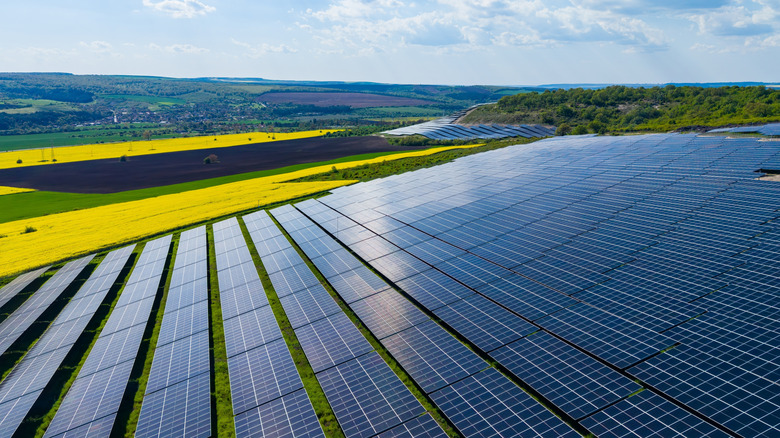
If the Steel River project gets completed as planned, it will be the largest solar generator in the United States. It represents Google's largest investment in solar generation and storage. Investments in these kinds of solar farms make sense for tech giants, as combining power generation, battery storage, and data centers in close proximity helps them overcome transmission problems that may occur with solar power generation.
The current largest solar farm in America that's in operation for both power generation and battery storage is the Edwards & Sanborn Solar + Energy Storage in the Mojave Desert in California. It has 875 MWdc of power generation and 3.287 GWh of battery storage. This project's power goes into the California Independent System Operator grid.
Other tech companies are making similar investments. Amazon purchased a 1.2 GW solar project in Oregon in early 2026 after the original owner went bankrupt. In mid-2025, Meta signed a contract to purchase 100% of the output of Enbridge's 600 MW solar farm in Texas, called Clear Fork. Additionally, Meta has partnered with Overview Energy for a project to develop space solar energy that could contribute up to 1 GW of power.