

China's Reusable Rocket Breakthrough Might Give SpaceX Some Serious Competition
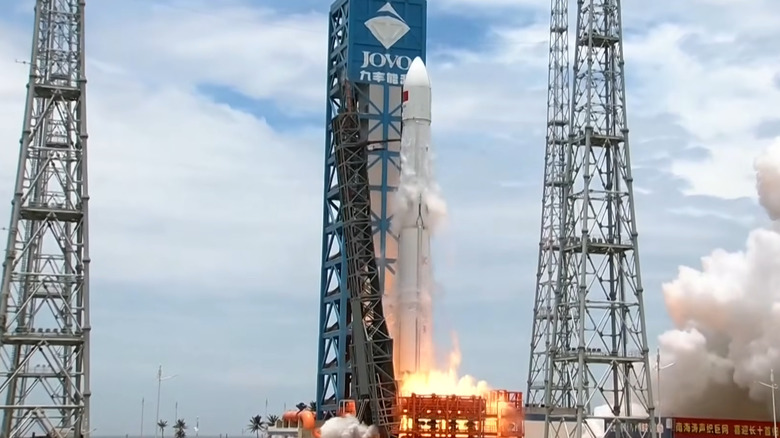
China Aerospace Science and Technology Corporation (CASC) has become only the third spaceflight entity in history to land a full-scale rocket booster on a recovery ship, accelerating China's race to match U.S. space technology. The Long March 10B made its maiden flight on July 10, launching from Hainan International Commercial Aerospace Launch Center in the Hainan Province of China, landing back on a specially designed barge off the coast. This successful maiden flight confirms that China is moving closer to matching U.S. spaceflight capability, with the Tiangong space station also seeing regular crew rotations and serious science experimentation.
This successful recovery of the Long March 10B is particularly significant, as CASC now becomes the first spaceflight entity to recover a booster using a barge on the very first attempt, which could indicate that China is operating on an accelerated development curve. The Long March 10B also launched a satellite into orbit as part of the maiden flight.
The Long March 10B is a 16.4-foot diameter rocket booster, based on the Long March 10A. This liquid-fueled rocket is powered by seven oxygen–kerosene engines, and is capable of delivering a reusable payload capacity of 17 tons to low-Earth orbit. This is less than SpaceX's Falcon 9, which can deliver about 25 tons to low-Earth orbit; however since this rocket is in its early stages of development, CASC is likely going to be able to increase that capacity over time.
Will China pose a threat to SpaceX's dominance?
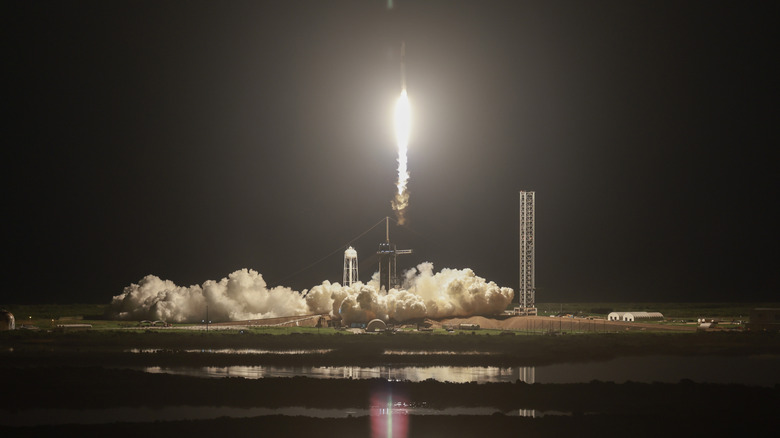
Given that this first test was so successful, it's easy to think that China is well on its way to disrupting the global commercial space industry. SpaceX has become a dominant player in this arena, with companies all around the world trusting the launch operator, which boasts a near-100% success rate over the course of more than 600 launches at the time of writing. The trust that SpaceX has built with its customer base was hard-earned, but helped along by highly competitive launch costs enabled by rocket reuse and the savings that come with high launch volume. But CASC has a long way to go before it can match SpaceX's reuse cadence.
With CASC being a government-owned enterprise, China could decide to subsidize launches to drive down the costs that commercial enterprises would be expected to pay to get payloads to orbit. This doesn't necessarily mean that China can directly compete with SpaceX though, even if CASC can nail reusability. The United States International Traffic in Arms Regulations prohibits any American-made satellites or even satellite parts from being launched on Chinese launch vehicles. This has essentially shut China out of the global satellite market, and could continue to do so unless China can establish a stronger foothold in the global satellite supply chain.
China has a growing list of space companies with reusable rockets like the Shanghai Academy of Spaceflight Technology, and private enterprises like LandSpace and Space Pioneer , which are all vying to break into the commercial space market.
China's unique landing system
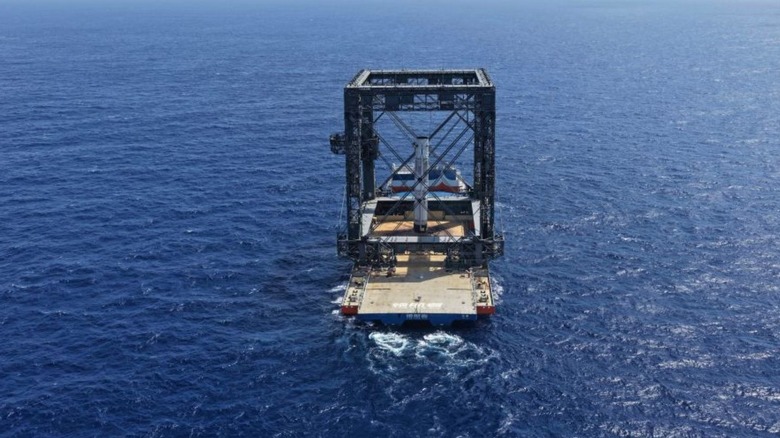
While the Long March 10B seen in this first flight works in a very similar fashion to that of SpaceX's Falcon 9, the recovery vessel, named Linghangzhe (Pathfinder), is unique in how it works. While both the SpaceX Falcon 9 and Blue Origin New Glenn rocket boosters deploy landing legs and land on a flat deck, the Long March 10B relies on a cable recovery system integrated into the landing barge.
The Linghangzhe has a large gantry-like structure with a ground arresting cable system that catches the rocket as it comes in to land and absorbs any remaining mechanical energy. The system works by moving two sets of perpendicular cable systems. The cables form a square center shape that moves along the horizontal axis of the barge and aligns itself with the approaching rocket by using a mixture of sensors and complex computational algorithms. The arresting cable system absorbs the impact of the landing rocket very much the same way that an aircraft carrier arresting cable system slows down landing fighter jets.
The cable system effectively removes the need to have shock-absorbent landing legs integrated on the rocket, which not only saves weight, but may improve reusability for future missions. The CASC team intends to refly the booster used in this recent test toward the end of this year.