

Robin Williams Had A Cameo In This Underappreciated Sci-Fi Movie
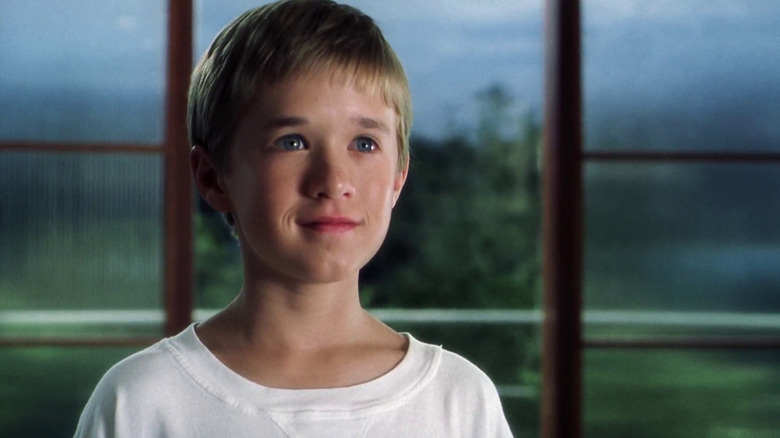
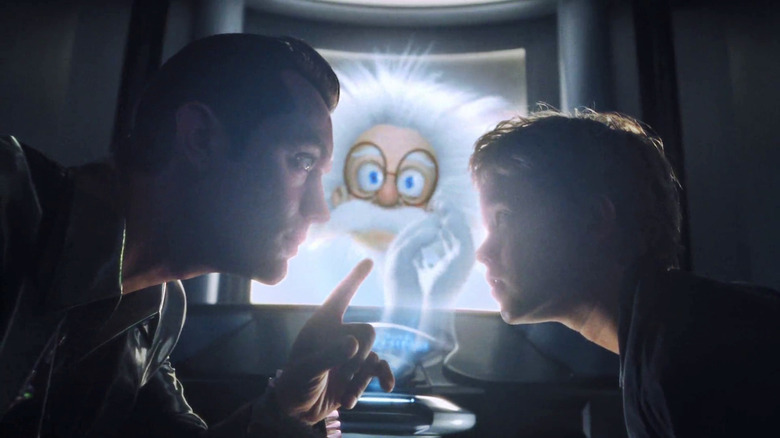
Steven Spielberg's 2001 "A.I. Artificial Intelligence" is one of the most divisive sci-fi flicks among his diehard fans — although it's one of the movies to watch after "Disclosure Day." It's usually viewed as inferior to the legendary director's lauded classics such as "Close Encounters of the Third Kind," "E.T.," or even "Minority Report." The film features a terrific cast that includes John Hurt, Jude Law, Brendan Gleeson, and even a short cameo by Robin Williams, who lends his voice to Mr. Know, an animated hologram playing a key role in the story's third act.
But "A.I" first and foremost belongs to the young Haley Joel Osment playing the android protagonist David, who provides the center of the story on every level. The plot follows him in the future as he becomes the surrogate child and pseudo-remedy to the married couple, Henry (Sam Robards) and Monica (Frances O'Connor), whose son Martin (Jake Thomas) is ill and in a medically induced coma. When Henry first brings David home, he tells her wife that he's the most developed Mecha (humanoid robot) of his kind, and if they agree to take him in, the only way to reverse that decision is by returning him to Cybertronics Corp, where he'll be terminated.
At first, Monica freaks out and questions Henry's intent with the Mecha, but as time passes, David grows on her, so she chooses to accept him and raise him as her son — until Martin recovers from his condition and turns everything upside down. Eventually, Monica abandons David in the woods with her supertoy Teddy (Jack Angel), where his quest to become a "real boy" in order to be truly loved by his mother begins and takes him on a poignant journey.
The fascinating symbiosis of human love and artificial programming
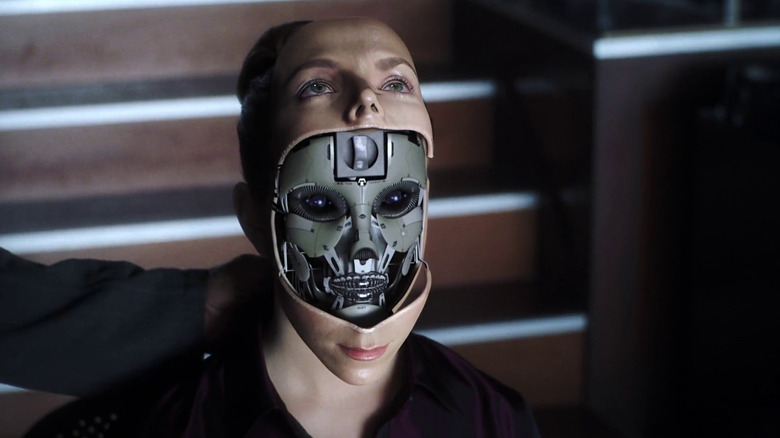
It's not an exaggeration to call "A.I" an emotional horror film of the highest order. Spielberg's familiar sentimentality is on full display here, but so is a much darker and inherently terrifying approach that's usually characteristic of the director's more grounded dramas like "Saving Private Ryan" or "Schindler's List." He combines wondrous emotional levity with a heavy and often uncomfortable milieu that keeps the audience in a constant limbo between real love and cold programming.
David can be both heart-meltingly sweet and alarmingly creepy — a range that Osment phenomenally exhibited at only 12 years old — due to his android nature, which at times makes it feel like "A.I." is just moments away from turning into a thriller like the terrifying "Ex-Machina" or "M3GAN." But this is not that kind of AI movie. Spielberg took a different and more complex route by turning David and other abandoned Mechas into relatable outcasts. The writer-director's most impressive achievement is ultimately making you root for the machines, giving you the very ability they long for yet cannot do: feel.
Depending on how you look at it, David's love for his human mother can feel relentless and suffocating as well as genuine and encompassing. But as the movie goes deeper into uncharted territories, you can't help but be reminded from time to time that the true emotions within this dystopia come from the humans. After all, David is a manifestation of his maker's, Professor Hobby (Hurt), grief and endless love for the son he lost — and whom David is based on. When the two meet again towards the end of the movie is when "A.I" hits its darkest and most surreal crescendo, revealing a disturbing God-complex that humans have over robots.
Despite Spielberg succumbing to sentimentality, A.I. is a fantastic piece of cinema
For the majority of its slightly bloated two and a half hour runtime, "A.I." isn't a hopeful, uplifting, or optimistic movie at all. It's a gloomy meditation on man vs. machine, filled with morally murky questions and disquieting scenarios where hope is nothing but a barely flickering light in a tunnel. So it's somewhat baffling that Spielberg can't restrain himself from launching into a 20-minute finale that attempts to mask that lingering sense of unease and melancholy seen before. He aims for a happier ending than the story would deserve (even if its main inspiration was the classic "Pinocchio"), bringing on an unnecessarily upbeat yet surreal finale (involving alien-looking entities, dream-like sequences, and the ultimate tear-jerking reunion between mother and child) that goes on too long and withholds concrete answers.
And the problem isn't that "A.I." lands on a rather opaque and open-ended conclusion, but the way it does it — when it had the opportunity to close off the story with David finally arriving at the destination he pursued since he was abandoned. Regardless of where you stand on the ending, it's hard not to be fascinated by Spielberg's wonder of a movie that's so masterfully done on every level.
Whether we're talking about Janusz Kaminski's immersive, pitch-perfect cinematography that treats nearly every frame as a painting, John Williams' gentle, ambient, yet at times unsettling score, or the impeccable performances led by a child actor who can command the screen with a single look. All in all, those are top-tier qualities (both collectively and individually) that they should've brought a lot more appreciation to "A.I." than they did back in the aughts (and perhaps ever since).