

Minnesota Solar Farms Are Having An Unexpected Effect On Local Insect Populations
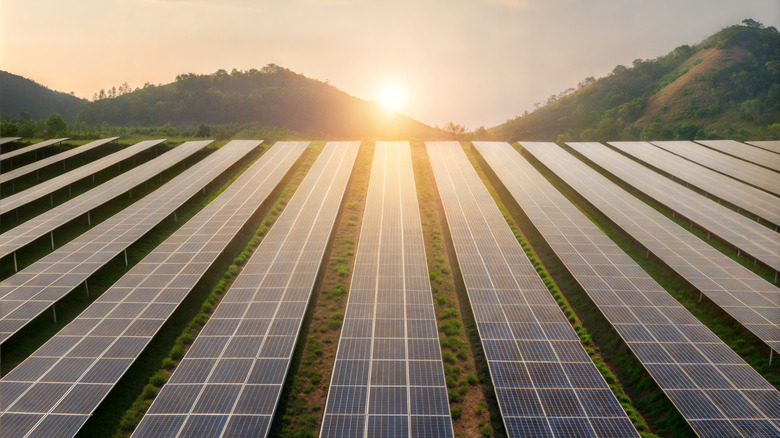
With news of AI data centers doing harm to local ecosystems, it's easy to have a knee-jerk reaction and think that everything humans construct is inherently damaging. After all, something as simple as a paved road demonstrably impedes the movement of wildlife species big and small, so it's not a stretch to believe that any man-made construction will inevitably cause damage to the environment. However, that doesn't seem to be the case with solar farms. Not giving off greenhouse emissions and requiring minimal water usage is brilliant in and of itself, but the fact that solar farms sometimes help endangered species is a proverbial cherry on top.
Believe it or not, if approached with just a tiny bit of care, a solar farm can both protect insect species in the area and help pollination. Researchers from Argonne National Laboratory closely studied two Minnesota solar farms, both of which were located on retired agricultural land and restored with native wildflowers and grasses. After five years of careful and consistent measurement, the research team confirmed significant growth in flowers and native plants, while beneficial insect species, including bees, butterflies, wasps, and hornets, also became more abundant. In fact, the critter numbers tripled, particularly benefiting the bees, which grew by 20-fold in number.
Why does this matter?
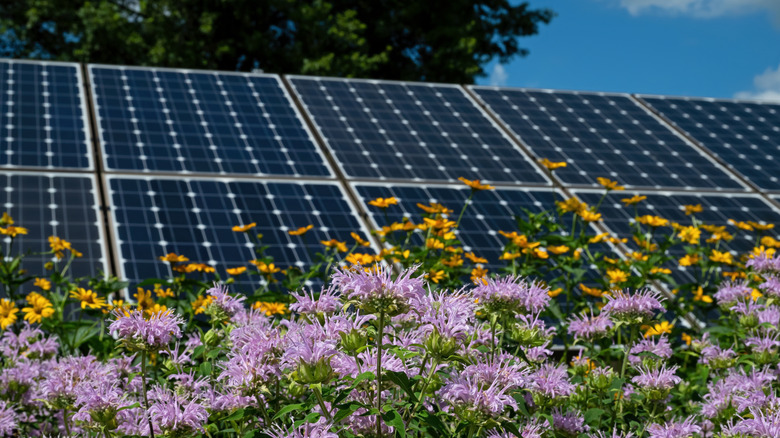
So, what made this finding a big deal? Addressing climate change head-on requires quite a lot of solar panels, meaning it also requires land. More precisely, optimal development of solar facilities (that can meet our environmental goals and grid demand) will require around 10 million acres of land. Of course, you don't want to disturb the wildlife or local ecosystems, so decommissioned agricultural fields are the perfect location for the brunt of the panels.
Revitalizing these lands by planting native flowers and grasses is thus a logical approach to supporting insect conservation at solar farms. All the while, the increase in insect population may provide a significant biome boost to nearby farmland. How? Researchers noted that insects that grazed on the plants at the solar farm eventually made their way to local farms and also pollinated those crops.
All things considered, this is just another piece of evidence that solar panels are actually saving lives. Sadly, insect populations are very much hit by the same perils as other species. You can blame climate change and pesticide use for this turn of events. However, the damage may be reversible, which absolutely matters as these critters are important cogs in the ecosystem. From pollination to boosting soil health, insects are our friends, and if solar farms brimming with native plants can help, why not offer a helping hand?