

The Two-Digit Code You Should Always Check On Outdoor TVs
We may receive a commission on purchases made from links.
It's not uncommon for devices like Bluetooth speakers to have an ingress protection rating. This is a two-digit code that starts with "IP," like IP55 for example, and one that should always be checked on outdoor TVs. The first number represents a product's dust and dirt resistance, measured on a scale between 1 and 6, and the second digit refers to liquid resistance, which is measured from 1 to 8. In both cases, higher numbers indicate higher resistance.
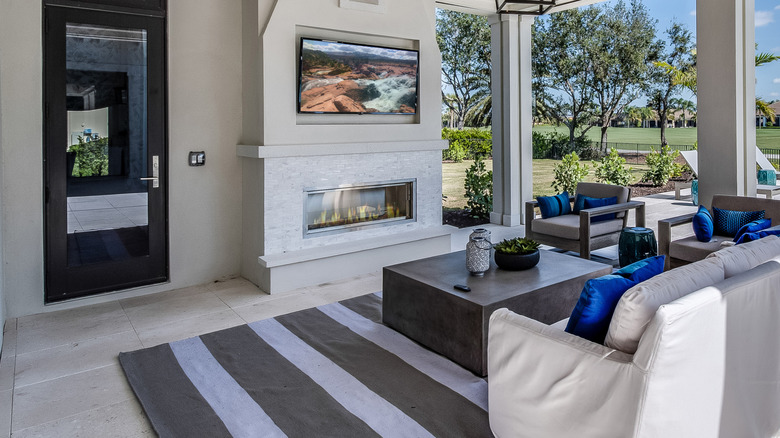
Finding an IP rating on, say, the best OLED TVs you can buy, however, is less common as they're generally not designed to be used outdoors. That said, TVs you should use outside will have IP ratings. If you're planning on mounting your outdoor set under some kind of cover, look for at least an IP56-rated TV. This ensures your outdoor screen can handle a dusty environment and that it's protected from powerful blasts of water.
Those of us living in rainy states like Florida and dusty environs like Arizona need more than just an IP-rated thumbs-up however; we need real-life insight. Like the Homeowners Reddit thread, where users say that Sylvox makes outdoor TVs that consistently stand up against wet, stormy summers in Texas. Home theater Redditors note that in dusty locales like Phoenix, Arizona, it's not so much the particle intrusion you need to worry about, but the constant fluctuations in temperature. This is where the importance of an IP rating comes into play.
Outdoor TVs are more expensive
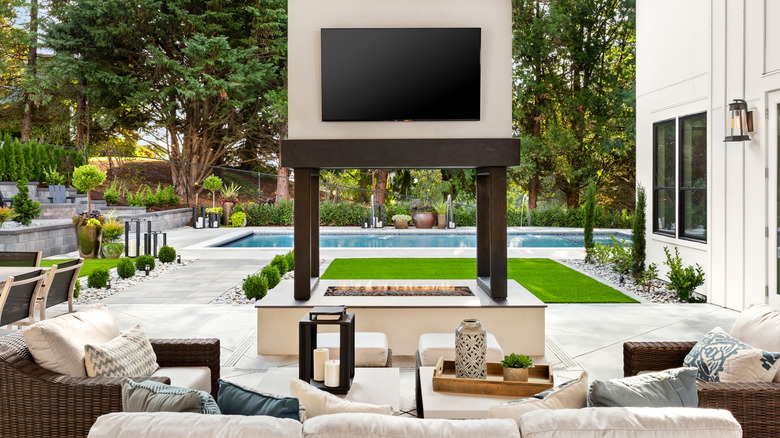
One drawback of buying an outdoor TV is how much more expensive they are than indoor sets. Sylvox, for example, makes a 65-inch outdoor TV (the Frameless Pro) that's IP56-rated and pushes up to 4K at 60Hz. That TV will run you $4,000, whereas a 65-inch OLED indoor set from Samsung lists for $2,700. If you're wondering whether any TV can be used outside, the short answer is yes, with the caveat that you don't want to do so permanently.
Non-outdoor TVs aren't protected from extreme temperatures, harsh sunlight, dirt, and water the same way an IP-rated TV is. So one bad storm or frigid night might be enough to kill your set. And while most indoor TVs use anti-glare coatings to combat ambient light, outdoors is where the sun really shines, so don't expect great clarity unless that indoor TV is in a perfectly light-controlled space.
At the end of the day, an outdoor TV can be a great investment. But there are already plenty of common mistakes you can make when buying a new TV. Don't give yourself the added headache of ruining a TV because you forgot to check that two-digit IP rating in the first place.