

Magnet Breakthrough In Europe Might Help Solve The Biggest Problem With Rocket Design
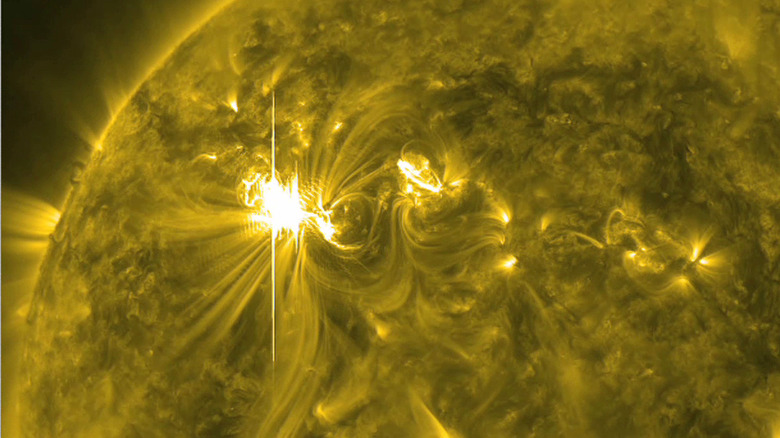
A team from Italy and Germany has made a breakthrough in research by demonstrating that permanent magnets could play a central role in how astronauts are protected against radiation when traveling through space. Radiation events like galactic cosmic rays and solar flares are among the most common dangers being addressed by researchers, and are an important consideration for current and future missions to deep space. The research team packed 1,482 neodymium-iron-boron permanent magnets, each measuring 1.6 square inches, into an 11-square-foot array that ended up weighing 661 pounds. The array deflected approximately 20% of solar particles in the 0.1 to 10 megaelectronvolts energy range. Even though the experiment showed that this solution could successfully deflect low-energy particles, high-energy particles were still able to penetrate the magnet's protection. While the concept doesn't deflect high-energy radiation, it could form part of a hybrid protection system to shield astronauts.
This is not the first time that researchers have looked into using magnets to act as a defense against radiation. Superconducting magnets that form a 1-tesla magnetic field around spacecraft have also been investigated, but have practical issues, needing cryogenic cooling and constant, fail-safe power sources to maintain protection. Providing these essentials on a spacecraft would be very challenging due to weight limitations and the likelihood of power interruptions.
The problem of how to protect astronauts against radiation is more topical than ever as humanity moves closer to exploring Mars, going farther into deep space than ever before. Spaceflight entities globally don't currently do enough to build radiation protection into the hulls of spacecraft, and research like this will break down feasibility boundaries that have existed since the Apollo era.
How do magnets deflect radiation?
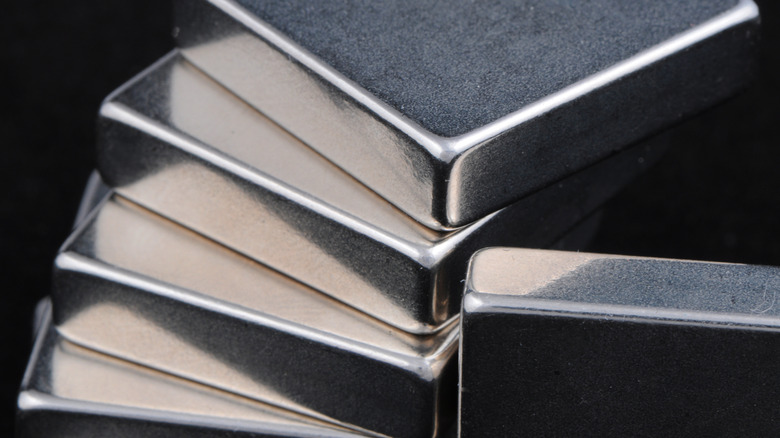
Radiation sources like cosmic rays mostly consist of protons that move at a high rate of speed. The force at play with the permanent magnets used in this test is known as the Lorentz force. This is a force that exists between a magnetic field and a moving charge. When a charged particle moves through the magnetic field, the Lorentz force acts upon the particle in a direction perpendicular to that of the magnetic field and the particle's trajectory. This alters the path of the charged particle, moving it away from the subject it aims to protect.
While this is a good solution in the context of a controlled test, teams will have to work out how to deploy the technology on a spacecraft. Cosmic rays don't originate from one single direction in deep space, and the magnets would therefore have to cover the entire hull of a spacecraft, or most of it. The directionality of the deflections would also have to be taken into consideration, as well as the effect of protons hitting the magnets, which could cause secondary radiation exposure.
Why radiation is such a problem in deep-space travel
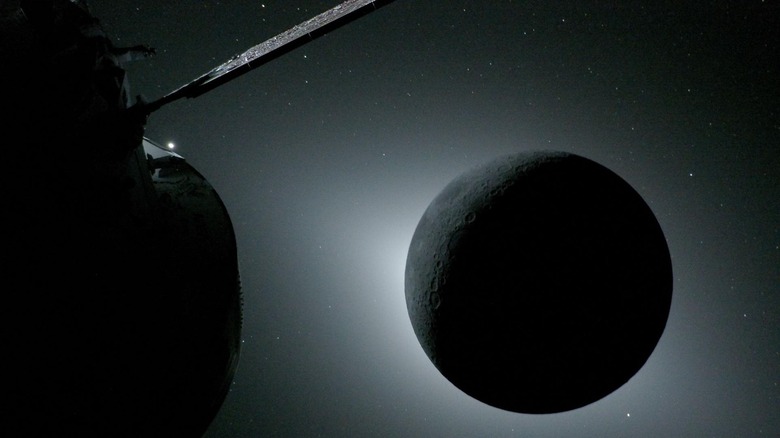
When leaving Earth on a deep-space mission, astronauts must travel through the high-radiation zone called the Van Allen belts, which are two rings of high-energy particles trapped by Earth's magnetic field. Astronauts would also be susceptible to other radiation sources like galactic cosmic rays and solar flares. Furthermore, the moon's surface is heavily radioactive, with levels about two to three times the amount seen on the ISS. To put this into perspective, astronauts who flew on the Apollo 14 mission experienced about 1.14 rads of radiation exposure during their mission, which is about double the dose experienced during an abdominal CT scan. This level of exposure is not considered to be that dangerous, but that's not the problem.
The problem is that only so many missions have been flown to deep space with astronauts on board, and while the radiation levels experienced were within safe limits, these missions did not see significant solar particle events. As humans explore deeper into space, a lot is still unknown about radiation exposure, and given the damage radiation can do to the body, protecting astronauts from it is still high on NASA's priority list.
In 1972, between the Apollo 16 and 17 missions, a solar eruption was documented that was later said to have been a near-miss for NASA, and had astronauts been in deep space or on the moon at the time, they would have experienced a fatal dose of radiation. Astronauts on the Artemis II mission only had one form of protection if a solar flare were to erupt while they were in deep space, and that involved building a fort around themselves consisting of cargo and supplies, and huddling within until the danger passed.