

The EU Just Confirmed A Major Downgrade For Samsung's Z Fold 8 Batteries

At its July 2026 Unpacked event, Samsung announced its latest smartphones and devices, including the Galaxy Z Fold 8, Galaxy Z Fold 8 Ultra, and Galaxy Z Flip 8. All of these devices sport the company's new silicon-carbon batteries, which, by and large, bring faster charging and higher capacity to the smartphones without adding extra bulk. While the arrival of silicon-carbon in Samsung's newest foldables is no doubt exciting, the news also comes with a downside, unfortunately — something that has now been confirmed by the European Product Registry for Energy Labelling (EPREL) database, which helps provide consumers with more energy-related information about the devices they use every day.
Based on the new labels provided by the EPREL, it appears that the Galaxy Z Fold 8, Z Fold 8 Ultra, and Z Flip 8 are all slated to follow in the Galaxy S26's footsteps by only offering a rating of 1,200 battery cycles (via Android Authority). This is substantially less than the 2,000 cycles that the Galaxy S25 series was rated for, and with the new phones moving to silicon-carbon batteries — something the S26 didn't take advantage of — it wouldn't be surprising for people to have questions about why Samsung downgraded the batteries in such a way. For some additional context, both the Galaxy Z Fold 7 and Z Flip 7 were rated for 2,000 cycles.
Understanding the downgrade
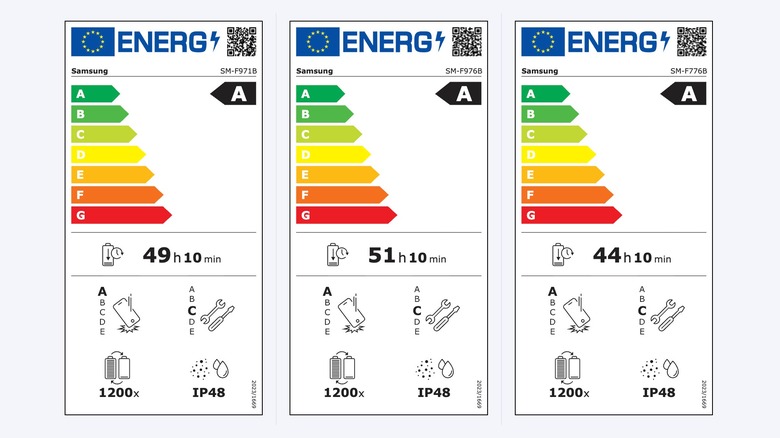
To fully understand the ramifications of this downgrade, though, you have to first understand how batteries in smartphones work. The endurance rating is essentially the number of charge cycles — each representing cumulative use and recharge equal to 100% of the battery's capacity — that a battery can undergo. In this case, it is the number of cycles the phone can sustain before its usable capacity falls to 80% of its rated capacity.
As has been noted in other reports, this particular downgrade is not wholly unexpected, especially after the S26 lineup suffered something similar. In fact, it could be argued that the downgrade makes even more sense in the Z Fold 8 and Z Flip 8, as the silicon-carbon batteries are expected to degrade faster than traditional lithium-ion batteries. This is one of the downsides to the new battery tech, as it can be more unstable, especially when compared with other options out there at the moment. However, considering the price of Samsung's latest foldables, it seems strange that the newer devices would be downgraded in a way that could actually make the older Z Fold 7 and Z Flip 7 more appealing to some.
Still a leg-up over the competition
While this news might sound disheartening from one perspective, it is also worth noting that the Galaxy Z Fold 8 and Z Flip 8 will still offer more charging cycles over the course of their lifetimes than the latest iPhone 17 or the latest Google Pixel 10. Both of those devices are only rated to offer 1,000 charging cycles of endurance before you have to worry about their capacity dropping. There is also the fact that the standards for how these energy labels are decided can change — though it is unclear if that has happened here. If any alterations have occurred, this could mean changes to the number of cycles that each battery is set to endure.
Ultimately, it's up to users themselves to decide if this is truly a downgrade. Considering the Z Fold 8 and Z Flip 8 should still see more than three years of daily charges from 0% to 100% before any of this becomes a factor, it's entirely possible that many users won't even notice a difference. But it is important to be aware of how your smartphone is changing, especially as prices continue to rise while manufacturers fight against the ongoing RAM shortages, as well as other supply chain changes that might affect manufacturing.