

The Power Symbol Is Everywhere On Tech, But What Does It Actually Mean?
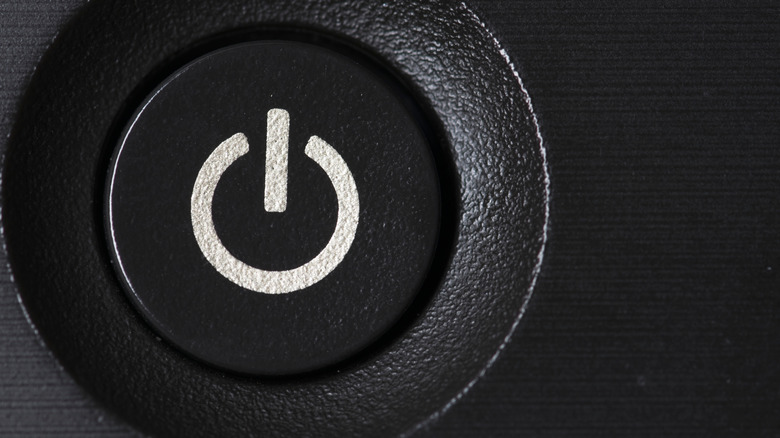
The universal symbol for power on electronics is ubiquitous. It's difficult to imagine a time when it didn't exist, because it's seemingly been around forever. But if you take a moment to look closer at it, as simple as it is — a circle with a line through it — there's really no indication of what the image actually is. What does it mean and where did it come from?
The symbol originated in the 1950s when power switches were used more often than buttons. A switch generally has an "on" and an "off" state. The issue with using those words, however, is that when you're dealing with international markets, language barriers can sometimes get in the way. Rather than use English phrases like on or off, it made more sense to use a logo or symbol everyone can understand. But that doesn't explain where the circle and line came from?
Computers rely on a basic language called binary code, written in 1s and 0s. In binary, 1 usually means "on" or "true," while 0 means "off" or "false." So, taking that definition and adapting it to a universal symbol, the power symbol becomes both a 1 and a 0. The result is what we have now: a circle with a vertical line through it, combining the two binary numbers. It also signifies that the power switch or button can control the system by both powering it up and down. It's a single button for both functions, and the symbol for it is language-agnostic. Power buttons are everywhere and on nearly everything now. There's even a button on portable power banks that's usually a power toggle.
The power symbol always means the same thing, but sometimes has other functions, too

Over the years, the power button has become the universal standard that everyone recognizes. Of course, as technology has advanced, becoming both more capable and more efficient, some of the power functions have changed. Initially, the power button was used to label a standby mode or low-power state rather than a complete shutdown or disconnection. Eventually, devices incorporated rest or sleep mode, a new form of standby with energy-saving functionality, which got its own symbol, a half moon or crescent logo. As a result, the power symbol earned its simplicity, becoming the default button for on or off.
Despite these changes, the power logo has always been associated with or symbolized the use of electricity in some way, whether to turn on a device or put a device into one of the various shutdown modes, resting or otherwise. For a long time, it has been the single most important button, switch, or function on an electronic device. And yet, with many of the latest devices, you don't even need a dedicated power button to shut down the system. You can restart your iPhone without even using the power button, and you can do the same with an Android device without touching the power button either. In fact, most devices incorporate a software-based shutdown function, including desktop PCs, the Steam Deck and handheld consoles, portable media players, and much, much more.