

What's The Difference Between Active And Passive Subwoofers?
We may receive a commission on purchases made from links.
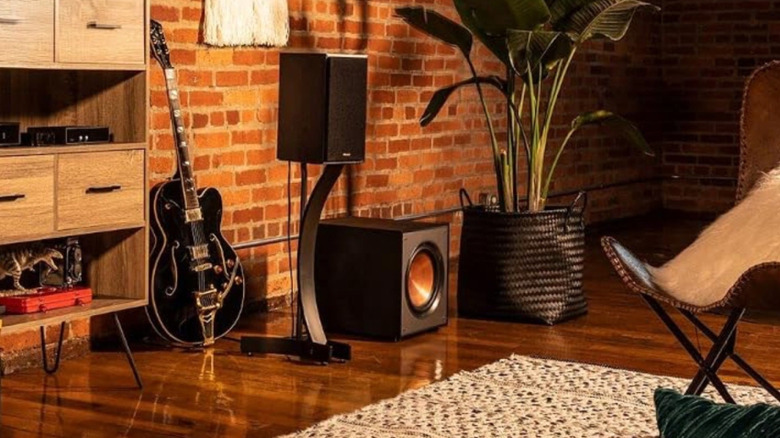
There's no denying how important a subwoofer is for your home theater system. It's the type of speaker purchase that could very well make your entire system sound better than ever before, especially when you take the time to pick the right one for your theater layout. But there are two main types of dedicated subwoofers on the market: active and passive. Understanding the differences between them is key, because investing in the wrong type could mean more headaches down the road.
Quite simply, it all boils down to amplification. An active subwoofer contains a built-in amplifier, so you just need to plug it into your AV receiver (AVR) for an audio signal and an AC outlet for power. Here's a quick trick: If you want to quickly confirm you're looking at an active woofer versus a passive unit, see if it comes with a power cord. If it does, you're looking at an active sub. A passive subwoofer, on the other hand, does not have a built-in amp. Instead, you're tasked with providing your own source of power, which means you'll be shopping for a dedicated sub amplifier.
Similar to an active woofer, a passive sub does feature an audio input, so you'll still be able to connect it to your AVR's subwoofer port (it's called an LFE output on most units). Now that you know the difference between the two woofer types, let's unpack why you may want to purchase one over the other.
Should you buy an active or passive subwoofer?
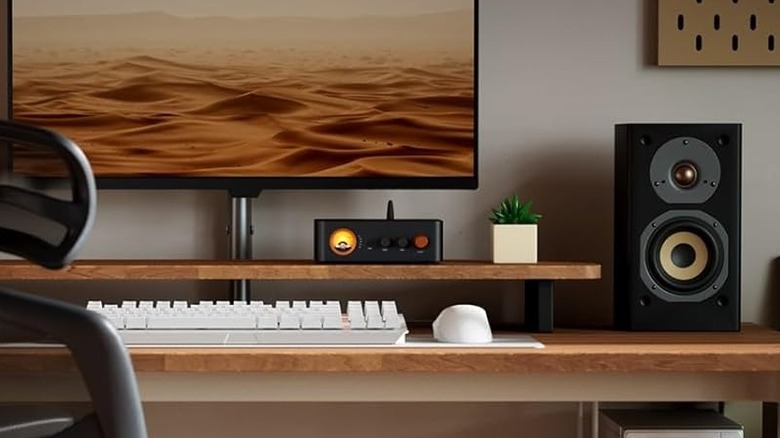
Building a home theater system can be an expensive undertaking, so one of the main benefits of an active subwoofer is that the shopping stops once you buy the unit — no heading over to Crutchfield to start pricing out external amplifiers. Yes, there are active subs that cost more than some premium TVs, but generally speaking, a solid active woofer should run somewhere between $150 and $600. Variables like actual woofer size, wattage, and onboard equalization (EQ) will ultimately determine the final price.
Since an active unit is self-contained, going the path of the passive subwoofer is objectively more expensive in most cases. While the woofers themselves are often similar to active subs in terms of pricing, you have to factor in the cost of an external amp. Budgetwise, you'll probably want to allot anywhere between $100 and $400 for this extra peripheral. That said, investing in your own woofer amp is an audiophile's dream come true, because you'll have more flexibility when it comes to settings like crossover frequency, phase, and other audio adjustments.
Both subs and external amps tend to come with audio cables, but some products don't. In that case, you may only need to purchase an LFE cable to line your woofer into your AVR or dedicated amp. Fortunately, subwoofer wires are a dime a dozen (not literally!) on sites like Amazon and Crutchfield. Oh, and here's a fun secret (our pals at r/audiophile gave us the idea): If you've got a random set of RCA cables hanging around — be it red/white, or red/white/yellow — you can just use these to connect your sub. At the end of the day, an LFE cable is just a glorified RCA lead.