

Repainted Los Angeles Streets Are Having A Big Effect On Local Heatwaves
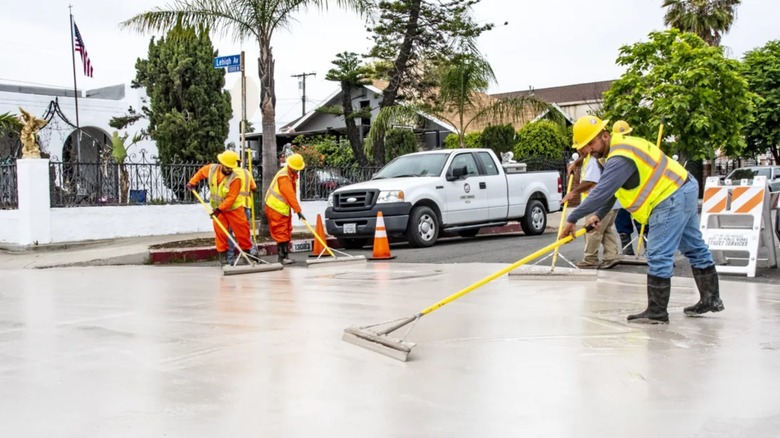
Summer heatwaves are unfortunately becoming the new normal, and people are desperate to beat the heat any way they can. In the U.S., citizens are using emergency energy backups. Meanwhile, China is utilizing rooftop rain to cool areas by up to 14 degrees Fahrenheit. However, another solution might reside in streets and a branch of physics known as thermodynamics. For the past several years, Los Angeles has been painting pavements with a special "solar-reflective coating" that reflects infrared light, thus keeping heat absorption to a minimum. The project began in 2017, but the city only started installing "cool pavement," as it's called, in 2021.
While streets have been the main recipients, the bureau behind the project, StreetsLA, hasn't ignored other popular and oft-frequented locations that rely on pavement, including parking lots and basketball courts. Since cool pavement reflects infrared radiation, one might assume that the name is ironic and it would have the opposite effect, but the science behind cool pavement states that the process cools ambient temperatures between 1.5 and 3.5 degrees, depending on the heat.
In 2024, a study on the effects of cool pavement in Pacoima, California, was published in Environmental Research Communications with results showing that the air above the pavement was anywhere between 0.12 and 1.21 degrees Celsius cooler (0.22 to 2.18 degrees Fahrenheit) during regular sunny, non-heatwave days. And those weren't the only benefits. The study also showed that cool pavement made surrounding areas warm up more slowly and cool down faster.
Could cool pavement work in other cities?
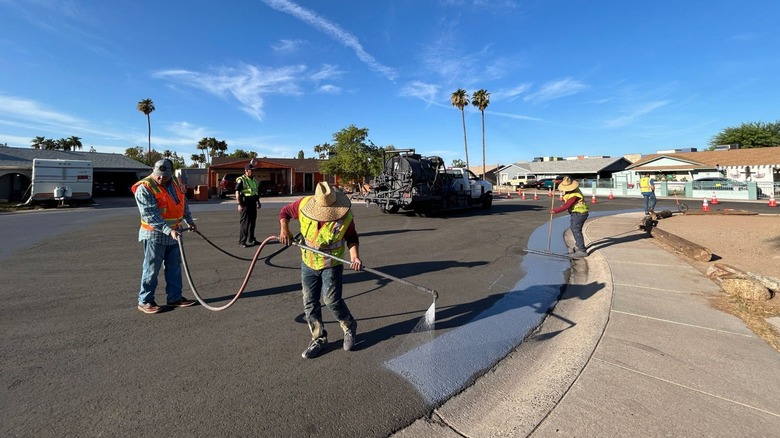
It makes one think that since cool pavement seems to work in Los Angeles, could it work in New York City? What about Seattle or Chicago? Presumably yes. Cities would have to install them first to find out, but it would probably work because these cities are what are known as "heat islands." The term "heat island" doesn't refer to actual literal islands but to general locations that exhibit "pockets of heat" which exceed those of nearby suburban and rural areas. Heat islands are generally cities and other urban environments where heat tends to reflect off manmade structures more easily than they do trees and rivers. And yes, that includes roads, which is where cool pavement comes into play.
Thanks to the "heat island effect," cities are anywhere between one to seven degrees Fahrenheit hotter than the surrounding areas, and this effect is only exacerbated in humid regions and cities with a glut of tall buildings and narrow streets. Going by the study, installing cool pavement in these areas could help cool both in terms of actual temperature and the rate of temperature change. But we won't know the true scope of the benefits until other cities join the project.