

Is An iPhone Actually More Powerful Than NASA's Apollo 11 Computers?
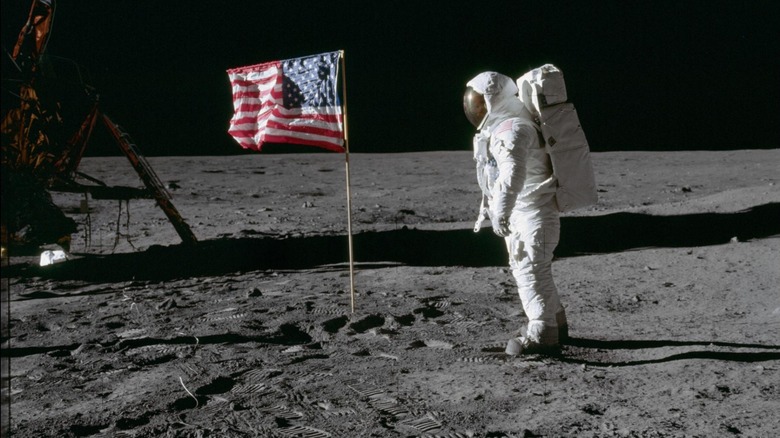
Technology is improving at an almost exponential rate. Yes, this progress can come at a cost (Amazon's data centers produce more emissions than some countries), but the pure processing power of modern devices puts the capabilities of older tech to shame. When people say your phone is more powerful than the computers that put astronauts on the moon, they aren't blowing smoke out of a rocket's exhaust.
Looking at the math, each Apollo command module housed an Apollo Guidance Computer (AGC). According to MIT's (link will download a PDF onto your device) documentation, each AGC contained 2,048 words of erasable memory (RAM). A "word" is an odd unit of measurement, but each word consisted of 16 binary bits, which means an AGC had 32,768 bits of RAM (or 4,096 bytes). Comparatively, the iPhone 17 Pro has 12GB of RAM (12 x 109 bytes), which is 2,928,257.69 times as many bytes as the AGC.
Of course, RAM alone makes for a poor computer; each AGC also utilized a processing unit and Read-Only Memory (ROM) – non-rewriteable data that tells a computer how to perform key functions such as start up. The CPU had a processing speed of 2.048 MHz, although some sources claim its effective speed was closer to 0.043 MHz, while the ROM housed 72KB of data. Comparatively, the CPU of the iPhone 17 Pro operates at speeds anywhere between 850 and 2,100 MHz, and while it doesn't have ROM in the traditional sense, the phone can store up to 1TB of data. Even if you pooled the processing and storage power of every AGC into a single unit, it wouldn't come close to a modern smartphone's capabilities.
Apples and Oranges

So that's it. Modern iPhones are exponentially more powerful than NASA's Apollo 11 computers. Then again, even the calculators that you use in math class outclass the AGC modules. So what would happen if rocket scientists harnessed the power of a phone and put it in a rocket ship? It would probably be a downgrade.
While the AGC has nothing on modern smartphones, especially the iPhone 17 Pro, the Apollo 11 command module's computer was state-of-the-art for the late 1960s. Conversely, smartphones are downright anemic compared to most modern computers. Just look at SpaceX's Falcon 9. While most of its computer specs are under wraps, the ships allegedly use dual-core x86 processors. Assuming SpaceX buys modern chips, the spaceship would use a processor that runs at around 4.10 GHz at the bare minimum. That's already double what an iPhone 17 Pro can muster.
Technology has advanced so much that the next time we go to the moon, astronauts might not need one of the most powerful computers on Earth (well, orbiting Earth) to land on the lunar surface. NASA could just get away with a setup similar to the hardware that powers China's food delivery drone fleet. Right now, the general public should worry less about what computers rocket scientists use in rocket ships and more about how to reach the moon safely; given that SpaceX's Starships have exploded so many times, they've clearly lost step a little.