

Looking To Get A Matte Screen Protector For Your Phone? Try This Instead

We may receive a commission on purchases made from links.
If you're spending any amount of time outdoors or in bright environments, you may find it hard to see your phone's display, or your tablet's if you're using that instead. A cheap and easy way to deal with this is to apply a matte screen protector, which also protects your phone's display from debris and other nasty elements. A matte protector, compared to a glossy one, offers unique benefits, such as better fingerprint and smudge resistance and improved visibility in sunlight. However, there are trade-offs to consider, as the matte design can affect the colors, sharpness, and brightness of those displays, making them look less vibrant in some ways. If you prefer the clear look but want the reflective properties, AR protectors are an excellent alternative.
AR protectors work differently because, unlike matte protectors, they don't use a textured surface, which is what changes visibility in the latter. By design, an AR film — a nano-scale optical coating — is applied to glass, incorporating polarized anti-reflective properties while still retaining a smooth, glassy surface. Some of the best anti-reflective screen protectors for iPhone 17, for example, are inherently engineered this way. AR protectors also keep the screen free and clear, allowing the display's high brightness or bright colors to shine through more accurately.
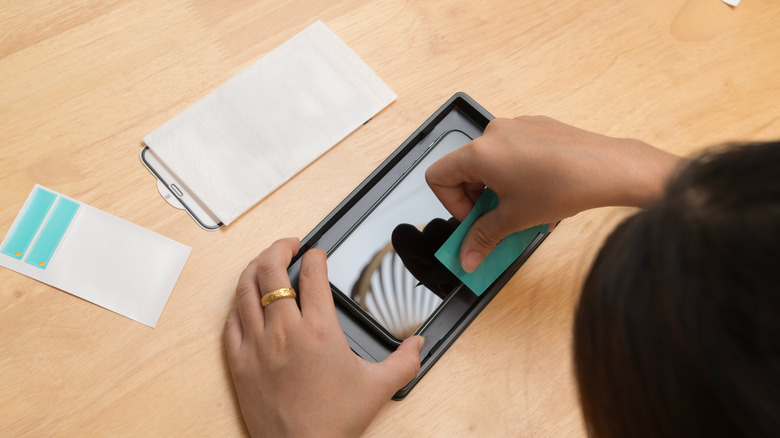
Because they are glass rather than film, they can be slightly more expensive. For a quick comparison, the JETech matte screen protector for the Samsung Galaxy S26 Ultra is $13 at full price on Amazon, while the JETech AR screen protector is $20 for the same model. That said, they're both applied the same way to the device screen.
Breaking down why anti-reflective might be preferable
Let's make one point clear. Neither protector type is better than the other. Regarding durability, both AR and matte protectors are tough, and you can find reinforced options in both formats, such as JETech's 9H-hardness protectors already mentioned. Just keep in mind any screen protector can break under the right circumstances. Even the most expensive screen protectors on the market are vulnerable, but that's how they save your phone; they take the brunt of a blow or drop.
When considering matte versus AR, you should also understand each type has pros and cons. AR protective coatings can wear over time like any optical coating, and on a darker surface, fingerprints can still appear, meaning AR protectors can get just as dirty at times. They're also glossy, so if you don't like that, you'll be unhappy with them. There are even disadvantages to applying privacy screen protectors, which reveals there are always cons to consider.
Choosing a protector really comes down to a matter of preference. Just like how matte is not for everyone, neither is the AR format. If you spend a lot of time outdoors or dealing with direct glare, AR is a big help. If you want true clarity, AR is the right choice. Finally, if your phone already has an AR coating, like the iPhone 17, and you don't want to lose the advantages of that, going with a similar protector is best. However, if you don't mind the textured, slightly foggy look or prefer softer visuals, you should opt for matte.