

These Tiny Bubbles Could Have A Massive Effect On The Future Of Inkjet Printing
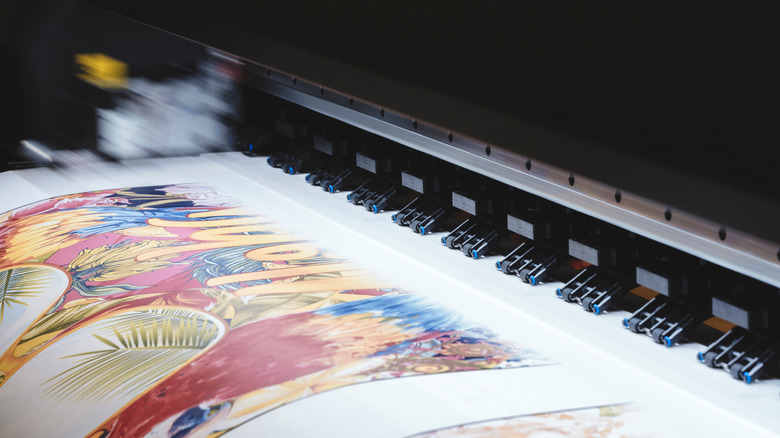
We're living in an era when a complete catalogue of humanity's knowledge is available from a mini computer in our pockets, but somehow, we can't get printers right. Home printers are notoriously bad, and even if you go for affordable inkjets that won't eat through ink after a dozen uses, they simply leave too much to be desired and will still put a dent in your wallet. Taking all this into consideration, you may believe that an inkjet printer is a piece of tech stuck in the past. However, Japanese researchers might have cracked the puzzle that will inject (pun intended) new life into these seemingly archaic devices.
According to ScienceDaily, research from Tokyo Metropolitan University has found a new way to affect the ink's drying process. Traditionally, this was achieved with chemical additives, but the new method involves adding tiny bubbles to ink. How does that help? Fine-tuning the number of bubbles in individual droplets of ink can significantly change the pattern that occurs after the liquid evaporates — all without leaving behind chemical residue.
Though it's uncertain how manufacturers will implement the technology in the commercial sense (or if they ever will), the finding doesn't have much to do with printing traditional A4 documents. Rather, it may make microelectromechanical systems (or MEMS for short) and microelectronics much more precise. Gyrometers in smartphones, for instance, use these types of printed circuit patterns and microscopic coatings.
How big of a deal are these bubbles?
An inkjet printer in your home may jam like it means business, but more refined versions are put to good use in printing passive electrical or even optical microparts. For example, the aforementioned MEMS are tiny microsensors that convert mechanical inputs into electrical outputs or vice versa. Naturally, accuracy is the bread and butter here, so when you zoom in to microscopic levels, small particles can form uneven patterns when the ink dries — a no-no, as it leads to a lopsided coating.
Until now, the solution was adding chemicals. Even if they made for a more precise coating, the additives would routinely leave residue that could affect the print and, in turn, change how these microparts operate. What the research found is that introducing nanoscale bubbles to the ink provides more control over the printed pattern. First, the researchers suspended tiny silica particles in water. They then fed the water through a bubble generator with an inkjet nozzle, and, finally, they shot a tiny droplet (measuring 1 nanoliter) onto a silicon substrate. After letting their masterpiece dry, the results showed that the coating was uniform and that the number of bubbles can be adjusted for different coatings.
Of course, this is mostly limited to manufacturing microdevices and may never enter the realm of consumer products. So, there is a strong chance that these microscopic bubbles won't do much to reverse the decline of home printers. It truly feels like a cosmic joke: Machines out there can print complex schematics on a microlevel, and researchers are injecting micro bubbles into ink. Meanwhile, most consumer printers are making everyone's lives miserable with their psychic ability to jam up when you're having a bad day.