

Which Nvidia GPU Is Equivalent To The Nintendo Switch 2?
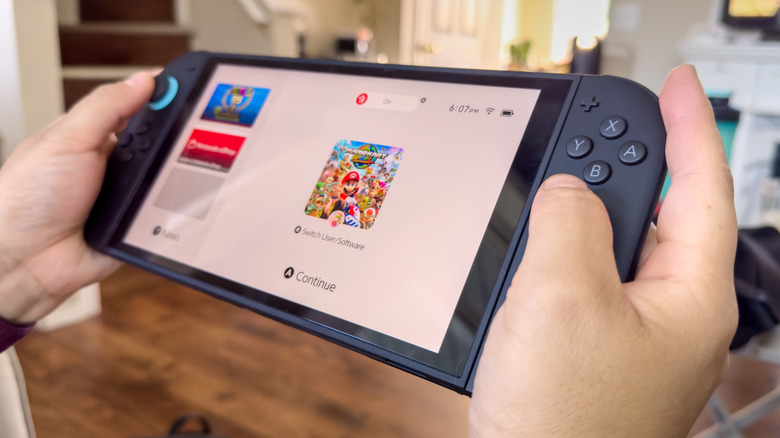
When Nintendo finally revealed the Switch 2's full specifications, the big headline wasn't the 4K output or the new Joy-Con 2. It was the GPU. The custom Nvidia chip inside the console is based on the company's Ampere architecture, the same generation that powers the RTX 30 series, and roughly matches the performance of a mobile RTX 2050. If you wanted a computer setup that matched the Nintendo Switch 2's performance, it would land somewhere around an underclocked RTX 2050 or a low-end desktop card from a few years back, with the Switch 2's clock speeds far lower than anything these desktop and laptop parts run at.
The Switch 2's SoC packs 1,536 CUDA cores and eight Arm Cortex A78C CPU cores, paired with 12GB of LPDDR5X memory, of which 9GB is available to games, plus 256GB of internal storage. The GPU itself is rated to hit 1,400 MHz in portable mode and 1,007 MHz when docked, but actually runs at 561 MHz and 1,007 MHz, respectively. That's a deliberate trade-off to keep the handheld cool and battery-friendly, and it means raw numbers only tell part of the story. The console launched on June 5, 2025, for $449 and is a major upgrade over the original Switch, which topped out at 1080p docked and 720p handheld. Switch 2 can hit 4K HDR and 120fps when docked, so the hardware gap to its predecessor is enormous.
The Switch 2's GPU is essentially a downclocked mobile RTX 2050
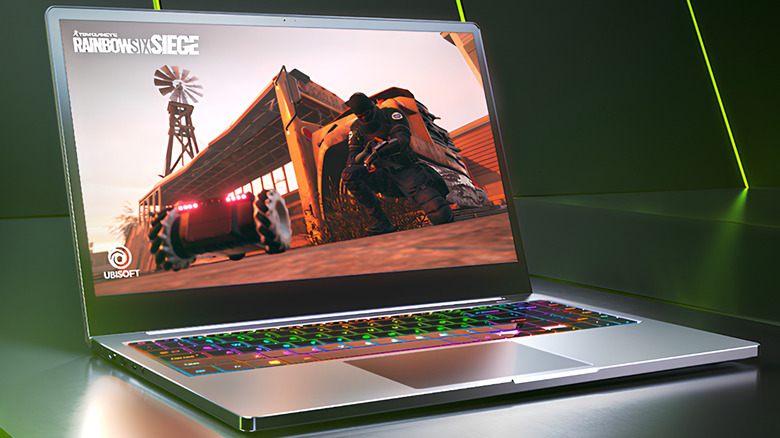
The closest Nvidia comparison is the RTX 2050 mobile, which is also built on Ampere. The Switch 2's GPU has 1,536 CUDA cores versus 2,048 on the laptop part, so it's a notably cut-down version of an already entry-level chip. It also shares DNA with the RTX 3050 laptop GPU, but the 2050 is a better match as both use the same architecture and sit at the same low end of Nvidia's lineup. What really separates the console from a real laptop chip is clock speed and memory bandwidth. The mobile RTX 2050 runs far hotter and faster, while the Switch 2's docked mode delivers around 102 GB/s of bandwidth and portable mode drops to around 68 GB/s.
Being on Ampere does bring one meaningful modern perk: real-time ray tracing and DLSS support. Nintendo hasn't announced any ray-traced titles, but several games rely on DLSS to boost performance, including "Cyberpunk 2077," which uses variable resolution scaling. That's the clever part of the design. The hardware is modest on paper, but upscaling lets it punch above its weight. In practice, owners shouldn't expect desktop-class frame rates, and games like "Cyberpunk 2077" will still run as scaled-down ports, which is why it helps to know what not to do with the console when trying to get the most out of it.
Switch 2 matches a low-end PC GPU from around 2021
So which GPU is equivalent to a Switch 2 in real-world terms? Think of an RTX 2050 laptop with the clocks turned right down, or a desktop card from the GTX 1650 era. That's roughly the raw performance band the console occupies when docked, and it's meaningfully weaker in handheld mode. The reason it still plays modern games at all is the combination of Ampere's upscaling tricks, aggressive settings cuts, and the fact that developers optimize heavily for a single fixed piece of hardware. A PC user would never buy a 1,536-core Ampere chip running below 1 GHz, but inside a hybrid console it's a clever fit.
That modest target is exactly why the Switch 2 has been such a strong seller, moving over 17 million units by the end of 2025. It doesn't try to compete with the PlayStation 5 or Xbox Series X in terms of horsepower, and it doesn't need to. What matters is it delivers a comparable handheld experience with modern features like ray tracing and DLSS on tap, something no rival handheld can claim right now. The GPU equivalent is unglamorous on paper, but it's the right tool for the job.