

It's Time To Stop Believing This Outdated Solar Power Myth
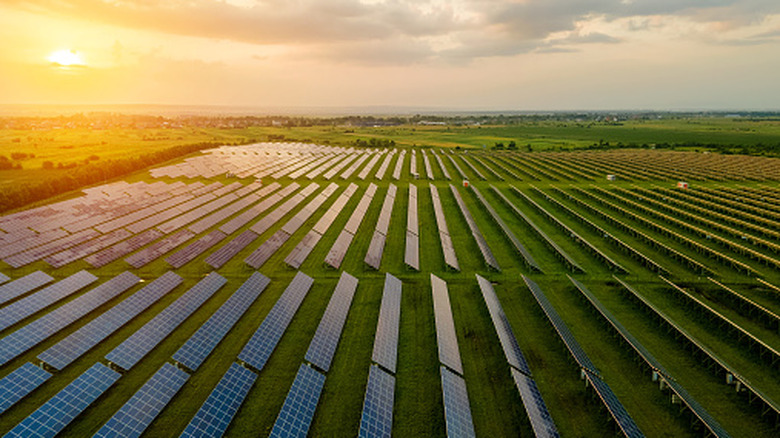
The human race has, unfortunately, pushed the pedal to the metal on climate change. And it's only getting worse, as the rate of climate change has doubled since the '70s. While it's still not too late to change course, renewable energy projects are not without opposition. Both wind and solar energy have progressed so much that they're cost-effective at scale. In the past, it was believed that achieving fiscal efficiency was enough to kickstart the process of constructing new facilities, but this didn't happen, in part because of value-based reasons and in part due to outdated myths.
There are countless innovations that make solar panels even more reliable than they already are. Yet, go through a few online forums, and you'll see that a lot of people still believe solar energy simply isn't enough to provide power during nighttime and periods of no sunlight. Put differently, the myth that a solar plant needs a 100% fossil fuel backup, while true in the past, is severely outdated by today's standards.
It's not just a bunch of tree huggers pushing the praise. The Department of Energy has outright confirmed that when combined with other renewable sources, using sodium-ion batteries and storing excess energy makes solar energy perfectly reliable — all without requiring fossil fuel backup power. According to the agency's studies, California is a prime example of this. In addition to dropping its natural gas dependency from 60% to 36%, by 2025, solar power accounted for 27% of its in-state electricity production.
Can renewable energy reliably power cities?

Is this theoretical, though? After all, 27% doesn't cover the entire state, so how can we know that ditching fossil fuels will be feasible? Well, believe it or not, you don't need to look far before the myth about solar power not being effective is decimated. Just 4,000 miles from the mainland (American Samoa, to be precise), there's a small island called Ta'u where a solar-powered microgrid produces all the power that nearly 900 residents need. With 1.4 MW at its disposal, the microgrid also relies on 60 Tesla-made power packs for six megawatt-hours of backup power.
That's just one small island, which makes the Masdar City community in Abu Dhabi an even better real-world case study. With 4,000 residents (expected to grow to 50,000), just one of its buildings, the Masdar City's Eco Villa, uses 87 rooftop solar panels to produce 40,000 kWh of electricity in one year, with excess rerouted into the local power grid. Granted, Masdar City still draws a small amount from the national grid, but in total, its 11 MW produced through solar energy alone dropped 16,000 tons of annual carbon emissions.
All in all, the myth of solar power being subpar is effectively erased both theoretically and in practice. Still, it may take years for the powers that be (excuse the pun) to recognize the urgency of the matter and finally take a dive into renewable energy projects. Until then, solar panels will only get better. Even at this very moment, solar energy isn't as effective as it could be because it's bogged down by fossil fuels and air pollution, so making a gradual switch would start killing two birds with one stone, so to speak.