

5 Everyday Gadgets More Powerful Than NASA's Apollo 11's Computers

With NASA and astronauts turning their focus to landing on the Moon again by early 2028 in the Artemis program, people are once again showing an appreciation for what NASA accomplished by landing successfully on the Moon in 1969. The technology that the Apollo 11 spacecraft used in 1969 was cutting edge in how NASA's engineers combined multiple components to work together. However, compared to today's consumer technology gear, Apollo 11 was operating at a distinct disadvantage in speed and power.
Even though the 1960s space race influenced the development of today's technology, almost any modern tech product offers significantly more processing power and computer memory than what was available throughout the Apollo 11 spacecraft. Some of today's gadgets that offer more power than what the Apollo 11 astronauts had at their disposal include digital calculators, smart lightbulbs, car infotainment systems, smartphones, and smartwatches. (Some modern musical greeting cards may even have more processing power.)
When discussing the computing power in the Apollo 11 spacecraft, people are referring to the Apollo Guidance Computer (AGC). It generated real-time navigation calculations, creating these calculations more accurately and far faster than the human astronauts could do. NASA had more powerful ground-based computer systems in its Mission Control Center (MCC), but the lag in radio communications of a few seconds was too great, meaning the navigation calculations needed to occur on board. The need to limit the AGC's weight for a successful liftoff also limited the computing hardware it could contain.
The graphing calculator you had in school had far more power
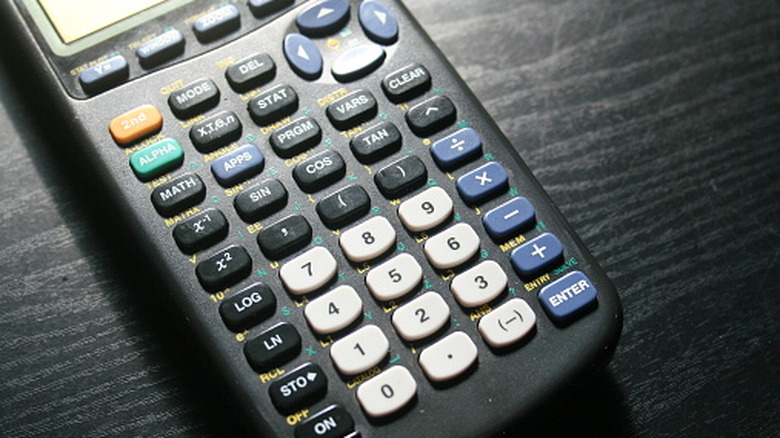
During high school math and introductory college courses, you may have used a Texas Instruments TI-84 graphing calculator. It's a popular model for helping students make a variety of calculations during testing. With many classrooms prohibiting use of the internet and smartphones during testing, students continue to use the TI-84 today, despite complaints over the cost. Since the TI-84 initially went on sale in 2004, its basic hardware components and specifications have remained the same. Still, it has significantly more processing power than the Apollo 11 AGC, as some estimates say the TI-84's processing speed operates about 350 times faster than the AGC could manage.
The Apollo 11 computer had the equivalent of 4KB of RAM (which is random access memory that loses its data when the computer loses power). The AGC had 72KB of ROM (which is read-only memory that stores data permanently). The code stored in ROM was written before the astronauts blasted off, and they could not change it. The TI-84 graphing calculator has 149KB of RAM and 3MB of ROM (or 3,072KB), both of which are significantly larger than Apollo 11 had available.
A smart light bulb has more processing speed than Apollo 11
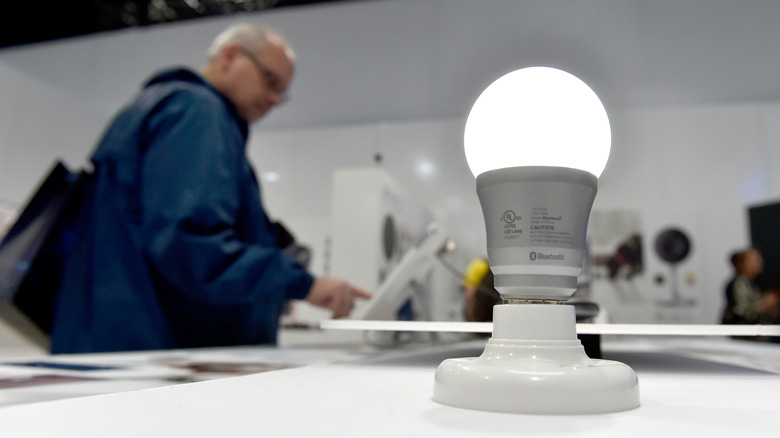
The first smart lighting products appeared in the late 1990s, but smart LEDs with a modern design appeared in the 2010s, offering remote control through a mobile companion app. Smart light bulbs usually require a processor inside to manage the signals they receives from the app and through your home's wireless network. The processor also manages any power schedules you've set up for the bulb's automatic operation, the changing of lighting intensity and colors, and measuring the energy being used.
In listing their product specifications, smart light bulb manufacturers generally focus more on the light output in lumens, the light's temperature range, and the energy savings available than on the processing power they offer. However, Vimpo, a popular hardware hacker, took a smart light bulb apart and used it to install a "Minecraft" game server. The tinkerer, who made a YouTube video of the process, reported that the light bulb had 276KB of RAM, 128KB of ROM, and a processor that operates at 192 MHz. In addition to having far smaller amounts of RAM and ROM than the smart light bulb, the Apollo 11 AGC's processor only operated at an equivalent speed of 0.043 MHz.
Your car's infotainment system is becoming a memory hog
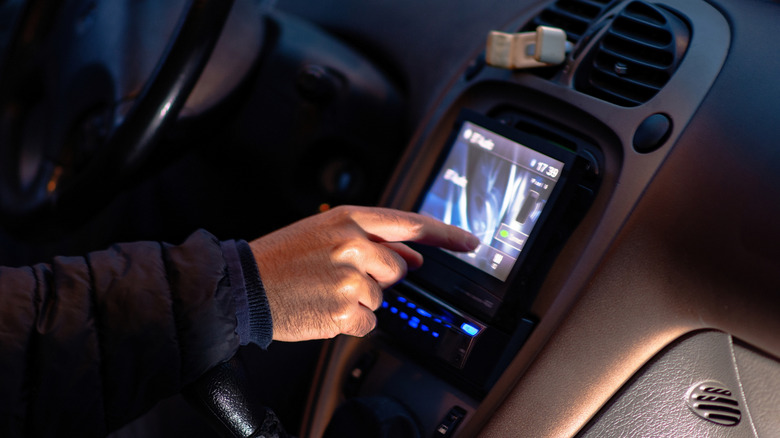
The Apollo 11 guidance computer helped the crew travel from Earth to the moon, a journey that covered about 240,000 miles. However, the AGC required just a fraction of the processing power to cover this distance compared to what your modern car's navigation and infotainment system needs to guide you across the 2.4 miles needed to reach a new neighborhood restaurant, for example.
When running your infotainment system and car stereo using an Android head unit, recommendations say you'll need at least 4GB of RAM. This amount allows for basic navigation, audio streaming, or managing phone calls while driving. However, 8GB is probably the better choice if you plan to own the car for at least five years. Compare that to Apollo 11's AGC, which had the equivalent of 4KB of RAM, and a modern automobile infotainment system needs about a million times more RAM for the recommended minimum setup.
Future automobiles, especially luxury models, will likely demand significantly more RAM. For example, the MBUX platform from Mercedes-Benz will offer head-up displays, video and audio streaming, and other features, as it combines navigation, entertainment, and connectivity. It may need as much as 24GB of RAM for these functions.
Smartphones are so much more powerful, they became cameras on a recent moon mission

The iPhone is more powerful than NASA's Apollo 11 AGC and has been since its debut almost 20 years ago. One of the newest models, the Apple iPhone 17, has either 8GB or 12GB of RAM, depending on the version you select. This gives the iPhone 17 about 2 million or 3 million times more RAM capacity than what was found with Apollo 11's guidance computer with 4KB. (The original iPhone from 2007 had 128MB of RAM, tens of thousands of times more than the AGC.) Apple doesn't share the operational speeds of its processors for the iPhone 17, but it's expected to be between 2.6GHz and 4.26GHz, significantly faster than the AGC's processors.
In a twist that shows how far space travel technology has come, crew members on the Artemis II mission that traveled around the moon and back in early 2026 carried iPhone 17 Pro Max models to shoot photographs of the journey. Even with millions of times more RAM and processing power in these iPhones than what the Apollo 11 astronauts had in their AGC, the modern astronauts only needed the pocket-sized devices to serve as expensive cameras.
A tiny smartwatch looks like a sci-fi device next to the AGC

Wrist-sized communicators in watches have long been a staple of science fiction. From watch-sized communicators in "Dick Tracy" comic strips in the 1940s to spy watches in modern "Spy Kids" movies, these wrist-sized communicators solve problems in a variety of sci-fi situations. Apollo 11 astronauts didn't have these gadgets in the 1960s, but we have devices that are close to them today in the form of smartwatches.
The idea of modern smartwatches might have seemed like sci-fi to the Apollo 11 astronauts because of their size and computing capabilities. One of the newest smartwatches, the Samsung Galaxy Watch Ultra 2, offers roughly half a million times more RAM storage than the Apollo 11 AGC (2GB compared to 4KB). Even the first Samsung smartwatch, the Samsung Galaxy Gear from 2013, had more than 125,000 times as much RAM (512MB) than the AGC. The Galaxy Watch Ultra 2's face measures just 47 mm (1.85 inches) in diameter, and the device weighs 61.5 grams. Meanwhile, the Apollo 11's AGC occupied almost 1 cubic foot of space and weighed about 70 pounds. Though, no one will be wearing it on a wrist.