

What Direction Should Your Subwoofer Face?

Setting up your dream home audio system or surround sound setup isn't a straightforward task. Whether you're figuring out how many surround sound speakers your living room actually needs, what equipment you need to buy, or where to place your hardware to guarantee that you have the most immersive audio achievable in your space. Your subwoofer is a key component, providing bass sound that can make spaceships, running dinosaurs and frantic car chases seem that much more real.
There are a handful of different ways you can set up a subwoofer to get the most out of its sound. Generally speaking, most subwoofers are designed to transmit omnidirectional audio, emitting low-frequency vibrations in all directions. With that in mind, you don't typically need to point subwoofers themselves in a specific direction, since the bass is radiating from the speaker cone. As a result, you can generally get away with facing a subwoofer in any direction, so long as you leave about four inches of space between the subwoofer and other surfaces to minimize the amount of sound being reflected back.
What matters more when trying to get the best audio out of your subwoofer is where it's placed, rather than what direction it faces. For that reason, the best way to pick where to place your subwoofer is by testing out how it sounds in your room to get a sense of the space's characteristics. Start by putting your subwoofer where you usually sit, and move around your room to find the spots where the bass sounds the loudest. Those spots can be other options for where to place the subwoofer instead.
Dual subwoofers can be a different story

If you have multiple subwoofers, you naturally have a few more options for where to place them, and which direction to point them in. When working with a dual-subwoofer setup, you don't have to have both subwoofers in roughly the same place or facing the same direction to achieve the best bass possible. In fact, they may have minimum distances you must keep them from one another for optimal sound. Also, regardless of where you put them, remember to make sure both are at least a few inches away from any other surfaces.
Just as with a single subwoofer, multiple subwoofers working together will sound different based on the characteristics of your room. What sounds best in your living room could sound terrible in an outdoor patio.
There are a few different placement approaches that tend to yield good results across a variety of spaces:
- In the front corners of the room facing where you might sit.
- On the inner side of each speaker.
- Set equally apart on opposite sides of the room in front of the sofa.
- On opposing diagonal corners facing the furthest walls.
Audio device maker SVS says you'll probably get the best sound with the opposing-corners-layout, or by placing your subwoofers so they face one another at your room's midpoint. Your exact results can vary depending on your environment, too.
Where should you put a car's subwoofer?
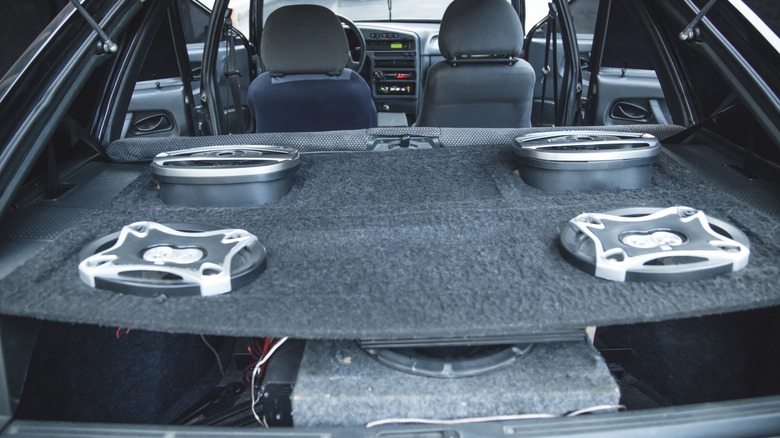
Installing a subwoofer is one of the best ways to upgrade your car's sound system. But, if you just mount it anywhere and without much consideration, you aren't doing yourself or your audio setup any favors. The inside of your car is an unusual environment, with a lot of competing elements for sound to contend with. It's a small space, yet it has a lot of different surfaces that can reflect or absorb the vibrations coming from your speakers and subwoofer. There's also road noise coming in from the outside, and that can be different based on the weather, and also where you're driving, such as a winding country road, bumper-to-bumper traffic, or a speedy highway.
For the most part, car subwoofers are mounted either in the trunk or under the seats. Aside from that, your subwoofer can also point toward the roof, to face the rear, or angled at the windshield. Which direction you pick depends a little on your taste and what type of car you're driving, but the most common position is generally for the subwoofer to face backwards. That's because it's an effective way of making the most of your car's dimensions, sending the vibrations towards the trunk before they bounce back throughout the rest of the car to reach you. In turn, it makes the most of your car's cabin, where reflections of sound waves can come together and sound even louder. The amount of space needed for the bass frequencies to bounce back can also give the waves time to develop before they reach you, making those low frequencies sound smoother than they would over a shorter distance.