

How Many Surround Sound Speakers Does Your Living Room Actually Need?
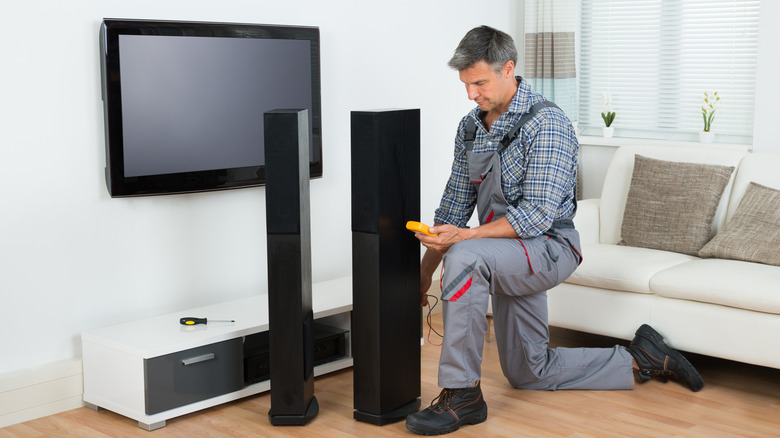
A great home theater system isn't a necessity, but who's going to argue with the kind of immersive audio that'll put your local cineplex to shame? If you're thinking about investing in an AV receiver and multiple speakers for your living room, you'll first want to consider how many speakers are needed to build out your surround sound configuration. The short answer is that it ultimately depends on your room size and budget.
At the most basic level, a proper surround sound setup is made up of three front speakers (the left, right, and center channels), two rears, and a subwoofer. This classic configuration is billed as a 5.1 setup, which formats like Dolby Digital and DTS can take advantage of. If you're working with a small footprint, a 5.1 system may be all you need. If your living room is really tiny, you could potentially get by with a 3.1 (no rears), 2.1 (no rears or center), or 2.0 configuration (no rears, center, or sub). Technically, though, those three speaker arrangements aren't "true" surround sound setups.
In a 3.1, 2.1, or 2.0 configuration, you only experience audio fired directly at you, not around you. That said, the nice part of building a home theater is that you can do it in stages. If you don't have the funds for a full 5.1 system or greater, start with a 2.1 or 2.0 build, and then add rear speakers when you can afford to.
Speaker size can make a big (or small) difference, too
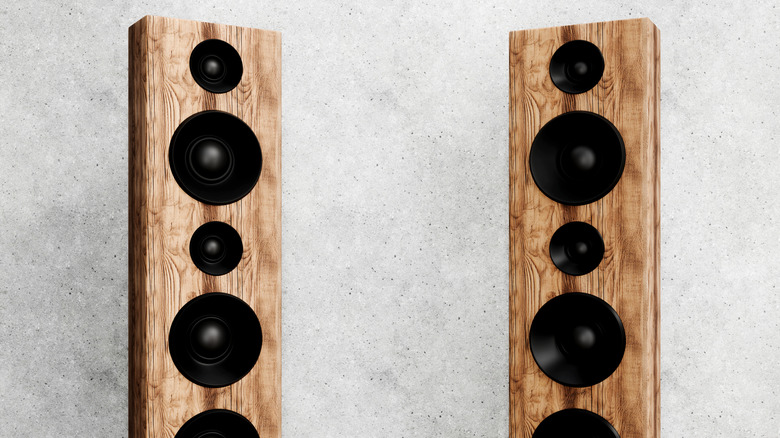
Floor-standing speakers are an alluring home theater visual, and certain living rooms will benefit from the expansive sound they deliver. Other theater spaces may barely have enough space to accommodate bookshelf speakers, which is another reason to be cognizant of the square footage you're working with. Even if you can fit tall speakers in your living room, putting floor-standers in an acoustically challenged area (e.g., the walls are too close to the speakers) may result in muddy, bass-boosted audio that's quick to overwhelm. You'll also find that many good speakers have ports in the back that improve the bass quality by expelling air. These speakers need to be placed at least two feet from the wall for best results.
Knowing your limits is key to building out a home theater, but just because you can't fit large speakers doesn't mean you're compromising your system's overall power and immersion. There are plenty of excellent bookshelf speakers on the market, and many can be combined with stands and wall mounts if there isn't a literal shelf or entertainment center to use. We've also yet to touch on the fact that a great home theater soundbar can deliver a "virtualized" surround sound experience even without speakers physically surrounding you, thanks to design elements like side– and up-firing speakers.
Wait a minute, you may be saying to yourself: What the heck are side– and up-firing speakers? There's another layer to all this surround sound business. Some speakers send audio out in more than one direction instead of simply directly forward, and this contributes to that feeling of being surrounded by sound. If you have enough space, you could opt for a 7.1 configuration, which adds two side-firing speakers toward the center of your system.
Not everyone can accommodate a Dolby Atmos speaker setup, and that's okay
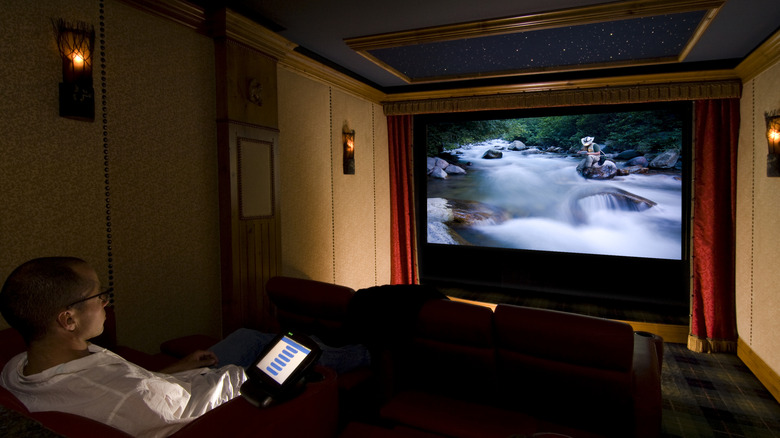
Then there are Dolby Atmos/DTS:X configurations that use a "X.X.X" label, which corresponds to speakers, subs, and height channels. This type of surround sound introduces vertical audio effects, which can be delivered via ceiling speakers or floor-level speakers with top-mounted drivers. The latter fires sound upward toward your ceiling and back down again, which isn't quite the same as a ceiling-zone speaker shooting sound downward.
One of the main drawbacks of a true Atmos configuration is how much more equipment and potential labor are needed to get everything installed. This is why a lot of apartment dwellers go with a premium soundbar over a multi-channel speaker system. But if you happen to have the space, money, and initiative required to go full Atmos, we highly recommend doing so.
As you can see, there isn't an easy answer to the question of how many surround speakers your living room should house. At the end of the day, a "great" 5.1 system can outperform a "good" or "okay" 7.1 or Atmos layout. As long as you're not upsetting neighbors or draining your bank account, the right number of surround sound speakers is the number that best suits your funds and lifestyle at a given point in time.