

Study Shows Particles Inside Of Rocket Engines Aren't Doing What They're Supposed To
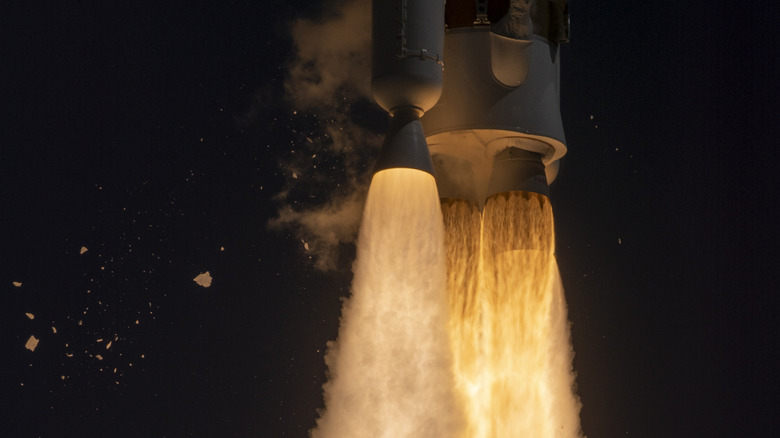
Rockets that launch to space go through violent energy exchanges from multiple fronts. The rockets themselves have to be able to travel at extreme speeds while moving through the atmosphere, and the engines that push them have to generate immense forces to get a rocket to an orbital velocity of 17,500 mph. Rockets have either liquid-fueled or solid-fueled engines. NASA's SLS uses solid rocket boosters (SRBs) to help get it to orbit, and each of those SRBs generates about 3.6 million pounds of thrust each. SRBs have to harness that power effectively, but damage is common, especially on SRB nozzles where particles move at hypersonic speeds. A new study published in Physics and Fluids has confirmed that long-held beliefs on how particles behave under the immense speeds, pressures, and temperatures inside SRB boosters have been wrong.
The belief was that alumina particles inside these boosters (and critically, their nozzles) always remain perfectly spherical as they move through the system. The study demonstrated otherwise, showing that particles traveling at hypersonic speeds had collisions with surrounding air molecules which caused rapid heating and melting. This led researchers to create a new drag model that more accurately predicts particle behavior under the extreme conditions throughout a burning SRB. This can be used to improve SRB design to make them safer and more reliable. The lessons learned during this study can also be applied to other forms of hypersonic heat generation, which is one of the U.S. Air Force's big challenges with hypersonic jets.
SRB nozzle failure remediations could benefit from study
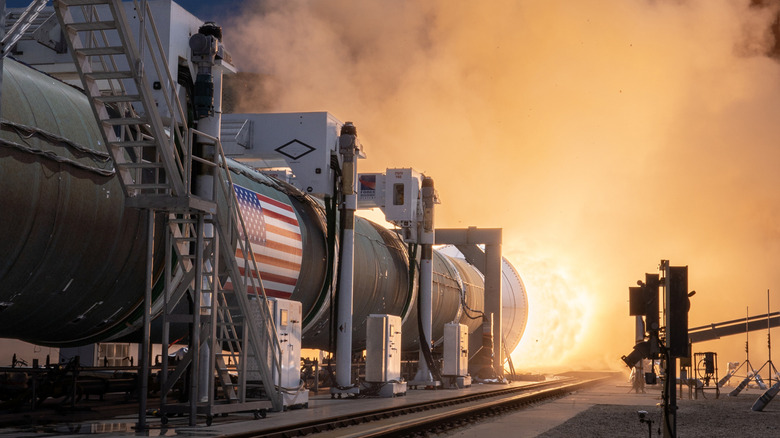
NASA's SLS moon rocket has two SRBs that contain aluminum, which means that this study could be directly applicable to how these SRBs are designed and how they can be made safer. While current SRBs on Artemis missions are legacy designs from the Space Shuttle era, new SRB designs are being tested for future missions. These new boosters form part of Northrop Grumman's Booster Obsolescence and Life Extension upgrade, which offers a more powerful SRB for future Artemis missions that may carry heavier loads to the moon. During a test in June 2025, this SRB's nozzle blew off just under two minutes into the test. The root cause was never made known, but was framed as a valuable data gathering moment that the company plans to implement for future iterations of the booster.
This is not the only example of such a failure. United Launch Alliance (ULA) has seen two separate failures of SRB nozzles, one happening on its Vulcan rocket in October 2024, and an eerily similar event on the same rocket in 2026. These examples also saw SRB nozzle failures. The GEM 63XL SRBs on the Vulcan rocket are also designed by Northrop Grumman, and also contain aluminum as part of its propellant formulation. The first ULA failure was confirmed to originate in insulators bonded to the inside of the booster's shell; the second failure remains under investigation at the time of writing.
While neither of these real-world examples publicly called out factors related to the study, erosive impact from re-entrained molten alumina is a known erosion mechanism, and it's likely that the study's drag model can aid in making these boosters safer in their design.
Study can help engineers better understand reentry particle behavior
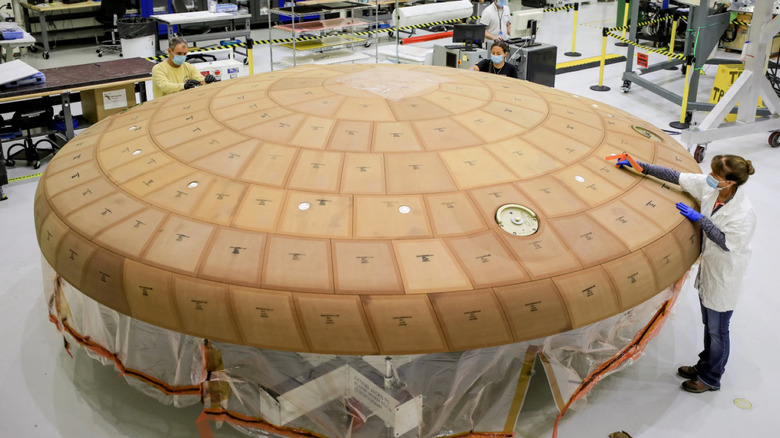
While the study focuses on the particle interactions found inside rocket boosters (and is specific to alumina particles), the findings of the study can help engineers design better spacecraft thermal protection systems. The modeling approach used by the research team can help engineers more accurately predict particle behavior under the extreme conditions associated with atmospheric reentry, even if the heat shield materials are different.
Every newly designed space rocket or capsule has similar inherently difficult engineering problems to overcome, and thermal protection systems feature prominently on that list. During reentry, the Orion space capsule can experience temperatures of around 5,000 degrees Fahrenheit due to the friction caused when the capsule enters the atmosphere at a speed of 25,000 mph. Indeed, NASA's Orion spacecraft had a potentially dangerous flaw with its heat shield that had to be resolved before the launch of the Artemis II mission, which further highlights the importance of understanding the behavior of thermal protection systems. If engineers can more accurately predict how particles behave on the surface of a spacecraft's heat shield, they can design much more effective thermal protection systems that will ensure the safety of crews on board.