

5 Popular Sites From The 2000s You Won't Find On The Web Today

Despite the idea that anything posted online lasts forever, there's actually no shortage of websites that have pretty much disappeared from the internet altogether. More specifically, many websites have had their entire rise and fall over the past twenty years. Perhaps one of the most famous examples is, of course, MySpace: a quirky social media platform known for its userbase's creative personal webpages, an underground and upcoming musicians' place to promote their music, and rising to the top of someone's coveted Top 8 featured friends list.
Unlike many fallen sites from yesteryear, MySpace is set to relaunch at some point in the future, according to an interview with People.com. Some other sites that made waves in the 2000s also never went away, whether they grew in popularity or shrunk into the shadows. Facebook and Tumblr, for example, launched in 2004 and 2007 respectively and are each still kicking today, admittedly to varying degrees of popularity.
Meanwhile, some other once-popular sites haven't been so lucky, and remain relics of the relative past. Although you might be able to dig these sites back up using tools like the Wayback Machine, they won't be as fully functional and accessible as they once were. Some stuck it out for years before competitors essentially replaced them, while others faded from popularity and into internet history before long. Whether they were short-lived or hung around for a while before the curtain fell, some now-defunct websites found massive user bases and tons of popularity during their heyday.
8Tracks

Not to be confused with the similarly named 8-track audio tech you might remember from the 1980s, 8Tracks was a playlist-based social network-come-internet radio station that you might remember from the late 2000s. Its premise was simple but fun: you played "DJ" by throwing together custom playlists around any theme you created, which you could then share publicly with anyone who could find them. Then, you could listen to any playlist directly through the website with a limited number of skips.
Even if you don't directly remember 8Tracks, if you spent any time on Tumblr or Pinterest during the site's existence, you probably came across a lovingly crafted playlist or so-called fanmix hosted there. That's because it was certainly popular. During the platform's lifespan, it accrued an impressive 19.6 million registered users and 3.5 million playlists.
8Tracks originally ran for 11 years, from its fittingly timed August 8th, 2008 launch to its closure on December 31st, 2019, before a brief resurrection in the early-to-mid 2020s. That's perhaps not a surprise, considering the rise of music streaming platforms, which tend to offer public, searchable, community-made playlists as an integral function, removing some of 8Tracks' original unique selling point.
According to a post on the official 8Tracks blog (which is still viewable, despite the main site's disappearance), the platform ultimately shut down after it failed to make enough money to pay royalties or cover the costs of product innovation. The company also couldn't raise enough money to cover its outgoings or find an appropriate "home for the company".
Bebo

Bebo was another quirky social media platform from the 2000s. Like many other social networks, it was built on the idea that every user had a profile page where they or their friends could post fun, interactive, personal content. You could personalize your profile with different cosmetic skins, upload quizzes and polls, write blog posts, share your favorite music, and interact with your friends and connections. It also offered a feature called Lifestream, which let you integrate updates and activity from other social media platforms, including MySpace and Twitter.
If you used Bebo back in the day, the site's social features are probably what you remember most. Besides being able to add tons of friends on the platform — regardless of whether you really knew them or not — you could also organize your connections into a ranked Top 16, highlight a specific special someone as your "Other Half", and perhaps most famously, "share the luv" with them using a daily unique interaction.
When you think of major social media platforms that have come and gone (or come and stayed) over the years, Bebo may not immediately come to mind. However, it certainly made waves online in the mid-2000s. In fact, at one point, it briefly overtook MySpace and Facebook in popularity among users in the United Kingdom in 2007, with 8.7 billion page views that year. Thanks to the platform's popularity, the site has had a few comebacks over the years, but they just didn't quite stick.
Yahoo! Answers
Sometime between the fall of Ask Jeeves and the rise of ChatGPT, users flocked to another place to ask questions online. That place was Yahoo Answers; a decidedly weird, community-driven forum focused entirely on asking or answering questions. If you have more of a tendency to find your answers on Reddit or Quora, then you might not have used the platform — but you've probably still seen some of its infamous posts. Despite Yahoo Answers' reputation these days, it was popular at the time. That's perhaps no surprise, given Yahoo's scale throughout the 2000s.
Despite the company's earlier successes, Yahoo Answers still had to close its doors on May 4th 2021, 16 years after its 2005 launch. Although Yahoo gave only one month's notice of the closure, archivists stepped in to preserve as much of the platform as possible. Both ArchiveTeam and Gizmodo stepped in to preserve the site's contents, with the latter scraping around 84 million questions. So, if you ever feel like a quick trip down memory lane to see if the answer to your burning questions is out there, then you're free to do so. There is still one place where you can find the answers to your unusual questions firsthand, though, without crossing your fingers that someone else had already asked it first. "Yahoo! Chiebukuro," Yahoo Japan's equivalent forum, is still up and running. You might need to get clever with a VPN to access it, though.
StumbleUpon
Before the unexpected outcomes of scrolling through TikToks or Instagram Reels without knowing what could come next, there was another way of finding random things on the internet. One way to do that was to use a platform called StumbleUpon. A little like Google's "I'm Feeling Lucky" button, StumbleUpon would take you to a random website or video. Except it wasn't completely, truly random; it was meant to match your interests or filters. So, theoretically, anything you stumbled across on StumbleUpon could be up your street. It was essentially a way of surfing the web without needing to direct exactly where the board was going yourself, so you could go on your own internet-based voyage of discovery.
StumbleUpon lasted for around 16 years before it eventually closed down and disappeared from the web. During its run, it served more than 40 million users via nearly 60 billion "stumbles". If you try to stumble across anything using the website now, you'll find some similar sites — but they aren't the original site, nor are they official successors, even if they are still worthy of your time. Instead, the original (and official) StumbleUpon actually essentially became a new platform called Mix, made by the same developers when it closed down. Old StumbleUpon accounts could be migrated to the new platform if users chose to, including any favorites, tags, and registered interests, and the old StumbleUpon URL now also redirects to its homepage.
Polyvore
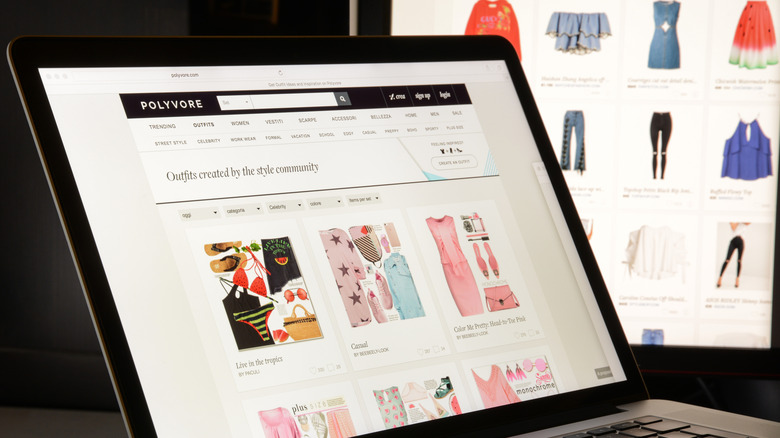
Pinterest wasn't the only popular digital mood board platform back in the 2000s. One of its competitors was known as Polyvore, a digital collage, commerce, and social media site centered around fashion, interior design, and just about anything else you could try to capture the aesthetic or vibe of. Users could craft collages called "sets" using up to 50 images and products from the site's database at a time, plus anything they uploaded to add to the board. Think of it a little like scrapbooking, except entirely online. You could then easily share those sets online through the platform, or by sharing them to whatever social media platform of choice you used in the late-2000s. Once you've finished putting together your ideal outfit, you could click through to find where to buy each item individually.
Polyvore launched in 2007, and by 2013, the site started reaping more than 20 million fashion-hungry visitors per month. Screenshots of sets depicting fashion co-ords and moodboards flooded sites like Tumblr and Pinterest, themed around anything from activities to aesthetics, celebrities to characters, and far beyond. Unfortunately, Polyvore's popularity didn't keep it afloat for the rest of the 2010s. The site shut down in 2018, following several acquisitions, first by Yahoo and again by Canadian fashion brand Ssense. Today, any attempt to access Polyvore directly on the web redirects to the Ssense website.