

The Navy's 3D-Printed Drones Could Be A Game Changer For Ships At Sea
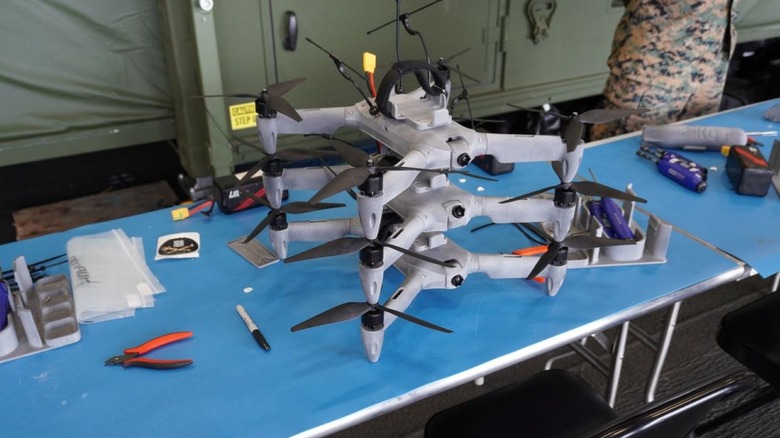
Modern naval warfare is rapidly changing in a time when drones are becoming an effective tool that navies can't do without. The conflicts in Ukraine and Iran have demonstrated the effectiveness of drones in combat, leading to a surge in advancements for small, expendable drones. The use of drones in naval warfare is becoming more common, to the point where drone swarms are becoming a threat to aircraft carriers, underscoring the need to field drone capability at sea.
While these drones are generally cost-effective, the logistics involved in getting them to U.S. Navy ships out at sea is a bigger problem due to high costs and delays. Firestorm Labs has demonstrated a solution to this problem by fielding a containerized 3D-printing facility aboard a Navy ship, which manufactured first-person-view (FPV) drones called Squall. This was done while en route to a Navy exercise called the Rim of the Pacific exercise (RIMPAC). The drone parts were additively manufactured and assembled on the ship.
Firestorm Labs is one of several companies that demonstrated additive manufacturing technologies during RIMPAC 2026. The exercise was used as a large-scale technology demonstration effort, with the Navy's Project Overmatch (a huge AI-powered data aggregation project) being tested as well. The companies were given the opportunity to demonstrate additive manufacturing technology for different uses as part of a Naval Postgraduate School initiative. The Firestorm solution printed over 1,000 parts during the deployment on the USS Essex, including spare parts for other uses onboard the ship.
The Firestorm Squall
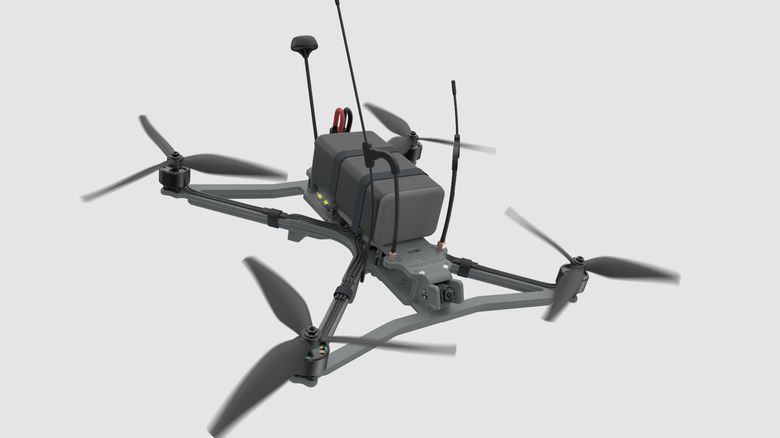
Firestorm's focus has always been to solve logistical issues by providing expeditionary manufacturing capabilities using 3D printing technology. Firestorm produces a containerized 3D-printing facility called Xcell, and by partnering with Orqa FPVs, the two companies created a system that could manufacture high-end military drones in remote locations (like a ship at sea) as the need arises. The result of the collaboration was the Squall FPV drone, which is based on existing Orqa drone technology, but optimized for additive manufacturing.
Orqa has two primary drone platforms called the MRM1-5 and MRM2-10, which have already been battle-tested in the war in Ukraine. The Squall FPV drone can carry 5.5-pound payloads at speeds of up to 80 mph over a range of about 20 miles. They can be used as attack platforms, small carrier drones, or surveillance platforms. After manufacture, the Squall drones were used as "red cell" Unmanned Aircraft System (UAS) adversaries for counter-UAS exercises, which involved training naval crews to neutralize incoming drones.
Ship-based 3D-printing will become a standard requirement
During the exercise, Firestorm and some of the other demonstrators not only printed drone parts but also printed spare parts, which included rotor droop stops for Apache Helicopters, which play a key role in ensuring that a helicopter's rotor blades don't droop while parked, where they could strike the ship's deck and become damaged in rough seas. This is a prime example of how 3D-printed parts can help reduce cost, as each of the Apache's rotor blades costs about $230,000. This is not the first time the Navy has tested this.
U.S. aircraft carriers are already using 3D-printed parts and are slashing availability lead times significantly in the process. Other crew-requested items were manufactured during the exercise, including a vacuum adapter for testing inflatable Life Preserver Units, deck tie-down gauges, reverse-engineered valve handwheels, and even Starlink mounts. What this demonstrated was that additive manufacturing capability may become a core requirement for future Navy ships. The manufacturing of spare parts onboard ships like the USS Essex could significantly mitigate supply chain challenges, which usually make obtaining spares costly and prone to delays.
Beyond its uses in manufacturing spare parts, 3D printing can be used to manufacture medical equipment for ships like the Essex, which also operates as a forward-deployed medical ship and crisis support vessel during disaster responses. If 3D-printed surgical tools can be effectively sterilized, medical tools for specific purposes can be manufactured as the need arises.