

The Biggest Obstacle To This Offshore Solar Farm Isn't Saltwater - It's Barnacles
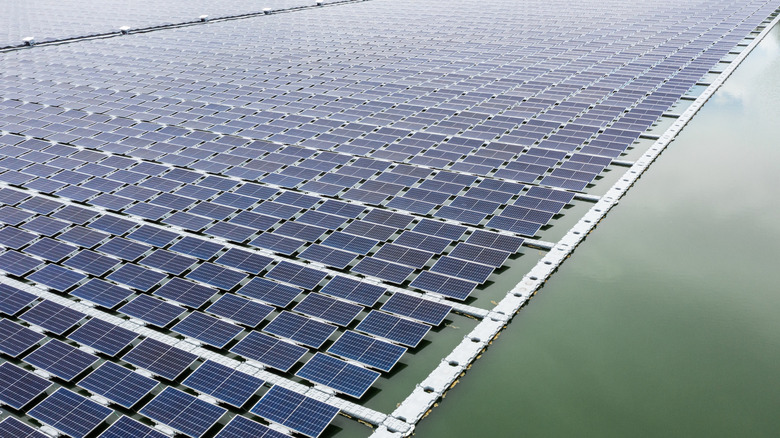
For engineers looking to set up solar farms in the ocean, there are plenty of hurdles to consider, from saltwater corrosion and rough seas to secure mooring and difficult maintenance. The humble barnacle can also prove a major challenge. Indeed, a solar farm set up in Singapore's Johor Strait near the town of Woodlands has been hampered by barnacles attaching themselves to the floating pontoons supporting the solar panels, adding significant weight and reducing the solar farm's overall buoyancy, according to environmental news site The Pulse.
Singapore has been turning to offshore solar for the obvious reason that it simply doesn't have enough land for large-scale solar farms. Completed in March 2021, the 5-MW Woodlands solar farm has 13,312 solar panels mounted on more than 30,000 floats and covers about 12 acres. The system was carefully designed for marine conditions, with a constant-tension mooring system to keep the array stable in waves and currents. It's built to generate around 6 million kWh of electricity a year and avoid roughly 4,258 metric tons of carbon dioxide emissions.
The developers of the facility were always aware of the risk of marine life causing disruption, with barnacles specifically identified as one of the challenges for the seawater-based project. Engineers also knew that other marine growth such as algae and mussels would be an issue and so set about designing and testing the system accordingly. The challenge now is finding a cost-effective way to control that growth over the coming years.
Deterring marine growth from solar farms
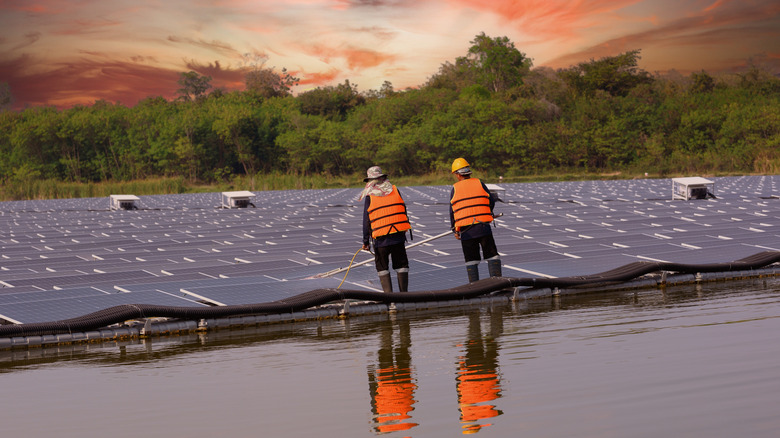
Preventing marine growth on solar farms can involve regular inspections and cleaning, as well as using surface designs and coatings to discourage organisms from colonizing pontoons. Another idea is to incorporate monitoring systems capable of tracking changes in the weight and buoyancy of the floating platforms, giving operators an early warning if the barnacles and other marine life begin to have an adverse effect on the condition of the facility.
Saltwater corrosion, by contrast, is a marine challenge engineers have already found ways to manage. For example, researchers found that modified epoxy-based and graphene–zinc coatings continued to provide good protection after 18 months in ocean water. Unlike corrosion, which can be handled effectively using protective coatings and other engineering measures, marine growth cannot be prevented so easily. It can and likely will keep returning, meaning operators of floating solar farms will have to factor it into the facility's ongoing maintenance schedule after it goes online. The hard truth is that if the problem becomes too costly to control, it risks undermining the benefits of generating power offshore.
The presence of marine life doesn't always have to be a problem for floating solar farms, though, as shown by a floating solar farm in the Netherlands, which benefits the underwater ecosystem without interfering with the facility's operation. Likewise, solar farms on land can also have a positive effect on local wildlife.
The world's largest open-water solar farm doesn't actually float
Unlike the one in the Johor Strait, Singapore's largest floating solar farm doesn't face the same challenges because it sits on a freshwater reservoir. The Tengeh Floating Solar Farm opened in 2021, with the 60-MWp installation comprising more than 122,000 solar panels covering about 111 acres. But freshwater solar farms can still experience biological growth and therefore need to be regularly inspected and cleaned.
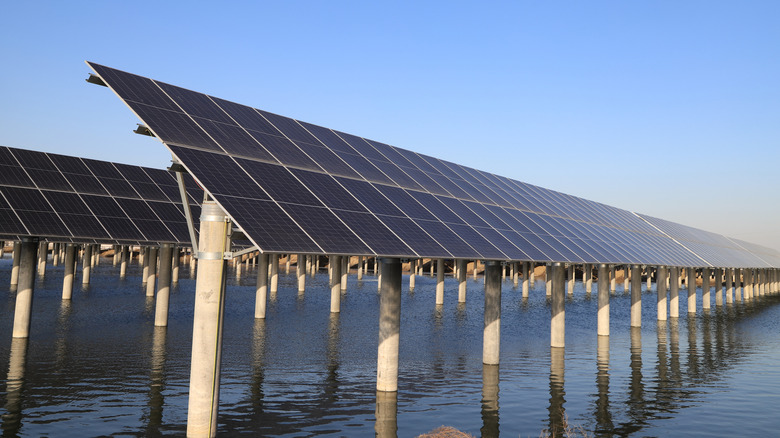
The world's largest open-sea solar farm by generating capacity is currently in China, a global leader in offshore wind farm development. But, notably, it's not a floating facility. Fully connected to the grid in December 2025, the 1-GW HG14 project off Dongying about 200 miles southeast of Beijing comprises thousands of solar panels mounted on steel platforms fixed to the seabed, placing the panels above the water instead of on it. This gives it an important advantage over floating solar setups in that while marine life can still attach itself to the structure, the added weight doesn't drag the solar panels lower into the water.
As for floating offshore solar facilities, the largest one by generating capacity is currently in Taiwan. The Changhua complex has a capacity of around 440 MW and spreads across 857 acres, an area larger than New York City's Central Park. Predictably, the project faces many of the same challenges as Singapore's farm, including saltwater, marine life, tides, debris, waves, and high winds.