

Star Trek Played A Critical Role In The Invention Of Mobile Phones
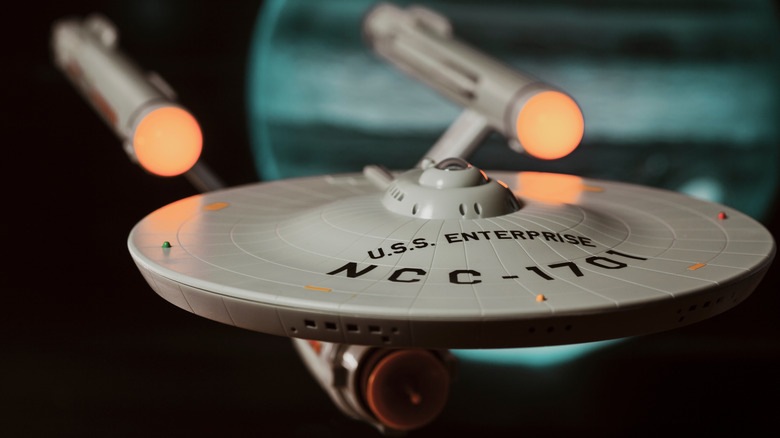
One of the most iconic gadgets in the "Star Trek" TV show is the communicator. The device is used like a mobile phone to speak to other crew members, but it made its appearance on the show long before the mobile phone was even invented. It actually led to the creation of the first cell phone by a popular name in the industry.
Martin Cooper was an engineer at phone company Motorola. In 1973, surrounded by a group of reporters, he picked up his mobile phone and made the very first mobile phone call to Joel Engel. The first words ever spoken on that call were "I'm calling you from a cell phone." Cooper actually stated that the original "Star Trek" series was an inspiration for his mobile phone design. Seeing Captain Kirk use a communicator to keep in contact with his crew no matter where they all were was one aspect that motivated Cooper to make the cell phone.
Even fans online were shocked to learn that "Star Trek's" communicators were inspirational to real-world technology. It's just one of "Star Trek's" most iconic sci-fi gadgets, and shows how the series wasn't just a fun TV show, but a cultural phenomenon that was way ahead of its time.
The invention of the mobile phone
Martin Cooper's vision for the first mobile phone came after a rival phone maker said it would focus on phones inside cars instead of cell phones. Cooper decided that instead of having people tethered to their vehicle, he and Motorola would make a phone that could be used anywhere. Wanting to beat AT&T at creating a mobile phone, Motorola built a prototype.
It took three months to build the mobile phone. The prototype was called the DynaTAC. It was rather hefty, weighing in at 2.5 pounds. It didn't look anything like modern smartphones, either. Instead of a sleek design, it featured a bulky body that made it appear more like a brick than a mobile device. Still, it was a brick that could make calls, and it was the future of mobile technology.
Bell Labs, where Engel worked, was experimenting with a cellular phone network at the same time. The company built a network of hexagonal cells each with its own base station that allowed mobile phones to connect over radio frequencies. Taking it one step further, the stations created a telecommunications network that would switch radio frequencies to allow two phones to interact with one another. At the end of the 1970s, the Bell Labs Advance Mobile Phone System (AMPS) was working. That network was an idea that became a reality, just like "Star Trek" gadgets that became real.
The mobile phone of today
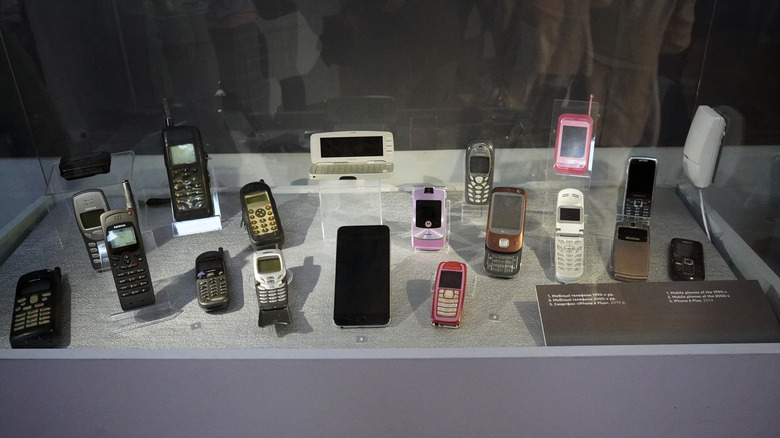
Like "Star Trek" paved the way for mobile phones, early cellphones led to the invention of modern smartphones. Motorola released its first mobile phone, the DynaTAC, in 1984. In today's currency, it would have cost over $13,300 for the general public. Compared to around $1,099 for the Apple iPhone 17 Pro, that's an expensive piece of tech to make a phone call.
Today, smartphones are part of everyday life. Everyone seems to have one, no matter how young —- even in the face of studies that show the harmful effects smartphones have on kids. They are used for way more than simply making phone calls. Smartphones can call, text, browse the internet, and much more.
"Star Trek" may have inspired the creation of the mobile device, but the technology has expanded to become a computer we carry with us. It was cool to see Kirk and Spock speak to one another using a communicator in the '70s. From a brick-sized phone to one most everyone carries around in their pocket, mobile phones have evolved and continue to do so, just like "Star Trek" explored the final frontier and beyond.