

5 Old Phones '90s Kids Will Definitely Remember
The '90s was an exciting time because it was the last decade of a century, which led to much uncertainty about the new millennium. Technology was really starting to boom. The internet was picking up steam, gamers had a variety of consoles to choose from between Nintendo, Sega, and Sony, and the variety of telephones was endless. Granted, unless it was a cell phone, few people probably gave a second thought about the different landlines that existed.
However, if you were to ask a '90s kid what kind of phones existed between 1990 and 1999, they'd likely mention the transparent phone, some block, basic-looking landlines, the first flip phone, and, of course, the prolific Nokia cell phone. Technology from the '90s holds a special place in history — so much so that there are some cool '90s-inspired gadgets on Amazon. If you really like the look of an old phone and want to add it to your collection, you shouldn't have much trouble finding one. Etsy and eBay are also great resources. These are some of the all-time greats.
Cortelco basic phone
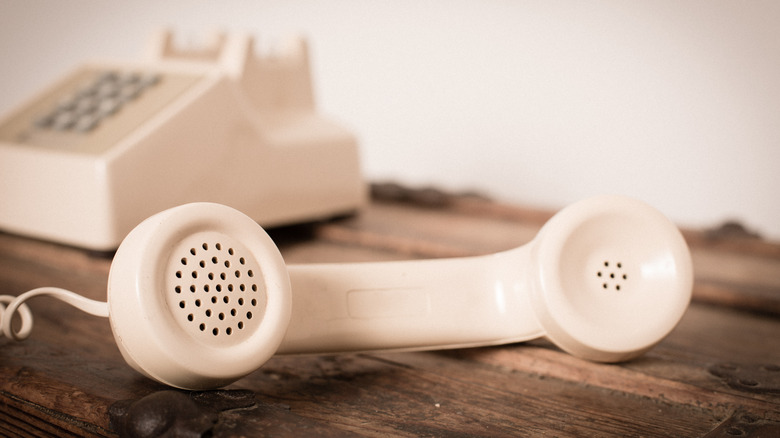
Cortelco Inc. got its start in 1897 and continues its operations to this day, but few people would know the name of the company that produced one of the most popular/basic-looking landline phones of the '90s. These phones were in just about every office, motel room, and many homes throughout the '80s and '90s. There wasn't much to them, but back then, phones didn't need to be supercomputers, especially if it was a landline.
There were also rotary versions of these phones, but that was more of a '50s thing. By the '90s, the push-button model became more popular since it was easier and faster to dial a number. What was nice about this style of phone was that if you wanted to walk around while you talked, you could pick up the receiver and carry it with you. And if you were a business, you could get a model with multiple lines. These vintage (vintage? really?) phones are easy enough to find on eBay if you're a fan of the look or want to deck out your home with retro tech.
Transparent
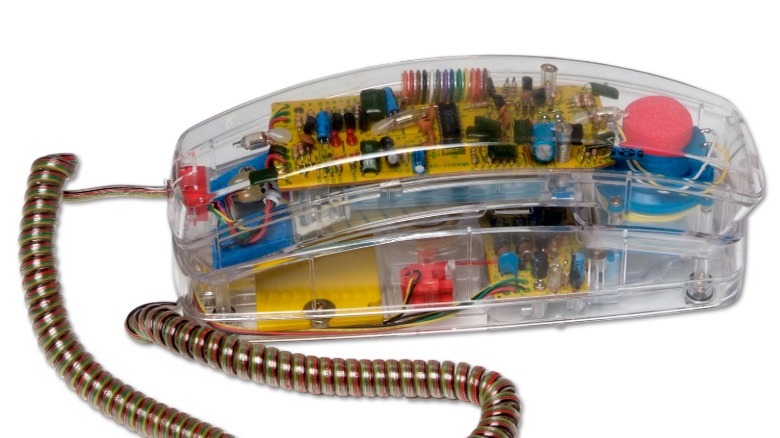
The '90s was the era of transparent consumer tech. If you're a gamer, you likely remember the versions of the Nintendo 64 controller that were translucent, especially the first atomic purple one. Years before the console's release, however, there were teenagers with see-through landlines in their room to gab with their friends, ignore homework, and prevent their parents from making important or equally unimportant phone calls.
It was a unique item that revealed the telephone's inner workings, which was cool, but it also served as a means for the owner to express themselves. This look said that they weren't like the boring adults in their life; they were interesting and went against the grain. Of course, as time went on, companies sold versions that weren't quite as colorful as the most memorable ones, because somewhere along the way corporations decided whimsy wasn't marketable, but you might be able to find one of the original transparent phones on Etsy or maybe even eBay.
Motorola DynaTAC
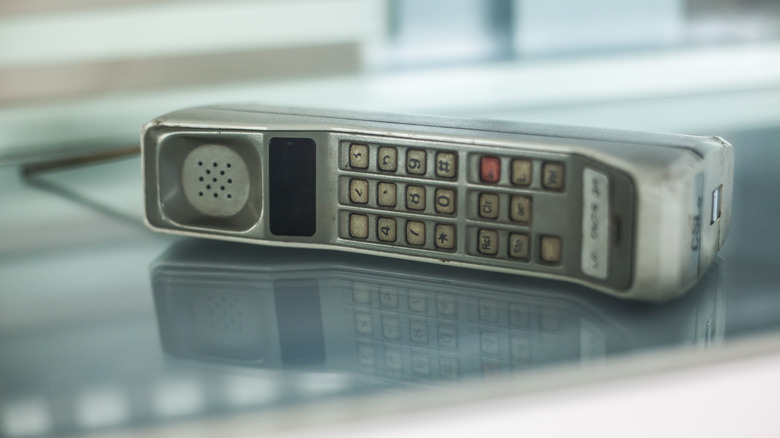
Anyone who has ever seen a couple of episodes of "Saved By The Bell" will recognize Motorola's DynaTAC phone, as it's the phone that Zack Morris (Mark-Paul Gosselaar) frequently used in various episodes. Thus, it popularly became known as the Zack Morris phone. It was the first commercial cell phone (the DynaTAC 8000X), which came out in 1984. Zack Morris was the epitome of "cool" at the time, so everyone wanted the same cell phone, but that was a big ask by anyone's standards. It cost around $4,000 (adjusted for inflation, that's around $12,000). So if you think mobile phones are expensive now, not even Apple would charge that much for an iPhone.
And what were people paying for? The phone's battery only lasted for 30 minutes before it needed a charge, which took 10 hours to do, by the way. And it only stored 30 phone numbers. By 1990, Motorola launched the updated and thinner 8800X with, one would assume, a lower price tag, though research yields few results to confirm this. It did have a two-line red LED display before later iterations of the 8800X (by 1991) released with an LCD display. The cell phone was definitely evolving.
The Motorola MicroTAC flip phone
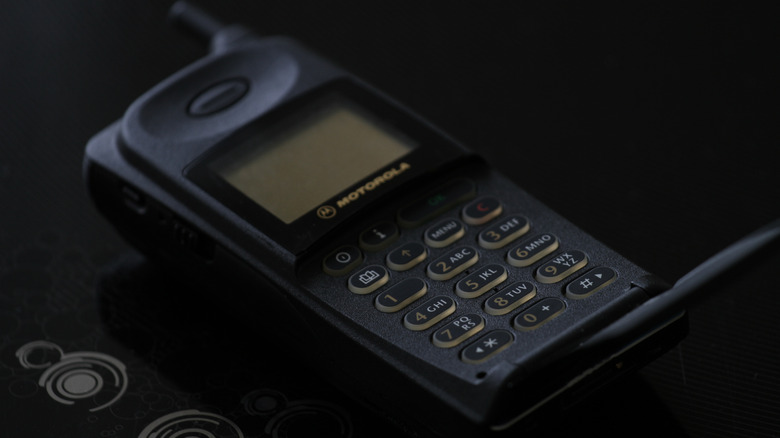
Not long after Motorola made the DynaTAC 8800X, it must have realized it needed something slimmer, more portable, and cheaper, because in 1989, it launched the first MicroTAC cellular phone, the MicroTAC 9800X, a cell phone that was actually small enough to fit in your pocket and is recognized as the original flip phone. It had a cover that flipped open and closed, which housed the microphone and ended any call once it was closed.
This phone retailed for $2,995, so it was cheaper than the DynaTAC, but still wasn't affordable for anyone who didn't work on Wall Street. Motorola saw the MicroTAC as the wave of the future, so it went on to create several iterations of it, including the MicroTAC II in 1991 and MicroTAC GSM in 1994, and they grew increasingly popular. The MicroTAC was designed with an eight-character red dot-matrix LED display, as well as a fake antenna.
There was a real antenna inside the phone, but focus groups made it clear to Motorola that consumers expected one that users could interact with. If you're a collector or feel compelled to own a piece of cell phone history, you can find a MicroTAC cell phone on eBay for roughly $45, a significantly better price than the first MicroTAC's original $2,500 price tag.
Nokia 6110
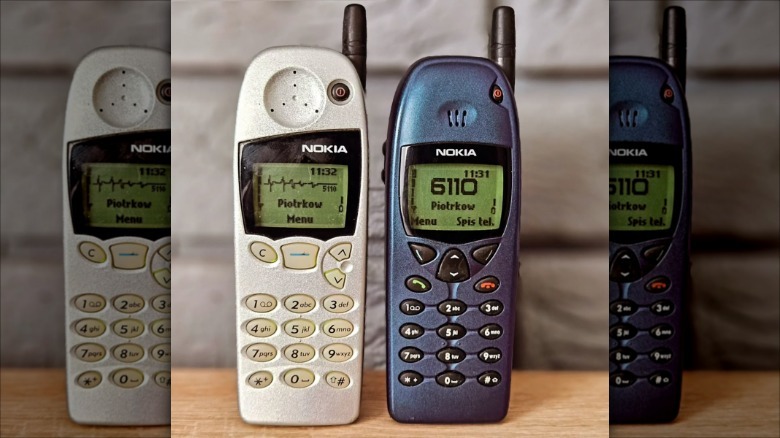
You can't talk about recognizable phones from the '90s without mentioning the Nokia 6110 mobile phone. While the 6110 wasn't the indestructible brick Millennials fondly remember (that was the 3310) nor the best-selling Nokia of all time, it was the first Nokia cell phone that kids could play the iconic "Snake" game on, to the frustration of many teachers. It was also the first Nokia with an infrared port that was supposed to let you connect the phone to a laptop or printer, but it was most likely more popular for letting teens play "Snake" with/against a friend. And that fact alone is priceless.
The phone launched at the tail-end of the decade (1998), so it wasn't exactly a powerful device. It could only save up to 50 phone numbers in its phone book, but that was okay because remembering important numbers was commonplace. We used to be a proper society. Its resolution could only be described as five lines, too, so no 1080p here. Yet, Nokia's commercials at the time described the 6110 as "everything you want in a mobile phone, plus a few extras you might not expect." Its specs aren't exactly sought after circa 2026, but the publicly traded Finnish company knew how to make a reliable phone with an impact.