

Which Nvidia GPU Is The Equivalent To The Steam Deck?
We may receive a commission on purchases made from links.
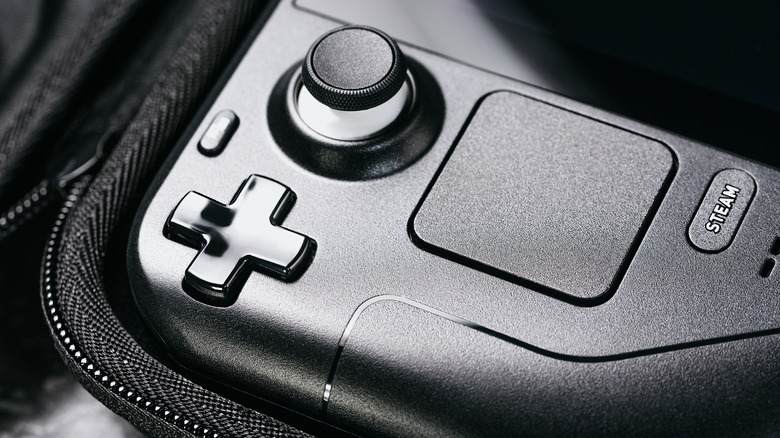
The Steam Deck is one of the most popular modern handheld gaming platforms on the market (the Nintendo Switch is the most popular), and it's easy to see why. The Steam Deck is basically a gaming PC that is easier to bring on long trips than a laptop. But all that portability comes at a cost.
While you can purchase various Steam Deck models, including several OLED models (not really worth purchasing if you already own an LCD Steam Deck), the internal processors mostly remain the same. All versions include a custom AMD GPU that utilizes eight RDNA 2 computing units (CUs), runs at 1.6 GHz, and provides 1.6 teraflops (1.6 trillion floating-point math calculations per second) of processing power. These specs make it hard to match with an equivalent Nvidia GPU, but it's not impossible.
If you crunch the numbers, the Steam Deck's custom hardware is about as powerful as an AMD RX 550 or RX 560. On paper, that puts the Steam Deck's graphical capabilities somewhere between an Nvidia GTX 950 and a GTX 1050. However, finding analogous GPUs isn't an exact science. When Digital Foundry reviewed the Steam Deck, the channel concluded that the device's GPU is comparable to an Nvidia GTX 1050 Ti, albeit with 720p resolution instead of the more standard 1080p. Exact performance and analogous GPUs typically vary depending on the game.
There's more to a GPU than teraflops
While GPUs perform the lion's share of computational processing in video games, their teraflops will only get you so far. Remember: There's a difference between what a GPU is designed to accomplish and what it can actually achieve.
The biggest hurdle a Steam Deck needs to clear is its power supply. Because of how the device was designed, the Steam Deck's GPU can receive only up to 15 watts of power. The device's RDNA architecture makes up for this shortcoming and outperforms older graphics cards, but when paired against newer GPUs playing more recent games, the Steam Deck's low-watt design isn't as reliable.
Another issue that plagues the Steam Deck — and gets in the way of finding a true analog — is its operating system. The platform runs SteamOS, a heavily modified version of Linux. Since most PC games are programmed for Windows, the Steam Deck needs a compatibility layer (Proton) to run games. If a title you want to play uses the Vulkan API, it might run as fast as, if not faster than, it would on Windows, which means an "equivalent Nvidia GPU" would be more powerful than a GTX 1050 Ti. Otherwise, performance varies depending on game optimization. That's a running theme with games on the Steam Deck: Even if a title could run better on the device, if it isn't verified for the Steam Deck, you're better off playing it on a computer with an equivalent (or better) GPU.
Forget equivalent GPUs; what about equivalent laptops?
While the Steam Deck is the theoretical equivalent of a GTX 1050 Ti, that GPU is almost a decade old. You can easily buy vastly superior graphics cards without breaking the bank. Plus, newer models support technologies that aren't available in GTX cards, such as ray tracing. You could even save money when compared to purchasing a Steam Deck.
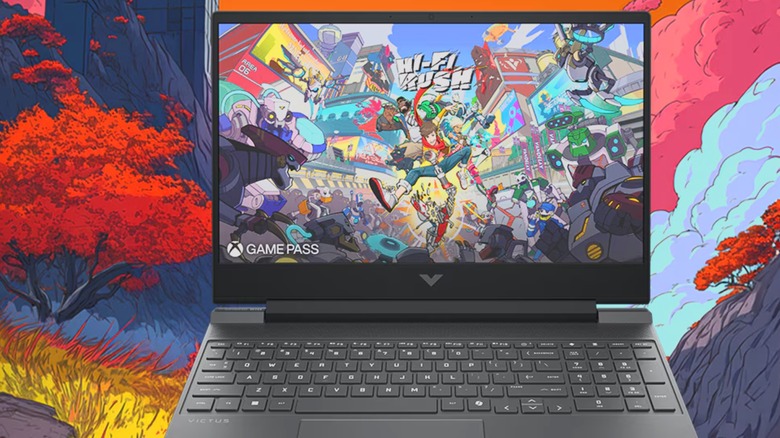
The HP Victus is a solid entry-level gaming laptop that outperforms the Steam Deck (and has better specs than the MacBook Neo). For $765 on Amazon, you get a laptop with a GeForce RTX 2050 Laptop — a mobile GPU that speeds past the GTX 1050 TI in all benchmarks. Sure, the Victus only has 8 GB compared to the Steam Deck's 16 GB, as well as only 512 GB of SSD space, but the laptop blows the Steam Deck out of the water in every other respect. And it's cheaper than the 512 GB OLED model, which is priced at $789.
The gulf in power only increases the more you spend. For instance, a high-end HP Victus, which costs just a penny under $1,000 on the HP webstore, includes a slightly faster CPU (Intel Core 5 210H compared to the cheaper model's AMD Ryzen 5 7535HS). However, most of that price goes to the GeForce RTX 5050 Laptop GPU, which makes the RTX 2050 Laptop look like, well, a GTX 1050 Ti. Granted, the higher price doesn't include extra storage or RAM (unless you spend even more), but given the other advantages, $999.99 sounds like a steal compared to the 1TB OLED Steam Deck's $949 price tag.