

Wind Turbines Cause Fewer Bird Deaths Each Year Than This Common Culprit

Renewable energy has its fair share of detractors, which isn't surprising considering the amount of misinformation and false representation of facts. While it's true that wind energy has a few noteworthy issues, including causing bird deaths and producing somewhat inconsistent output, none of them are as bad as they seem on the surface. Just as solar panels helped Europeans produce a surplus of energy despite years of misinformation about solar energy being ineffective, it turns out that the threat to birds by wind farms isn't as bad as you were led to believe.
Wind turbines can kill birds. That's a fact. However, the number of deaths only sounds shocking in isolation. Take Germany as an example. If you say that wind turbines are to blame for anywhere between 100,000 and 250,000 bird deaths per year, it makes it appear as if they're the number one hazard to avians. Yet, domestic cats kill at least 400 to 2,000 times more birds than wind turbines — between 100 and 200 million in Germany, to be exact. Ultimately, wind farms pose a threat to only 0.05% of the total population of avians.
In the U.S., we've got even more figures that bust this pervasive wind farm myth. Wind turbines in the U.S. kill around 150,000 birds in a year, while outdoor cats routinely knock out 1 billion annually. Taking things further, cars are much more dangerous to flying creatures than wind turbines, accounting for between 60 and 80 million deaths in the States. Funny enough, glass buildings kill 100 million birds annually, yet you never hear politicians or critics of renewable energy raising their fists over fancy downtown offices with glass facades being unsafe for avians, do you?
How can we protect birds from wind farms?
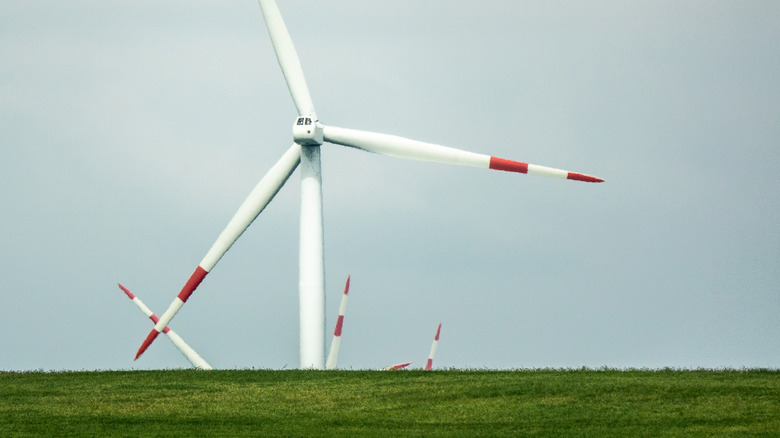
Even a few thousand bird deaths are too many. Fortunately, scientists and experts are already figuring out different ways to mitigate the threat to avians. On the eastern shore of the U.S., Timothy Boycott, a biologist and researcher, tested whether he could use sound to "warn" birds about imminent danger by planting an acoustic lighthouse. This structure played white noise focused on the 4 to 6 kHz frequencies, which fall in a range that most birds can clearly hear. It worked: Using various cameras, Boycott captured birds actively changing their flight paths to avoid the acoustic towers over six days.
Though it's also possible to monitor bird movements and then ramp down wind farms when birds are in sight (a process known as curtailing), it turns out that the simplest of solutions may actually be one of the most effective ways to protect birds from wind farms. Painting just one turbine blade black reduces bird fatalities by 70%. Why? Simple: the paint provides better contrast and makes turbines much more noticeable. Of course, further research will give us a clearer idea of the effectiveness of the method. The results so far are promising, but the problem with the research was the fairly small sample size, involving only two groups of turbines: four painted and four vanilla.
Either way, bird deaths aren't a reason not to invest in renewable energy. In fact, traditional fossil power plants actively kill around 14.5 million birds per year in the U.S., making them a much bigger problem than wind farms. This proves that in most cases, despite its quirks and issues, renewable energy is a much safer choice than sticking to the fossil fuel status quo.