

Chinese Robot Breaks Usain Bolt's 100m World Record Time — Then Smashes Into A Wall
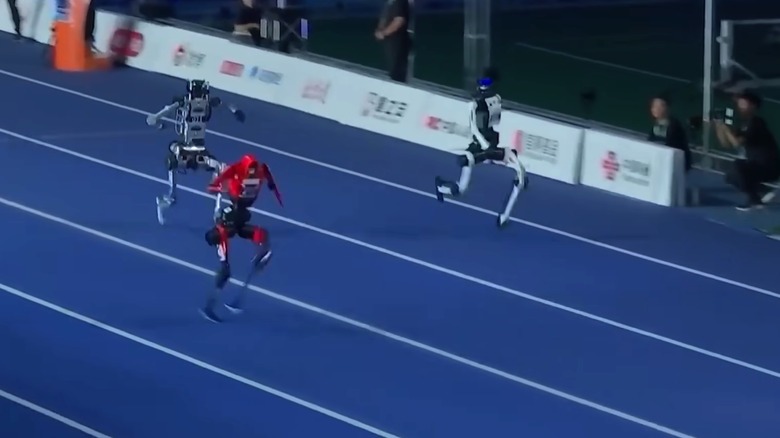
China held its second World Humanoid Robot Games event in late August 2026 at Beijing's National Speed Skating Oval, an event meant to display the country's advances in and commitment to robotics. The field has attracted plenty of research and development — not to mention interest — in recent years, particularly after the arrival of large language models like ChatGPT and Gemini. Similar AI technology may provide the brains to humanoid robots. But the 2026 Robot Games in China made the news not because of new robotics innovations that would allow a humanoid to fold clothes faster than before. Instead, the event surprised the world with robots that could run the 100-meter race even faster than humans. A few robots beat Usain Bolt's 2009 world record (9.58 seconds) several times, with the fastest time dropping to 8.64 seconds in the final. While these humanoids ran significantly faster races than last year, they were not able to stop like a human would. Instead, they crashed at full speed into a padded wall after passing the finish line, requiring assistance.
A Tiangong Ultra robot model won the 100-meter race on August 26 with a time of 8.64 seconds, a significant achievement compared to its 21.50-second time in 2025. A version of the robot finished in 9.39 seconds during a heat earlier in the competition. A similar model improved to 8.86 seconds during a semifinal. The Honor Lightning model is another humanoid that beat Bolt's time during the Games. The robot finished in 9.47 seconds during the opening heat that Tiangong Ultra won. Before the Games, Lightning was even faster (9.32 seconds) during a test.
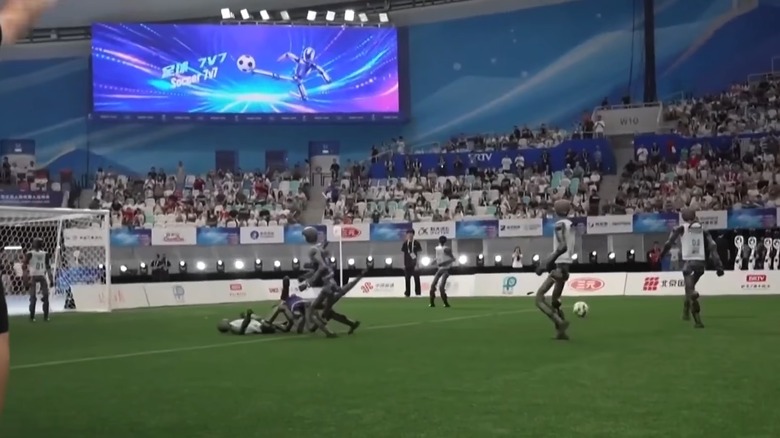
The Robot Games also showed other types of humanoids involved in other games, including soccer, table tennis, and jumping, in addition to running.
Why is beating Usain Bolt's time important?
Having a robot beat Bolt's record, even if that means the machine would sustain significant damage while crashing against a wall at full speed at the end of the race, achieves two goals. First, it's a powerful marketing tool to show the rapid advancements in the humanoid robotics industry, with an emphasis on Chinese companies. Second, a robot being able to complete a 100-meter race and reach a high enough speed to beat Bolt's record shows that the various technologies required to enable a robot to reach that speed are working outside of the laboratory.
A human running 100 meters would know what to do instinctually, from starting the race to accelerating, moving their hands and feet, keeping track of the competition, crossing the finish line, and braking. Researchers would need substantial development work to make a robot perform similarly. Batteries provide energy to motors moving the robot's limbs. The humanoid's joints and gears would execute the movement, while a cooling system would ensure the battery and mechanical parts do not overheat. Also crucial are the software algorithms that allow the robot to plan its leg movement in real time. The software has to account for various factors, including landing on each foot without losing balance and planning for the next step. The software would also determine the length of the stride and the cadence required to win the race.
While this is speculation, these technologies were all on display starting with the race that went viral after the opening of the Games, regardless of the humanoid model. Honor's Lightning robot led that race initially, with Tiangong eventually overtaking it near the finish. Both robots beat Bolt's record, and both crashed against the wall.
What comes next for humanoid robots?
Humanoid robots beat other human records in longer races at the Games. Tiangong Ultra won the 400-meter race in 38.15 seconds, well under Wayde van Niekerk's 43.03-second world record. In the 1,500-meter race, the winning robot finished in 2:21.64, more than a minute faster than the 3:26.00 human record (Hicham El Guerrouj).
There may be no need for a commercial humanoid robot to run faster than a human. Humanoids designed for warehouse work will need to perform specific tasks with accuracy and safety. Humanoids made for the household will need to perform specific chores, like loading and unloading the dishwasher and dealing with laundry. On that note, China already has humanoid robot schools in place that teach robots how to fold and unfold laundry, a key step for training the AI algorithms related to precision movement. In other words, beating Tiangong Ultra's new record may not be a priority for researchers. But teaching a speeding robot how to stop safely might be one of the things researchers study next.
At the very least, the researchers proved their hardware was able to reach faster speeds than last year. The batteries, motors, and joints worked reliably, and the algorithm allowed the robots to complete the races. These are important developments for industry, as they may offer additional data compared to lab tests. The robots may have been damaged when hitting the wall at a high speed, but the researchers will walk away with important data concerning a robot's AI capabilities, mobility, and durability during the race. These events may lead to key innovations for future commercial models, including a robot's ability to understand its surroundings and adapt, or new battery technologies involving fast energy discharge and thermal management.