

NASA's Roman Space Telescope Could Finally Settle The Dark Energy Debate Once And For All
The universe is expanding, and the rate at which it's doing so is accelerating. Scientists across the globe agree on this, and attribute this acceleration to what we call dark energy. For decades, scientists believed this force to be unchanging, a concept Einstein introduced via the cosmological constant. However, recent findings present an alternate view: dark energy is dynamic and changes over time.
Dark energy is invisible, and the universe is too vast to be observed directly. As such, we rely on different methods to calculate distances across the universe and measure its rate of expansion. Depending on what method is being used, we get different numbers for the speed of the universe's expansion — a discrepancy known as the Hubble tension. This presents a seemingly impossible challenge, one that NASA's Roman space telescope aims to solve — despite the U.S. government wanting to cut NASA's budget.
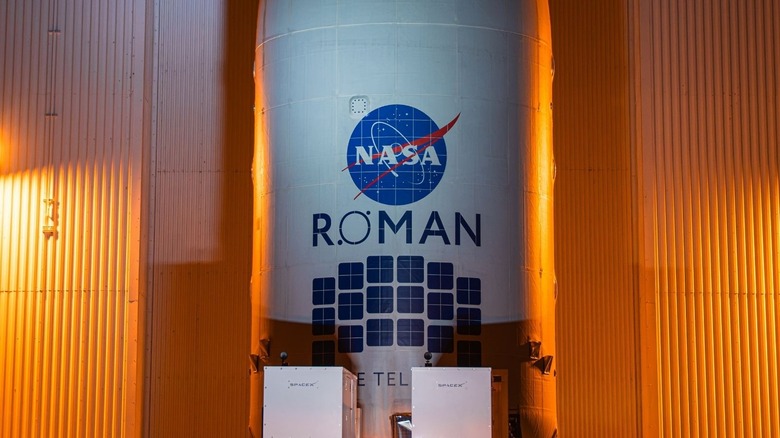
NASA's Nancy Grace Roman Space Telescope is set to launch on August 30 from the Kennedy Space Center in Florida (which you can watch live), and one of its primary goals is to resolve the discrepancies in the speed at which the universe is expanding and to find out more about dark energy. Roman uses the same 2.4 meter mirror as Hubble, but has what's called a Wide Field Instrument that's made up of 18 4K detectors. This makes Roman capable of capturing 300-megapixel images that are a hundred times larger than what prior space telescopes could capture, letting scientists analyze vast regions of space instead of focusing on specific celestial objects. NASA estimates that this larger field of view will survey more than a billion galaxies in a five-year period, data that would otherwise take more than a century to gather if we were to rely on other telescopes.
What is dark energy and how can Roman help us learn more about it?
Edwin Hubble was one of the first scientists to conclude that the universe is expanding. He did so by noticing redshift — the phenomenon where light traveling from distant cosmic objects reddens as it reaches Earth. This happens because space physically stretches the light as it expands, much like how a spring stretches as its ends get pulled. This increases the light's wavelength, shifting it toward red on the light spectrum. Hubble believed that this expansion of the universe would slow down with time due to gravity. Contrary to his beliefs, scientists in 1998 found proof that it's instead speeding up. This meant that there was some invisible force counteracting and overpowering gravitational forces, and scientists ultimately chose to call this force dark energy.
NASA plans on utilizing several different observational methods to unify results and arrive at a definitive conclusion about how dark energy behaves. To this end, Roman will first observe Baryon Acoustic Oscillations (BAOs), the lingering remains of sound waves from the universe's earliest years that froze in place once the universe cooled down.
The space telescope will also use standard candles — objects that we know the luminosity and maximum brightness of — to make observations of distant celestial bodies, namely type Ia supernovae. Specifically, white dwarfs result in type Ia supernovae under certain conditions when they reach a specific mass threshold, and we know how brightly these supernovae shine. By observing their dimness against how bright we know these to be, we can calculate exactly how far away these stars currently are and use red shift to figure out how much space has expanded.