

A Set Of 'Silent' Speakers Had A Huge Impact On Wildlife Wind Turbine Collisions
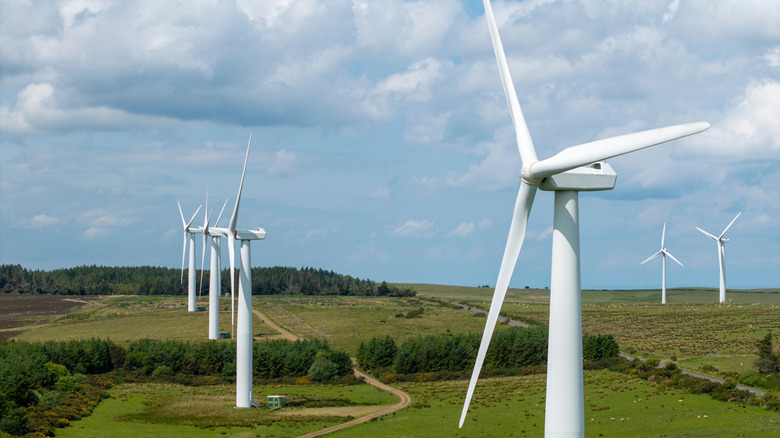
You've probably heard the claim that wind farms kill a lot of birds. While the numbers are exaggerated (wind turbines cause fewer bird deaths each year than housecats), these statements contain a kernel of truth, as people across the globe, especially in Europe, are trying to prevent birds from colliding with wind turbines. Bats haven't been forgotten either, as a team of researchers published a study in 2025 about a method to keep bats away from wind turbines.
The paper (via ScienceDirect) describes a series of "aerodynamic-whistle-based blade-mounted" deterrents to keep bats away. They're designed to supplant ultrasonic speakers that are currently being developed to prevent bats from slamming into the turbines. The document details one particular brand of speaker, the Bat Deterrent System (BDS), that is developed by NRG Systems. According to the study, the BDS works by generating ultrasonic tones via six sub-arrays of speakers.
Each BDS installation can produce "sounds" between 20 kHz and 50 kHz — imperceptible to humans, but well within the frequencies most bats can hear, and louder than those they use for echolocation. As a result, these speakers drown out the chirps bats use to navigate, convincing them to go elsewhere, specifically someplace where they can actually hear themselves. It's a Skinner Box-style deterrent that has reduced the fatality rate of bats colliding with wind farm turbines by anywhere between 50% and 78%, according to the Department of Energy (DOE).
What engineers used before the BDS
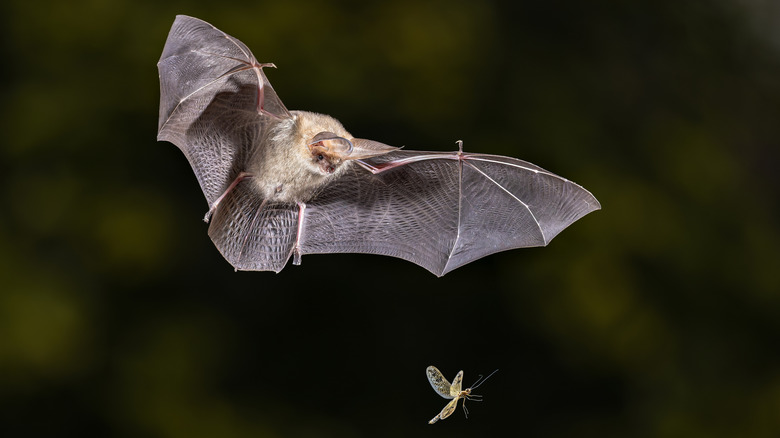
Contrary to popular belief, bats are not blind; they actually have good eyesight. However, since they hunt at night, they need echolocation to know what's in front of them. Despite this somewhat common knowledge, the BDS speakers designed to scare away bats with a disorienting veil weren't the first idea.
Since 2003, the DOE and Bats and Wind Energy Cooperative (BWEC) have been working together on ways to keep bats away from wind turbines. Initially, researchers hit upon the idea that they could adjust the turbines to only operate at higher wind speeds — bats were at higher risk when wind speed was low. While this strategy reduced bat mortality rates, it prevented the turbines from providing enough power to offset the cost of maintenance and setup. Researchers didn't even consider ultrasound speakers until 2006, and it took until 2009 for the BWEC to start prototyping such a deterrent.
Unlike the modern iteration, this early version utilized eight transducers, mounted to boxes around the nacelle of the turbine. As organizations continued to test the concept, they upgraded it (i.e., reduced the number of speakers from eight to six) and learned about limitations as they went along. For instance, while the 2015 version of the system was better equipped to handle adverse weather, it did not have any effect on the Eastern Red Bat; members of that particular species continued to fatally slam themselves into wind turbines.
What's with the whistles?
By now, you're probably wondering what's wrong with the "silent" speakers that are currently in development. For starters, they require external power sources, which reduces the efficacy of the turbines they help. Add in the cost of maintenance and lack of coverage (the ultrasound waves don't reach the blade tips), and you can see why some people want an alternative solution.
The theory behind the whistles is that as the blades spin, air passes through the whistles and creates natural sound waves. Since the whistles work so long as the turbines move, they are effectively self-sustaining. More importantly, engineers can customize the whistles to create ultrasonic noises that are inaudible to humans but well within the hearing range of bats. It's the same principle that dog whistles utilize to make noises only dogs can hear.
As the paper only went over the basics of the concept behind the whistles, the efficacy of these deterrents is a complete mystery. Can the whistles prevent more bat deaths than ultrasonic speakers? Just how much will the speed of turbine blades affect the sounds the whistles make? The concept might prove pointless, or it could be to deter bats as a single black wind turbine blade is to discouraging bird collisions.