

Samsung's New Portable Gadget Redefines USB Drives At A Hefty Price
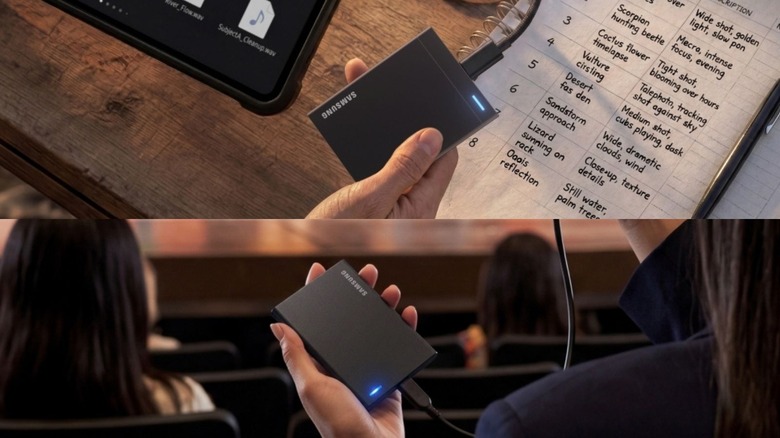
Samsung has unveiled two new P Series SSDs purported to offer "next-generation" USB4 connectivity. Dubbed the P9 and P7, the two sleek drives feature impressive specs and capabilities, but also come with a premium cost even with the current hardware prices trending higher across the computing market. The P9 advertises high performance, with read speeds up to 4,000 megabytes-per-second (MBps), and write speeds up to 3,800 MBps, paired with high capacities. The P7, on the other hand, also features USB4 and similar speeds, but is designed for broad usage. It also passed 6.6 feet drop tests, as well as shock and vibration tests, making it a solid option for travelers and outdoor trekkers. Think, a durable design without the traditional rugged look. Both drives support AES 256-bit hardware encryption for data security.
The P9 will debut with a price of $340 for 1 TB, $650 for 2 TB, $1,350 for 4 TB, and $2,700 for 8 TB models. Meanwhile, the P7 is a bit more reasonable, at $290 for 1 TB, $550 for 2 TB, $1,150 for 4 TB and $2,290 for 8 TB. The 8 TB models are the "world's first" at their sizes with high-level speeds. Bigger capacities are ideal for sensitive data storage, since it's a general rule you should never use more than 85% of a drive to prolong its lifetime — filling external SSDs is something everyone should stop doing.
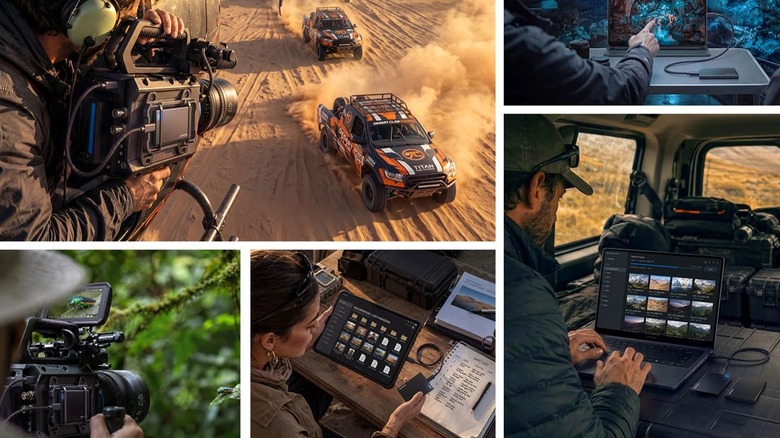
The P9 supports tasks like 12K direct recording with enough power and performance to enable RAW image and video editing at ultra-high resolutions direct from the drive. P7 is tailored for general use, to transfer data across devices, or add extra storage to portable devices like gaming consoles, cameras, and smartphones.
What SSDs are comparable to Samsung's new P Series?
A close comparison in Samsung's lineup, the T9 portable SSD is $1,145 for the 4 TB model and features read and write speeds up to 2,000 MBps. It uses USB 3.2 Gen 2x2, not USB4, but also incorporates resilient features; like drop resistance up to 9.8 feet.
Seagate's LaCie Rugged SSD4 with USB4 is $1,280 for 4TB with read and write speeds up to 4,000 MBps, much closer to Samsung's P series. The Lacie is also IP54-rated and can withstand 9.8.feet of shock and up to one ton of pressure. LaCie rates highly with review outlets like PCMag, and its drives are engineered to be tougher, like Samsung's P7, ideal for those on the move or on adventures. Imagine photographers who need extra storage, videographers in the field, remote professionals, that kind of thing.
There's also the SanDisk Extreme PRO USB4 in 4TB for $1,250 at full price, with read speeds up to 3,800 MBps, and write speeds up to 3,700 MBps. Corsair's EX400U USB4 SSD in 4 TB is $1,555 for 4,000Mbps read and 3,600MBps write speeds, directly comparable to Samsung's P9. However, Corsair's EX400U Survivor series, a rugged offshoot, is cheaper, about $590 for a 4 TB model with 4,000 MBps read speeds, 3,600 MBps write, and an IP55-resistance rating. Though, you'll find a lot of these sold out across retailers. If Samsung can offer better availability for the P Series that will go a long way towards its success. Additional brands with rugged USB4 and fast SSDs are Oyen, Glyph Technologies, WD Black, PNY, Lexar, and Kingston.
The P Series SSDs are purpose built as are similar external models

The cost of Samsung's P Series and comparable models can be quite high when you look at standard SSDs with slower speeds, even at such large capacities. That brings up a valid question. Is there actually any point to buying an expensive SSD in 2026 like the ones mentioned? Well, that depends on what you need.
The P9 adds high-performance speeds, some of the fastest on the market, up to 4,000 MBps. That's not going to matter much if you're transferring small files like personal photos, home videos, or music. But if you have a huge library of content, like 4K or ultra-high-resolution videos that you've captured with a top-of-the-line camera, it significantly speeds up transfer times. More importantly, as advertised, it allows you to edit, modify, and access those files at reasonable performance levels, presumably without latency issues or hang-ups.
These purpose-built SSDs are designed to withstand quite the beating. That's important when you're out in the field. You might drop the drive, drop your bag with drives in it, or may have to deal with bumps while trekking over tough terrain, in a vehicle or otherwise. Not to mention exposing drives to the elements, hot and cold temperatures, and variables like humidity while adventuring. To preserve valuable data in extreme conditions, the premium cost is worth it. While many of these rugged and expensive SSDs are reliable for long-term storage, there are always risks to be mindful of including data loss or corruption. That's why standard hard drives tend to be better for long-term cold storage.