

What's The Difference Between The Nintendo 64 And N64DD?
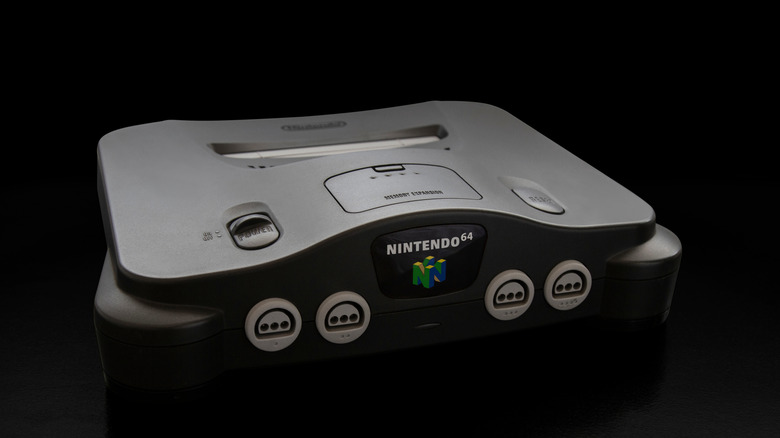
In 1996, Nintendo introduced a console that featured enhanced graphics: the Nintendo 64. Able to transport players to new 3D worlds in games such as "The Legend of Zelda: Ocarina of Time," "Super Mario 64," and "GoldenEye 007," the console included upgraded colors, real-time lighting, and improved sound quality. That same year, Nintendo announced an addition to the 64 called the 64DD, meant to revolutionize gaming but which didn't quite find its mark.
The Nintendo 64DD was a physical add-on to the Nintendo 64 that attached to the console's bottom. Instead of playing cartridges like the original hardware, it played floppy disks. After Nintendo sold the 64DD in Japan, it never really caught on in the States. You could order one through a mail-order subscription service for 2,500 yen a month for an entire year. That got you the 64DD and access to its online service, all cables and software, an expansion pack, and six DD games.
The 64DD was delayed for a few years before it launched in Japan in 1999, the same year Nintendo announced a new system that would join its home console lineup. The 64DD didn't sell well, and barely any games were released for it, making it more of a gimmick than a full-on console. It was more or less an add-on anyway.
Why the N64DD was not a great success
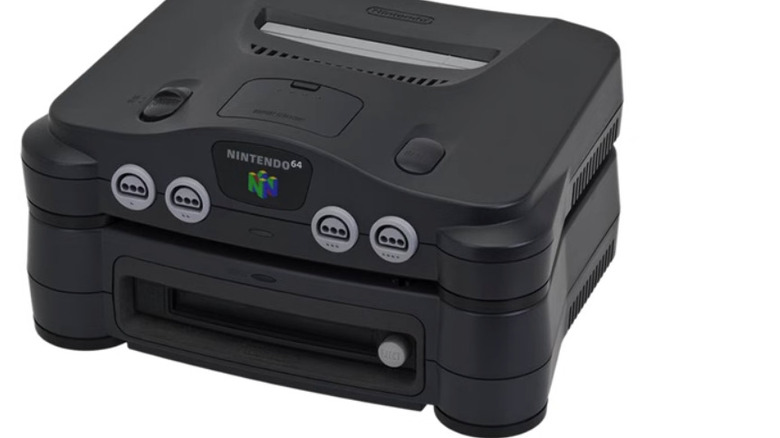
By all means, the 64DD sounded like a good plan on paper. However, while the idea was sound, the execution fell short. The truth was that the technology already existed by the time the 64DD shipped. Along with a few games, it could capture images from a TV, create 3D models and animate movies. Players could even make their own levels in games like F-Zero and share them online. However, players had been gaming online years prior with games such as "Diablo."
The Nintendo 64DD also didn't have many games. Reports show that only ten games were ever released for the add-on. Because it wasn't a mainstream console, that small number of games wasn't enough to move it off the shelves. Game stores didn't even want to sell it, as retailers felt it wasn't doing well enough to warrant listing.
To sell consoles, Nintendo created a subscription service plan. The company also made a second subscription option that included a smoke-colored Nintendo 64. In the end, Nintendo released a small number of 64DD add-ons to retail stores to sell what they had left. You may have better luck selling your Nintendo 64 than the company did in selling 64DDs.
This isn't the only item like it Nintendo made
Nintendo has made a lot of strange decisions. The Nintendo 64DD may not be one of them, but Nintendo has made nearly a dozen weird products, like the Game Boy Printer. Another odd yet ingenious example is the Game Boy Player for the Nintendo GameCube.
The Game Boy Player was an attachment for the Nintendo GameCube. It sat underneath the console and let players insert any Game Boy or Game Boy Advance game to play through the console. Using the included Game Boy Player GameCube disc and a handheld game, you could play it on a TV. You could also play games with the GameCube controller instead of a Game Boy or Game Boy Advance.
Reddit users say that if you own a GameCube and the Game Boy Player, it's a great way to play classic games on TV. However, it may be pricey, as a refurbished one was found on Amazon for around $299. If you own a Nintendo Switch or Switch 2, you could also get access to retro Game Boy Advance games through Nintendo Switch Online for a monthly or annual fee.